

Here's my Top 10 items from around the Internet over the last week or so. As always, we welcome your additions in the comments below or via email to bernard.hickey@interest.co.nz.
See all previous Top 10s here.
My must read is #6 on the new technology in cars and what it could mean for motorway investment.

1. Tax carbon and the world will end - Some people (among them Tony Abbott) say the global economy can't afford to reduce carbon emissions to address climate change.
Some people said similar things before various previous moves to regulate parts of the economy to protect the environment.
Yet the world didn't end, as this chart below shows.
Now that America and China appear to be getting serious about reducing carbon emissions, perhaps a few others will take it seriously, including New Zealand.
Meanwhile, the other approach might be to say growth might actually slow if our carbon emissions continue ever upward on their current path.
Here's a reality check to the doomsayers:

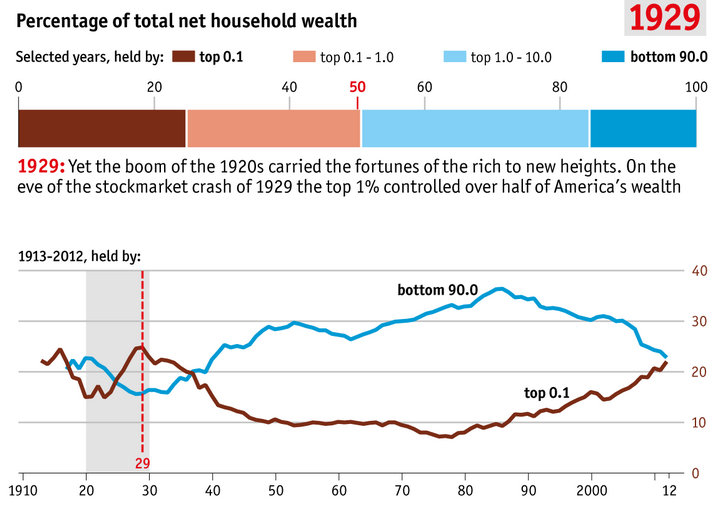
2. Downton Abbey style - The Economist points out the shares of wealth going to the top 0.1% and the bottom 90% in the United States are back to the same levels seen in the 1920s. That didn't end so well.
3. Show us the rents - It's not often I link to a story in the Hoxton Gazette, but this one on a housing protest in London is worthy.
It was led by Russel Brand against a quadrupling of rents charged to those in a social housing association estate which had just been bought by a US fund manager.
This Guardian piece by Aditya Chakrabotty on how a millionaire Tory MP, Edward Benyon, was involved in the said quadrupling of rents seemed to galvanise the publicity around the protest.
It really took off when Brand got involved and the Tory MP has since backed down from his involvement at least. The bigger question is around the sale of community owned assets to private individuals driven by a profit motive.
This will be one to watch during the Government's state house sale process. Bill English says he's open to selling them to anyone, but the first in the queue will be Iwi and community housing groups. We'd do well to keep an eye on this.
Simon Collins in the NZHerald reports this morning that the number of state houses has dropped by 1,600 in the last three years as plans to build new homes has lagged behind new house sales. He cites a plan announced two years ago to build 500 new homes on a former Papakura army base, yet none have been built so far.
Here's the Hoxton Gazette:
Last week Brand – dressed as a street urchin - led them on a “Dickensian” protest around the De Beauvoir neighbourhood, pinning an eviction notice to the Benyon’s office door in Southgate Road as a crowd of 200 blocked off traffic as they shouted “Benyon out”.
They then went around the corner to Northchurch Road where Brand climbed up scaffolding outside Edward Benyon’s home and hung up a poster saying ‘social housing not social cleansing.’
In a statement issued on Thursday, Edward Benyon, whose family firm owns about 300 properties in De Beauvoir Town, said: ““New Era residents have made it clear that they do not welcome our involvement in the future of the estate. They made it clear that they wanted us to pull out, and this is what we have reluctantly decided to do.

4. The price of failure - Bill Gross, who I've quoted regularly in previous Top 10s, got paid a bonus of US$290 million in 2013 despite underperforming his peers and presiding over a massive exodus of funds from Pimco. The top 60 managers there shared in a bonus pool of US$1.5 billion.
Here's Barry Ritholz with the details of how Gross enriched himself and his fellow managers, mostly through the fall in interest rates and inflation over the last decade and the massive unconventional policy launched after the GFC:
Pimco also became the go-to company for the Federal Reserve and U.S. Treasury in many of the credit facilities used to combat the continuing economic fallout from the financial crisis. Pimco's success in the federal government's program to jumpstart consumer lending and a variety of mortgage-backed security programs added more luster to its reputation. Gross even managed to buy up lots of MBS'sbefore the Fed officially announced the programs. Shareholders of the Total Return Fund netted about $10 billion from its mortgage plays.
Beyond the sheer size of Pimco's bonuses, there are other aspects of its compensation practices that should give pause to everyone involved in institutional asset management.
For one, Pimco has been part of a publicly traded company -- Allianz -- for the past 15 years. Unbeknownst to Allianz's shareholders, employees of one of its business units have been paying themselves these extraordinarily large sums of money.

4.1 If you hire them, pay will come - This piece from Buttonwood in the Economist looks at research into executive pay in the US and finds that managers who employ remuneration consultants to recommend their pay levels and keep them are (shock, horror) paid more than those who do not ask for 'independent' advice on how much they're really, really worth.
The study looked at pay disclosures in tandem with disclosures about specialist pay consultants employed by managers, rather than general HR consultants hired by the board.
What were the results? You will be shocked, shocked to learn that your worst suspicions are confirmed. Yes, firms that hire pay consultants pay their executives 7.5% more than those who don't. Yes, companies that hung on to their multi-service consultants paid their executives 10% less than those that switched to specialist consultants. Executives who work at firms where the board hired the consultants earned 13% less than when the consultants were hired by the management themselves. When executives get a big pay rise, their companies are less likely to replace their consultants in the following year.

5. Melbourne and Sydney are hot, hot, hot - This AFR piece on the big money pouring into Sydney and Melbourne development land from Chinese investors has some interesting detail, in particular the idea that Chinese investors are much more willing to accept lower yields, for whatever reason. The end result is a boom in land prices. Sound familiar?
In an interview with The Australian Financial Review, Mr Carolan said the free trade deal would accelerate the flow of Chinese investment funds into the local property market.
“It’s a supply and demand scenario and part of that scenario is land availability. There’s a shortage of housing on the eastern seaboard and that shortage is only going to free up on the basis that land is made available,” he said. “That land availability relates to investment. And what we’re seeing is that Chinese investors have return expectations that are lower than Australian investors.
“This means that the paradigm on land price changes, because the return expectations are lower, which means that land prices go up.”
Mr Carolan said: “What we’re seeing for major sites, for example, in Sydney, is that the major bidders are almost exclusively Chinese.”

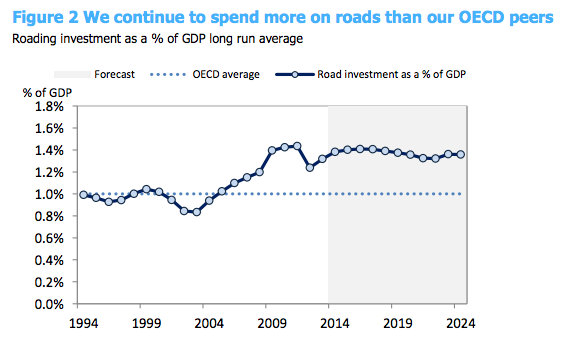
6. Do we really need to spend quite so much on motorways? - Nick Allison at NZIER has written an excellent paper on how the adoption of new smart driving technologies such as driverless cars, electric cars, congestion-reducing car-to-car communications and Uber-style ride sharing systems could reduce the need for heavy new investment in motorways that will be around in 40-50 years time.
The chart below showing how much more we invest in roads than the OECD average was an eye-opener for me.
The benefits from the new technologies will arrive well inside the 40-year planning horizon of road and rail investments we make today. The technologies have the potential to significantly affect the expected returns from these investments. We need to quantify the impacts and start taking them into account when we make transport infrastructure investment plans. We discuss below how the technologies can reduce the need for infrastructure investment by government.
The question for government is how it might best reconfigure its transport expenditure patterns to take account of the new technologies. Another question is whether it should facilitate the more rapid adoption of the technologies by consumers and thereby enable reductions in road and other infrastructure investment.
7. Is milk really that good for us? - As the world's largest milk powder exporter, New Zealand takes it for granted that all this milk we're pumping out is good for people's health.
US paediatrics professor Aaron Carroll has a few doubts in this New York Times piece.
A study published in JAMA Pediatrics this year followed almost 100,000 men and women for more than two decades. Subjects were asked to report on how much milk they had consumed as teenagers, and then they were followed to see if that was associated with a reduced chance of hip fractures later in life. It wasn’t.
A just-released study in The BMJ that followed more than 45,000 men and 61,000 women in Sweden age 39 and older had similar results. Milk consumption as adults was associated with no protection for men, and an increased risk of fractures in women. It was also associated with an increased risk of death in both sexes.
This wasn’t a randomized controlled trial, and no one should assume causality here. But there’s no association with benefits, and a significant association with harms.
Even studies that examine the nutrients in milk, trying to look for protective effects, often come up short. A 2007 meta-analysis in the American Journal of Clinical Nutrition examined high-quality studies of how calcium intake was related to fractures. The many studies of more than 200,000 people age 34 to 79 could find no link between total calcium intake and the risk of bone fractures.
8. Uber's culture problem - I love the idea of Uber and have even signed up to use it in Wellington. But the more I see of the company the less sympathy I have.
The latest flare up involved one of its executives suggesting Uber might employ private detectives to ferret out embarrassing private details about critical journalists. All very 'Dirty Politics'.
Here's Matthew Yglesias at Vox with a good summary.
Uber's business was (and is) to destroy the value of those (taxi) licenses by opening up the rides-for-hire market to a potentially unlimited supply of vehicles and drivers.
It's a perfectly good idea for the world, but you never could have gotten it off the ground by asking permission first. Even where Uber's business didn't violate existing rules, it undermined the (pernicious) purpose of those rules and rules could always be changed to exclude it. Consequently, the company benefitted enormously from a "shoot first, ask questions later" mindset.
But dispositions that are functional and useful in one context can become rancid in another. A conviction that the rules don't (or shouldn't) apply to you is fine when you're battling a taxi mogul who compares your business to ISIS. But it's extremely unattractive when you start talking about compromising customer user data for the purposes of blackmail. And it's completely insane when that kind of recklessness leads you to talk to journalists about the oppo tactics you're planning to deploy against other journalists.
9. The German solution - This Forbes article on how German councils keep house prices under control is a fascinating look at how to do things differently. House prices there are down 10% in real terms in the last 30 years.
A key to the story is that German municipal authorities consistently increase housing supply by releasing land for development on a regular basis. The ultimate driver is a central government policy of providing financial support to municipalities based on an up-to-date and accurate count of the number of residents in each area.
The German system moreover is deliberately structured to encourage renting rather than owning. Tenants enjoy strong rights and, provided they pay their rent, are virtually immune from eviction and even from significant rent increases.
Meanwhile demand for owner occupation is curbed by German regulation. German banks, for instance, are rarely permitted to lend more than 80 percent of the value of a property, thus a would-be home buyer first needs to accumulate a deposit of at least 20 percent. To cap it all, ownership of a home is subject to a serious consumption tax, while landlords are encouraged by favorable tax treatment to maximize the availability of rental properties.
10. Totally John Oliver on US salmon cannons:
We welcome your comments below. If you are not already registered, please register to comment
Remember we welcome robust, respectful and insightful debate. We don't welcome abusive or defamatory comments and will de-register those repeatedly making such comments. Our current comment policy is here.