

Here's my Top 10 items from around the Internet over the last week or so. As always, we welcome your additions in the comments below or via email to bernard.hickey@interest.co.nz.
See all previous Top 10s here.
My must reads are #6 and #9 on the emergence of money-printing currency wars in North Asia to combat product price deflation, particularly in China. These currency wars are pumping up asset prices all around the region (which includes us). Non-printing countries like New Zealand are being slammed.

1. A Google tax - Britain's Chancellor of the Exchequer, George Osborne, last night announced a so-called 'Google Tax' of a 25% of "profit generated by multinationals from economic activity here in the UK which they then artificially shift out of the country."
Osborne reckons it could raise 1 billion pounds a year.
Now it's getting serious.
The noose is tightening on companies such as Google, Apple, Facebook and Starbucks, who use some fancy footwork involving the likes of the 'Double Irish' and the 'Dutch Sandwich' to shuffle their profits off to tax havens.
Our own Government is slowly grinding into gear on this, but, understandably, is waiting to see what the big boys do. This is good news.
Here's The Telegraph's version:
2. Really? - The Guardian though suggests the headline on the Google Tax may be bigger than the story. The tax advisor smugness below fair drips off the page.
The rules for the Treasury’s “diverted profits tax” will be published in draft legislation on 10 December and introduced in April 2015. They are designed to hit companies that use artificial structures to minimise UK profits and therefore lower their UK tax bills.
The rate is 5% higher than next year’s UK corporation tax rate of 20%, suggesting the chancellor hopes companies will choose to dismantle complex structures that divert profits to low-tax nations such as Luxembourg and Ireland, and choose to pay HM Revenue and Customs instead.
“The chancellor said this will raise a billion over five years, but ultimately this is a tiny proportion of the profits the multinationals he has in mind are generating,” said Toby Ryland, a partner at accountants HW Fisher & Company.
“In reality, many of the UK’s double tax treaties with other countries dictate where profits can be taxed. Sweeping measures like this often come to nothing. The chancellor has made the right noises, but most multinationals will be able to side-step these new rules without breaking into a sweat.”
Google paid just £20m tax in the UK last year. But its actual British revenues were £5.6bn. The group as a whole has a profit margin of 20%, suggesting the company’s real profits in the UK could have been as high as £1.2bn. Taxed at the proposed 25% rate, this would deliver £280m a year in revenues for the Treasury from just one company. But the government expects to collect no more than £360m a year from the diverted profits tax.

3. The pros and cons of the oil price slump - Martin Wolf looks here at the good and bad things to come from the amazing oil price slump over the last month. It will boost global demand by cash-strapped consumers, but risks increasing the carbon intensity of economies.
He has a few ideas to help solve a problem, but it won't get him elected.
Falling oil prices threaten to make economies more carbon intensive and less energy efficient. But they also give an opportunity to raise taxes on oil or at least cut wasteful subsidies to consumption permanently. It is an opportunity that any sensible government would seize. Needless to say, the supply of such governments is rather small.
Much uncertainty remains over how low prices will go, and for how long. But to the extent that they reflect strong supply rather than reduced demand, they offer a welcome boost to the world economy. They also represent a welcome transfer of income from unattractive petro-despotisms. It is hard not to cheer that, even if the opportunity for lower subsidies and higher taxes will yet again be thrown away.
4. The King is dead. Long live the King - I'm fascinated by the rise and fall of Bill Gross at Pimco. Bloomberg has written a profile detailing some of the reasons why he was dumped (or jumped) from Pimco. Gross essentially bet that interest rates would have to rise at some point, but they haven't really ... yet. He was wrong like everyone else. Deflation is now endemic and interest rates are staying awfully low for an awful long time.
Gross fell out with Mohamed El Irian in a spectatcular fashion and Gross refused to let El Irian run the world's biggest bond fund.
“I’m Secretariat,” Gross said, referring to the famous racehorse, according to the Journal. “Why would you bet on anyone other than Secretariat?”
Pimco managers worried that Gross was becoming increasingly uncontrollable in public appearances after he strolled on stage at Morningstar’s investment conference wearing sunglasses and referring to himself as the bond market’s Justin Bieber. He also made a lengthy allusion to the movie “The Manchurian Candidate,” suggesting he wished he could hypnotize journalists into writing positive things about him.

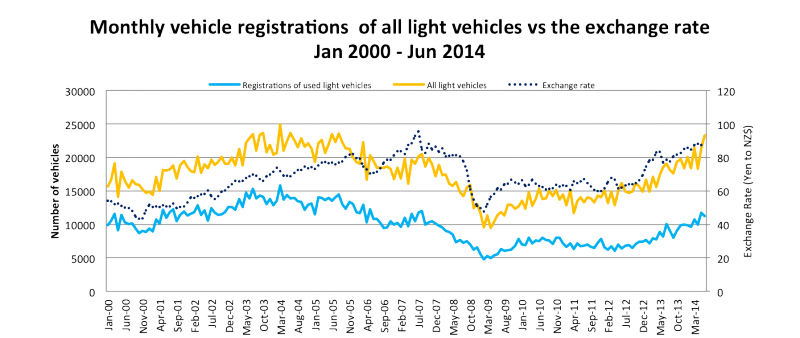
5. Seen the NZ$-Yen rate lately? - Anyone thinking of buying a Japanese made car needs to know that there's an awfully close (and understandable) relationship between new and used car registrations and the NZ$-Yen rate.
The New Zealand dollar has basically doubled vs the yen since early 2009 and is now at record highs. That's partly because Japanese investors are buying into New Zealand assets using lots of freshly minted money. The latest example is Nikko Asset Management New Zealand, which targeted five such New Zealand dollar denominated bond funds worth NZ$337 million at Japanese investors this year.
Overnight, the World Bank just added NZ$250 million to a Kauri bond issue. See #6 and #9 below for an idea of what's going on in the background.
This chart below tells the story.
6. Currency war anyone? - Henry Sender at the FT looks at the Bank of Japan's latest money printing moves and surveys the People's Bank of China's response. He's nervous about tit-for-tat money printing breaking out in the developing world as well as the developed world. All of these players are our largest trading partners.
In mid-November, the People’s Bank of China cut interest rates. In part that is because the cost of capital in China has been too high for many borrowers. But it is also because the Chinese currency has already moved up 10 per cent from its lows of earlier this year. “The PBOC would not have moved as quickly as last Friday if it were not for Kamikaze Kuroda,” noted Chris Wood of the CLSA unit of Citic Securities. The Bank of Korea has already cut rates twice, most recently in October.
That suggests the world is entering a new phase where quantitative easing, once the tool of choice to stimulate ailing economies in the developed world, is going to be increasingly deployed in the emerging world as well. QE has become the latest – albeit apparently indirect – weapon in driving down currencies. Currency wars are especially intense when global trade is stagnant and one country’s gains come at the expense of its rivals.
“A sustained weakening in the yen will have regional consequences. The depreciation of the Korean won and Taiwan dollar will likely accelerate, making the regional backdrop resemble that in the quarters leading up to the Asian crisis in 1997,” warns Stephen Jen, of research boutique SLJ Macro in London.
7. What a waste - Not if you're a property buyer. Sender goes on to lament how all this money printing is a waste of time. That's not true if you're a leveraged up property or stock buyer. It's the best of times and the party will never end...
Here's Sender:
The resort to QE as the tactic of choice to drive down the value of a given currency is doubly sad because the combination of QE and low rates stimulates asset prices and financial engineering far more than capital spending and improvements in the real economy. It is fiscal stimulus that can contribute to growth in the real economy.
Any gains from competitive devaluations, however disguised as monetary policy, are likely to prove fleeting. Sadly, today’s gains, which bring with them an artificial sense of lasting comparative advantage, will come at the expense of tomorrow’s potential growth.
8. This can't last - This November piece from DairyNZ on operating costs is a fascinating look behind the curtain of farm finances. It reckoned that the break-even level for dairy farmers in 2012/13 wsa NZ$6/kg. So a NZ$4.25 payout this year is a mighty big worry. If prices don't rebound then a payout of NZ$3.65 is possible, says AgriHQ.
It's interesting though that DairyNZ's number one priority is "Equity Growth over Time."
Here's its view:
This is the ultimate financial KPI, however it is often not discussed or calculated. A high level of wealth creation or equity growth over time comes from:
- investing in productive assets
- not paying too much for them
- operating them efficiently
- investing the resulting profits wisely
- capital gain.
9. A deflationary spiral - The problem of deflation is central to the economic world's problems at the moment. Central bankers and investors are regularly surprised by falling prices.
They shouldn't be.
This FT profile of deflation in China is an eye-opener. Further to the issue of over-capacity, this Jamil Anderlini piece on how even China admits it wasted US$6.8 trillion on ghost cities, steel mills and highways gives an indication of what created all that capacity.
After a decade in which rapid growth and investment gobbled up China’s enormous output, many of its factories – like those in Yiwu – are finding it difficult to shift stock. Demand at home and abroad has been stalling, leaving many industries with chronic overcapacity, especially in basic commodities like steel, glass and cement. For many, the only answer is to keep cutting prices.
The result is reflected in China’s official statistics, which show that so-called producer prices have been in outright deflation for nearly three years. Perhaps even more worrying, consumer prices have dropped to a near five-year low of 1.6 per cent on an annual basis in October. “You think there’s a problem in the eurozone? There’s a far bigger problem in China,” says Albert Edwards, strategist at Société Générale.
China is the world’s top exporting nation, and the main trading partner with dozens of countries. As its manufacturers drop prices to increase sales, the impact is being felt across the world, from the factory floor to the shop shelf. With policy makers in many economies – Europe and Japan especially – worried about falling prices, China’s own ability to boost inflation is becoming a key part of the puzzle. As George Magnus, an economic adviser to UBS, puts it: “The rest of us need Chinese deflationary pressures like a hole in the head.”
10. Totally Clarke and Dawe on Australia's changing media and political landscape...
Bonus Clarke and Dawe with Joe Hockey's views on economic growth
We welcome your comments below. If you are not already registered, please register to comment
Remember we welcome robust, respectful and insightful debate. We don't welcome abusive or defamatory comments and will de-register those repeatedly making such comments. Our current comment policy is here.