

Here's my Top 10 items from around the Internet over the last week or so. As always, we welcome your additions in the comments below or via email to bernard.hickey@interest.co.nz.
See all previous Top 10s here.
My must read is #9 on the politics of Ageing.

1. Decade Zero - Naomi Klein asks the fair question about inaction over climate change in this Guardian piece: 'What is wrong with us?".
She puts forward a few ideas on why the world has collectively failed.
Firstly, there's the idea that global cooperation on complicated non-immediate problems is impossible. Yet agreements on ozone depletion and nuclear proliferation were made, not to mention global trade rules.
Secondly, there's the idea that humans are too selfish. Yet entire nations have over the years reduced consumption to stave off a national threat, and families and individuals regularly put off consumption for decades because they believe they'll be better off if they save.
Ultimately, Klein blames a globalised and corporatised marketplace. I'm not so sure, but there's certainly a collective failure on climate change.
Here's her conclusion:
As Fatih Birol, the IEA’s chief economist, bluntly put it: "The door to reach two degrees is about to close. In 2017 it will be closed forever.” In short, we have reached what some activists have started calling “Decade Zero” of the climate crisis: we either change now or we lose our chance.
All this means that the usual free market assurances – A techno-fix is around the corner! Dirty development is just a phase on the way to a clean environment, look at 19th-century London! – simply don’t add up. We don’t have a century to spare for China and India to move past their Dickensian phases. Because of our lost decades, it is time to turn this around now. Is it possible? Absolutely. Is it possible without challenging the fundamental logic of deregulated capitalism? Not a chance.

2. Meanwhile - The Miami Herald reports Florda's Department of Environmental Protection has been ordered to stop using the phrases 'climate change' or 'global warming' in official communications, emails or reports.
Yes. The Climate Change deniers in Florida's state government have ordered the scientists to deny the existence of climate change...
“We were told not to use the terms ‘climate change,’ ‘global warming’ or ‘sustainability,’” said Christopher Byrd, an attorney with the DEP’s Office of General Counsel in Tallahassee from 2008 to 2013. “That message was communicated to me and my colleagues by our superiors in the Office of General Counsel.”
Kristina Trotta, another former DEP employee who worked in Miami, said her supervisor told her not to use the terms “climate change” and “global warming” in a 2014 staff meeting. “We were told that we were not allowed to discuss anything that was not a true fact,” she said.
This unwritten policy went into effect after Gov. Rick Scott took office in 2011 and appointed Herschel Vinyard Jr. as the DEP’s director, according to former DEP employees. Gov. Scott, who won a second term in November, has repeatedly said he is not convinced that climate change is caused by human activity, despite scientific evidence to the contrary.
3. That proves it - Oklahoma Senator Jim Inhofe brandished a snowball in the Senate to prove that global warming was a hoax.
He chairs the Senate Environment committee. I'm not making this up.
In his recent book on climate change, which he titles The Greatest Hoax, he assures readers that the scientists -- which he refers to as "alarmists" throughout the book -- can be ignored because a greater Authority has already spoken.
"I take my religion seriously," Inhofe writes. "[T]his is what a lot of alarmists forget: God is still up there, and He promised to maintain the seasons and that cold and heat would never cease as long as the earth remains."
For those still skeptical of his climate change skepticism, Inhofe quotes from the source material, "one of my favorite Bible verses," Genesis 8:22: As long as the earth remains, There will be springtime and harvest, Cold and heat, winter and summer.
Phew.

4. Intergenerational equity - Australia's Treasury produces an Intergenerational Report every five years to assess who's winning and losing out of Government policies over the longer term. It's a lot like New Zealand's Long Term Fiscal Outlook, but with an inter-generational twist.
Nicholas Reece writes here at The Age that Tony Abbott and Joe Hockey "talk of intergenerational theft, yet they seek to deny young people the benefits of government largesse that their generation enjoyed more than any other group in history."
Reece is not happy. Here's his thinking:
Many of the initiatives in the 2014 budget were a direct attack on Australia's youth, while the wealthy, older generation of Baby Boomers were largely spared. This is despite the fact that at almost every turn in their lives, Baby Boomers like Abbott and Hockey have benefited from a welfare system that today's young people could only dream of.
When the Prime Minister and Treasurer received their university education it was free. Someone seeking the same qualifications today can easily pay more in tuition fees than Abbott or Hockey paid for their first home.
When Abbott and Hockey were trying to enter the workforce for the first time in the 1970s and 1980s, Australia had a civilised social welfare net for those who struggled to find work.
That support has been steadily wound back over subsequent decades, and now in the name of "intergenerational theft" the Abbott government is trying to make a tough scheme truly cruel by denying a person under 30 access to the dole for six months.
When it comes to tax breaks, Abbott was also fortunate enough to raise his children during the Howard government years. This was the golden age for middle class welfare – when the Commonwealth frittered away billions from the first mining boom on a Family Tax Benefit scheme that was overblown and poorly targeted.
Sound familiar?
5. So what would Gens X and Y do if they noticed? - Preece makes a few suggestions:
PAY MORE TAX ON SUPER ABBOTT: Surely this is the budget where the government must ring the bell on superannuation tax breaks which at around $30 billion a year are now worth close to the amount spent on the pension.
FAIR SHARE FROM PROPERTY HOCKEY: Property tax breaks mostly benefit ageing rich Baby Boomers, particularly those with multiple property holdings like the Treasurer. Changes to negative gearing and capital gains tax exemptions could save the budget up to $5 billion and $4 billion respectively each year. It is time they were trimmed.
DON'T CUT HEALTH, EDUCATION & INFRASTRUCTURE: The argument that government debt steals from future generations is overly simplistic and is usually based on a muddled understanding of government borrowing. If the return on investment in people or infrastructure is higher than the rate at which the government borrowed, then future generations actually benefit from the debt.
CLIMATE INACTION IS THEFT: While today's debate will focus on the budget, degradation of the environment is really the most shameful example of young Australians being massively screwed by the Baby Boomers. If the Abbott government wants to make good on its intergenerational theft mantra, then it must take real action on climate change.
Hear hear.
6. Show us the unions again - New York Times columnist Nicholas Kristof is no lover of unions, but he concludes here after looking at recent economic history that unions are needed to grow the stalled wages of low to middle income workers.
I’m as appalled as anyone by silly work rules and $400,000 stagehands, or teachers’ unions shielding the incompetent. But unions also lobby for programs like universal prekindergarten that help create broad-based prosperity. They are pushing for a higher national minimum wage, even though that would directly benefit mostly nonunionized workers.
I’ve also changed my mind because, in recent years, the worst abuses by far haven’t been in the union shop but in the corporate suite. One of the things you learn as a journalist is that when there’s no accountability, we humans are capable of tremendous avarice and venality. That’s true of union bosses — and of corporate tycoons. Unions, even flawed ones, can provide checks and balances for flawed corporations.
It may be that as unions weakened, executives sometimes grabbed the gains from productivity. Perhaps that helps explain why chief executives at big companies earned, on average, 20 times as much as the typical worker in 1965, and 296 times as much in 2013, according to the Economic Policy Institute.
Lawrence F. Katz, a Harvard labor economist, raises concerns about some aspects of public-sector unions, but he says that in the private sector (where only 7 percent of workers are now unionized): “I think we’ve gone too far in de-unionization.” He’s right. This isn’t something you often hear a columnist say, but I’ll say it again: I was wrong. At least in the private sector, we should strengthen unions, not try to eviscerate them.
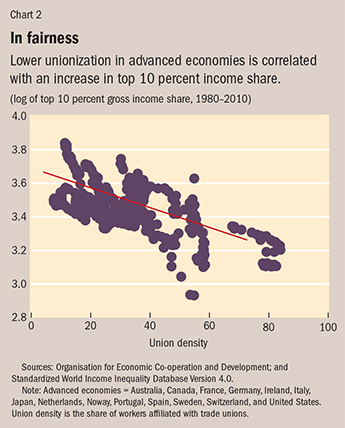
7. Another non-usual suspect - Here's the IMF also concluding that the fall in unionisation in recent decades was responsible for a rise in incomes of the top 10% in the world's advanced economies.
We examine the causes of the rise in inequality and focus on the relationship between labor market institutions and the distribution of incomes, by analyzing the experience of advanced economies since the early 1980s. The widely held view is that changes in unionization or the minimum wage affect low- and middle-wage workers but are unlikely to have a direct impact on top income earners.
While our findings are consistent with prior views about the effects of the minimum wage, we find strong evidence that lower unionization is associated with an increase in top income shares in advanced economies during the period 1980–2010 (for example, see Chart 2), thus challenging preconceptions about the channels through which union density affects income distribution. This is the most novel aspect of our analysis, which sets the stage for further research on the link between the erosion of unions and the rise of inequality at the top.
8. Those bloody pods - I was always a sceptic of those pod coffee machines that George Clooney keeps trying to sell. The look so convenient, but there's a dark side, as The Atlantic points out by talking to the inventor of the coffee pod.
Sylvan knew the pods would sell. As he explains the appeal now, “It's like a cigarette for coffee, a single-serve delivery mechanism for an addictive substance.” But he had no idea at the time how ubiquitous the product would become. And like printer cartridges or razor blades, the Keurig business model was predicated on another type of dependence.
The machines are not too expensive as appliances go. You can get one for $63; a bargain for a taste of the good stuff. But once you have one, it has you, too. The cups contain a mere 11 grams of ground coffee, vacuum-sealed in nitrogen to prevent oxidation. K-Cups are extremely profitable, selling standard coffee grounds for around $40 per pound. But what are you going to do, not buy the refills for your machine?

Our demographic transition is not just a problem of pension math. There's also the problem of what it does to economic growth as society ages. As workforce growth slows, so does gross domestic product growth. In theory, this can be made up with greater productivity growth. But productivity growth is moving in the wrong direction -- and because older people tend to be more risk-averse as workers and investors, that too may be a natural result of an aging society.
And, of course, there is the question of who will provide the actual hands-on care that people need. Here, the usual solution proposed is immigration. There are a couple of problems with that. The first is that everywhere else is undergoing the same demographic transition as we are, so the limitless supply of young foreigners may dry up as aging parents require them to be nearer to home and family capital gets concentrated upon a few people rather than dispersed among many children.
10. Totally Clarke and Dawe on the Labor Opposition Leader and his policies.
We welcome your comments below. If you are not already registered, please register to comment
Remember we welcome robust, respectful and insightful debate. We don't welcome abusive or defamatory comments and will de-register those repeatedly making such comments. Our current comment policy is here.