

Here's my Top 10 items from around the Internet over the last week or so. As always, we welcome your additions in the comments below or via email to bernard.hickey@interest.co.nz.
See all previous Top 10s here.
My must read is #1 on the future of work, unions and wages.

1. Protest in an 'Age of Acquiescence' - This Atlantic piece on 'Why Workers Won't Unite' is a useful lap around the decline of the union movement in America (and the rest of the developed world) and whether the rise of the precariat and income inequality might actually spark some sort of mass protest movement that forces political change.
The conclusion is apparently not, now that so many are independent contractors and freelancers.
It's a dystopian vision that may be truer in America than here.
Last night's capitulation by Restaurant Brands over the issue of zero hours contracts suggests the power of collection action isn't completely dead.
But the look at the issue of worker power in an age of contractors is well worth reading.
It's instructive that the Unite union behind the successful zero hours campaign here is not one of the 'traditional' industrial unions.
With the on-demand economy thriving, the ranks of freelancers are growing—one can now hire a lawyer, doctor, computer programmer, or run-of-the-mill office worker for short-term service via the Internet. They, too, generally lack the basic perks of stability, such as a retirement plan and health insurance. Describing one boss who compelled his workers to set themselves up as legal corporations so the company could avoid the cost of employee benefits, Geoghegan writes, “Sometimes I think: one day, every American worker will be a John Smith, Incorporated, every cleaning lady, every janitor, every one of us—it will be a nation of CEOs in chains.” His bleak vision captures the culminating challenge facing a labor revival. That hurdle is rooted in the contemporary ethos of work itself, never mind global and technological factors: how to liberate wage slaves who are, however perversely defined, their own masters.
Today, even as jobs get more precarious, the ideal of independence endures, and a seductive language of artisanship flourishes, promising opportunities for self-realization and freedom from the routinized, bureaucratic workplace of yore. What today’s workers are missing is the pull of collective action. The rising generation grew up not with the memory of labor’s early tenacity and vigor, but with the reality of unions under attack from without and in disarray within.
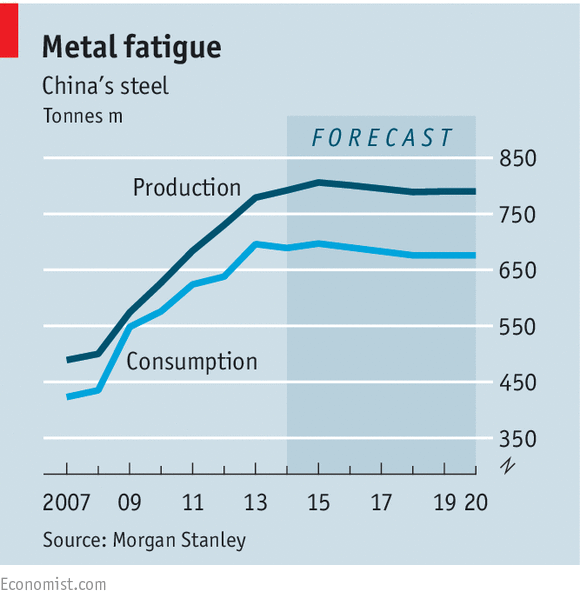
2. No wonder the Australians are struggling - This Economist piece on steel demand and production in China is sobering, particularly for Australians. The chart below says it all. No wonder prices of steel are dropping all over the world. I hope they are here too, although I'm not a Fletcher Building shareholder...
Aside from the risk of undermining the rationale for investments such as these, what are the potential knock-on effects of China hitting peak steel? Trade wars, for a start. Unable to peddle all of their output at home, Chinese steel producers have been exporting increasing quantities—to the consternation of producers elsewhere, who accuse them of dumping. MEPS, a consulting firm, estimates that China exported more than 90m tonnes of steel last year, which is greater than the entire output of America’s steel industry and was a rise of over 50% on the previous year. Exports are continuing to surge this year.
3. The problem with HSBC - This global bank has rightly taken a lot of criticism lately for its enabling of tax evasion and money laundering on a grand scale.
Now the FT is calling for the end of the 'non-dom' status of British residents who classify themselves as foreigners for tax purposes. Guess who has done this: the CEO of HSBC...
This anomaly has been highlighted in recent days by the case of HSBC’s chief executive, Stuart Gulliver. While a British citizen born and raised in the UK, Mr Gulliver badged himself as domiciled in the low-tax haven of Hong Kong. Yet not only has Mr Gulliver worked in Britain for the past 12 years, he has also retained links with the UK, for instance sending his children to school there. Whether or not the arcane rules have been obeyed, this hardly counts as severing all ties.
It is hard to know how much the Treasury is losing out. There are no reliable figures for tax foregone. But the inherent unfairness of allowing the richest in society to avoid paying their fair share of tax has become a matter of fierce public irritation.
4. Property Ponzi? - Shambeel Eaqub from the NZIER has stirred up a hornets nest of debate with his latest comments in the New Zealand Herald that Auckland's housing market is "essentially a Ponzi scheme."
I'm not sure I'd go that far, given real incomes are being used to pay interest on all the debt underpinning the prices. But he has a point in arguing there's an element of people buying each others homes with pumped up equity. That equity is not completely sustainable if either interest rates spike or employment slumps (or heaven forbid these things happen at the same time
Shamubeel Eaqub, NZIER principal economist, said this decade's housing market was like last decade's finance companies, being run as a high-risk money-go-round which could eventually end in misery.
"Essentially it's a Ponzi scheme because you need more and more new entrants to keep prices rising and that's exactly what's happening in the housing market. We've seen this in all kinds of businesses, for example finance companies were a classic. Who are the people buying the houses? We're paying higher and higher prices to each other," he said.
5. Finally - All the celebration this week about almost hitting parity against the Australian dollar seemed to ignore the very real impact on exporters.
So it was good to see the the Timber Industry Federation point this out via TVNZ.
The industry has relied on the Australian market but since 2012, the rising value of the New Zealand dollar has eroded 20 per cent of the value of our timber sold in Australia, Mr McVicar says.
"There simply isn't that sort of margin in the product and mills will now be supplying at a loss to stay in the market," he says.
"That scenario is not sustainable and will be devastating for many mills."
6. Top half of the OECD - It's not often New Zealand is in the top half of the OECD.
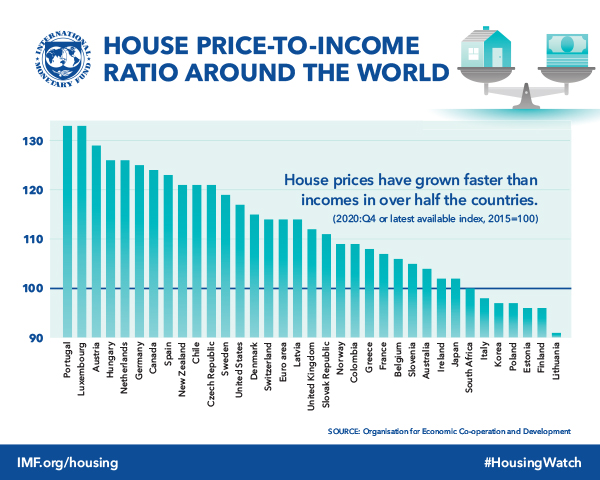
This week the OECD reported that New Zealand was in the top half of the OECD when it comes to the growth in our house price to rent ratio over the last four years (ie how much more out of whack with rents our house prices have become). Woohoo.
We're the seventh best (worst) in the world.
7. Gotta love this pic - I've tried to ignore the British election because I'm still trying to get over the New Zealand one last year. But this pic caught my attention.
Some politicians should stay away from schools and children.

8. A climate of distrust - We're lucky in New Zealand that we don't have to bribe our doctors to treat us.
This is normal in China, as Didi Tatlow reports in the New York Times.
Another reason to migrate to New Zealand.
During a two-week stay in a Beijing hospital, here’s what I wrote in my diary: ‘‘One has a curious sense of being in a machine, an irritant, like a grain of sand. … No one has the right to anything, not even medical care. You can only demand, beg or seize.’’
And people do. ‘‘Kan bing nan,’’ or ‘‘It’s hard to see a doctor,’’ they say about the country’s oversubscribed, underfunded, often corrupt, health system. In frustration, patients may attack their physicians. Bribery is common.
9. Drones and the military - I'm a big fan of New Zealand screenwriter and director Andrew Niccol. His 'The Truman Show' is one of the great movies I reckon.
Niccol has directed a new movie about the US drone pilots that push the buttons to attack targets in the Middle East. Here's an FT interview with Niccol.
The film’s combination of eye-in-the-sky omniscience and fateful fallout is surreal and perturbing, even by the standards of a film-maker whose Hollywood calling card was the script for The Truman Show (1998). “All the incidents we depict were based on true events. There was a funeral in 2009 where 60 people were killed. Although George W Bush began the drone programme, it has been escalated by Obama. In fact, on his third day in office a drone hit was ordered and it hit exactly the house targeted. Only it was the wrong house.”
Mistakes happen. But it’s no accident — it’s true to actuality — that the film’s mordant vision of drone war as a giant video game played for real is set in the gaming capital of the nation. Creech Air Force Base, the model for Niccol’s fictive 61st Attack Squadron base, is near Las Vegas. “It was intentional. When they train pilots, they want terrain that looks like Afghanistan. So they use the Sierra Nevada.”
10. Totally Clarke and Dawe - Tony Abbott is planning some Budget changes...
We welcome your comments below. If you are not already registered, please register to comment
Remember we welcome robust, respectful and insightful debate. We don't welcome abusive or defamatory comments and will de-register those repeatedly making such comments. Our current comment policy is here.