

Here's my Top 10 items from around the Internet over the last week or so. As always, we welcome your additions in the comments below or via email to bernard.hickey@interest.co.nz.
See all previous Top 10s here.
My must read is #7 on the meaning of the new age of machines.

1. High debts + ageing populations = slow growth - That's the conclusion of the IMF in a recent report highlighted by the always excellent Ambrose Evans Pritchard at the Telegraph.
He wraps in the implications for the Greek crisis, which is symptomatic in many ways of the worst outcome of those two trends.
He then talks about the risk of a 'super taper tantrum' when (or is that if) the Federal Reserve finally starts putting up interest rates.
His conclusion is a little concerning.
What if the debt was never repaid, he asks.
I can see a debate in decades to come about how central banks will have to cancel or forgive all these Government bonds they bought.
Here's Ambrose:
A baby boom and surging work-force enabled us to grow out of debt in the 1950s and 1960s without noticing it. No such outcome looks plausible today. The IMF's World Economic Outlook describes a prostrate planet caught in a low-growth trap as the population ages across the Northern Hemisphere, and productivity splutters. Nor is this malaise confined to the West. The fertility rate has collapsed across the Far East. China's work-force is shrinking by three million a year.
The whole world has been drawn deeper into a Faustian Pact. Total public and private debt levels have reached a record 275pc of GDP in rich countries, and 175pc in emerging markets. Both are up 30 points since the Lehman crisis.
Nobody knows for sure whether this is benign, or how it will end. The haunting fear for the lords of global finance at IMF headquarters this year is that it may never be repaid. Caveat Creditor.
The report warned of a “persistent reduction” in the global growth rate since the Great Recession of 2008-2009, with no sign yet of a return to normal. “Lower potential growth will make it more difficult to reduce high public and private debt ratios,” it said.
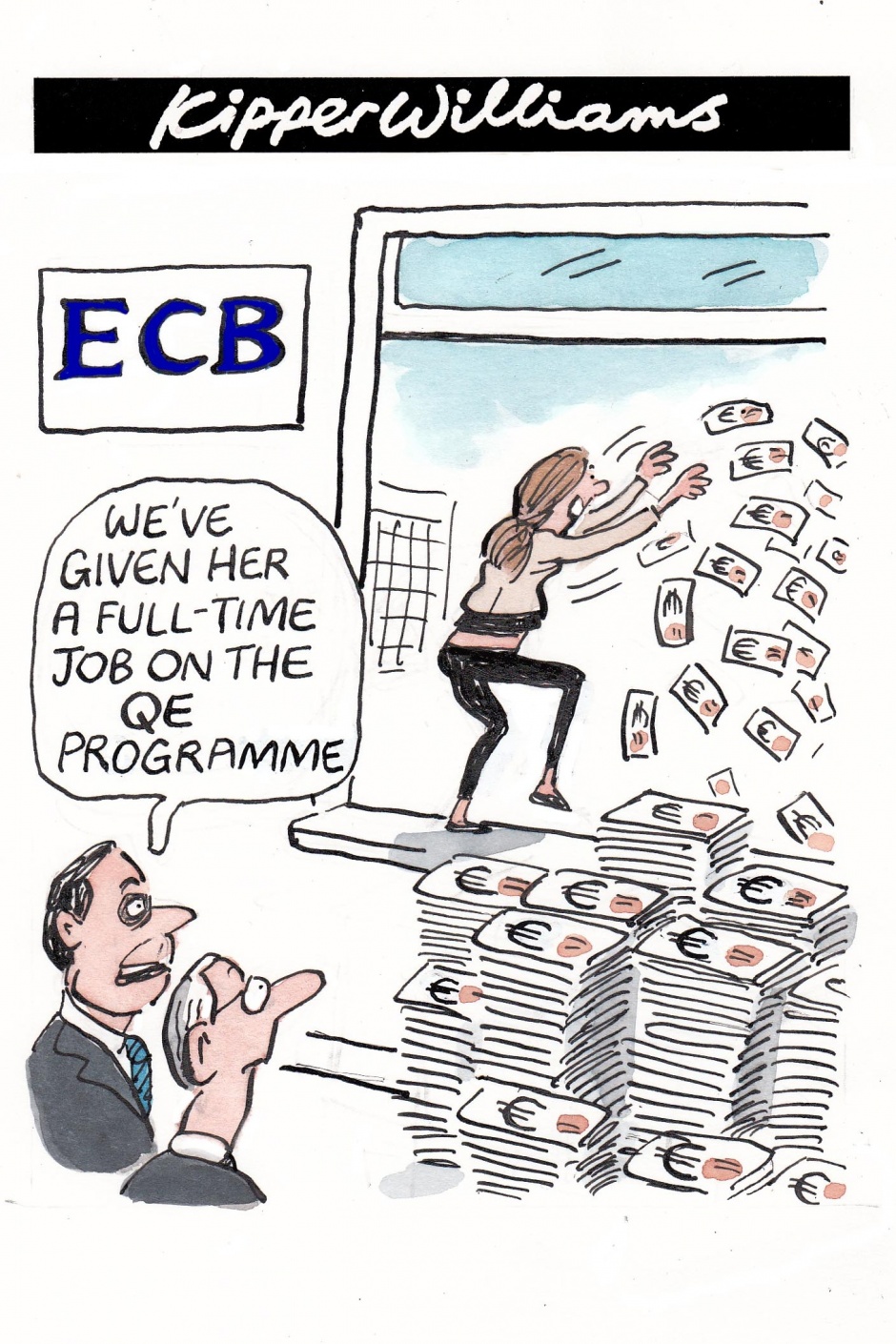
2. Out with Keynes and in with Piketty - John Cassidy's preview of the British general election on May 7 is well worth a read. He highlights the Labour Party's apparent poll success by targeting the rich with higher taxes, particularly on mansions, but also its pledge for fiscal balance.
In signalling its break with Keynes, the Labour Party has not undergone a big shift to the right, and it would also be a mistake to conclude that its progressive tax-and-spend policies have been discredited. To the contrary, in eschewing the free lunches (or cheap lunches) that deficit financing might offer, Miliband and Labour have nonetheless adopted an explicitly redistributive policy agenda.
They propose to tax the rich in order to pay for initiatives like expanding day care, reducing university-tuition fees, and hiring tens of thousands more doctors and nurses for the N.H.S. While Keynes was being unceremoniously booted out the front door of Labour’s headquarters, Thomas Piketty was being ushered in through the side entrance.
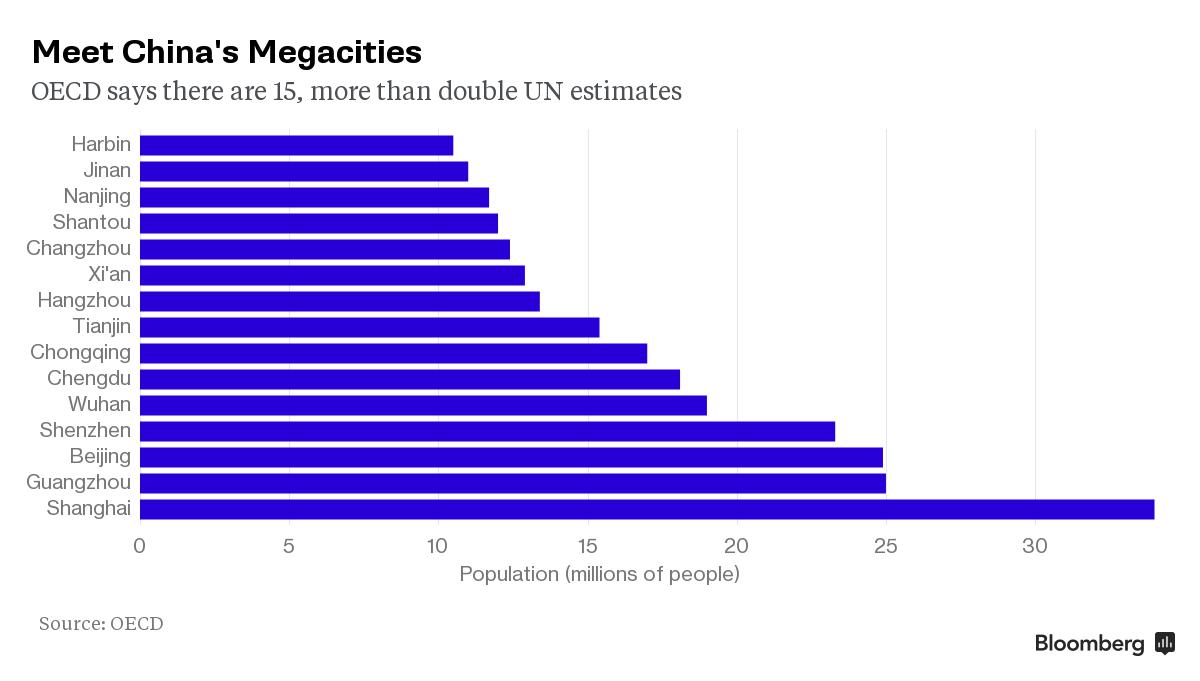
3. Megacities galore - Bloomberg reports on a fresh OECD study showing there's actually 15 'mega-cities' in China with more than 10 million people each, not the six previously thought. That's good news on the whole for New Zealand.
China is urbanizing at a staggering rate—in 35 years, it has added more than 500 million people to its cities. As a result, it looks like the world has vastly underestimated the size and scope of growth in China's megacities, defined as those with more than 10 million people, according to a new report by the Paris-based Organization for Economic Cooperation & Development.
The research used analysis based on functional urban areas, rather than cities defined by administrative borders. Besides such better-known places as Shanghai, Guangzhou, and Beijing, the new list includes Harbin, a northeast city with a renowned annual ice and snow sculpture festival, and Nanjing, a former capital city that sits on the Yangtze River.
4. Why CEO reform failed - The New Yorker's James Surowiecki takes a look at why attempts to reform CEO pay in the United States failed. See #8 below for the contrast.
Executive compensation dipped during the financial crisis, but it has risen briskly since, and is now higher than it’s ever been. Median C.E.O. pay among companies in the S. & P. 500 was $10.5 million in 2013; total compensation is up more than seven hundred per cent since the late seventies.
There’s little doubt that the data for 2014, once compiled, will show that C.E.O. compensation has risen yet again. And shareholders, it turns out, rather than balking at big pay packages, approve most of them by margins that would satisfy your average tinpot dictator. Last year, all but two per cent of compensation packages got majority approval, and seventy-four per cent of them received more than ninety per cent approval.
5. US$229 billion - Someone needs to do a cost-benefit analysis of America's gun laws. Mother Jones reckons the cost of permissive gun laws is is US$226 billion.
I can never work out why New Zealand doesn't promote itself more as a relatively gun-free destination for tourists and migrants.
6. What negative yields actually mean - The WSJ has had a useful look at how Europe's negative yields are affecting banks and insurers in the long run. It's not good.
Tumbling interest rates in Europe have put some banks in an inconceivable position: owing money on loans to borrowers. At least one Spanish bank, Bankinter SA, the country’s seventh-largest lender by market value, has been paying some customers interest on mortgages by deducting that amount from the principal the borrower owes.
The problem is just one of many challenges caused by interest rates falling below zero, known as a negative interest rate. All over Europe, banks are being compelled to rebuild computer programs, update legal documents and redo spreadsheets to account for negative rates.
7. The robots are coming - The commentary around the effects of new technology on jobs and wages is heating up in Europe and the United States. It's not all positive, as this New York Times piece shows.
But computers do not just replace humans in the workplace. They shift the balance of power even more in favor of employers. Our normal response to technological innovation that threatens jobs is to encourage workers to acquire more skills, or to trust that the nuances of the human mind or human attention will always be superior in crucial ways. But when machines of this capacity enter the equation, employers have even more leverage, and our standard response is not sufficient for the looming crisis.
Machines aren’t used because they perform some tasks that much better than humans, but because, in many cases, they do a “good enough” job while also being cheaper, more predictable and easier to control than quirky, pesky humans. Technology in the workplace is as much about power and control as it is about productivity and efficiency.
8. Peak wages - Yet again the US economy seems to be under-performing all the grand expectations of a strong bounce back this year.
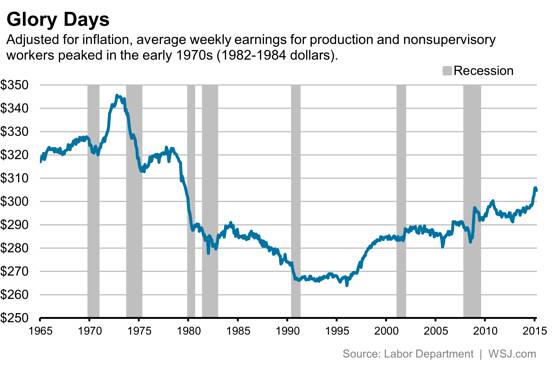
Maybe the fact that wages for most workers remain well below their early 1970s levels in real terms is the reason, the WSJ reports.
By one measure, wages for most U.S. workers peaked more than four decades ago.
Adjusted for inflation, average weekly earnings for production and nonsupervisory employees–the bulk of the workforce–topped out in October 1972, according to the Labor Department. In today’s dollar, that weekly paycheck was the equivalent of about $811, compared with just under $703 a week last month.
Data released Friday showed real average hourly earnings for production and nonsupervisory employees fell a seasonally adjusted 0.1% from February to March, and real average weekly earnings decreased by 0.4%, underscoring soft wage gains during this recovery.
9. Totally Clarke and Dawe on Australia's Budget dramas.
We welcome your comments below. If you are not already registered, please register to comment
Remember we welcome robust, respectful and insightful debate. We don't welcome abusive or defamatory comments and will de-register those repeatedly making such comments. Our current comment policy is here.