

Here's my Top 10 items from around the Internet over the last week or so. As always, we welcome your additions in the comments below or via email to bernard.hickey@interest.co.nz.
See all previous Top 10s here.
My must read is #5 on the changes in the power industry.

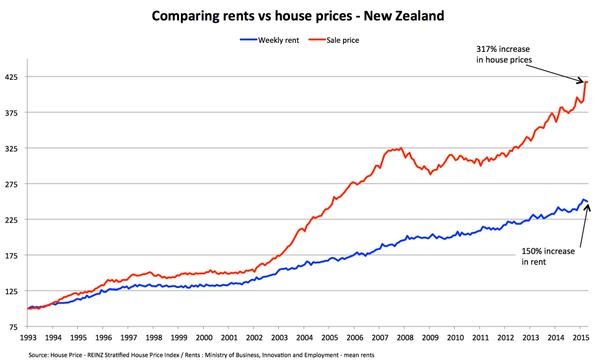
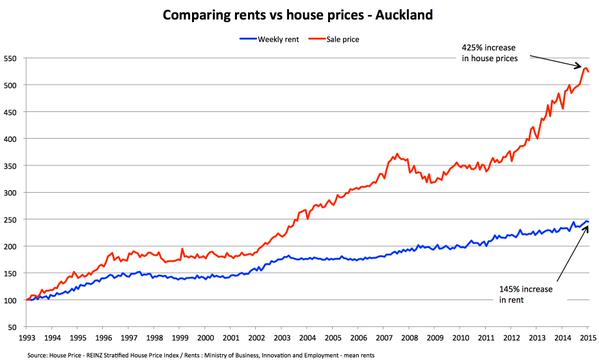
1. Can anyone explain these charts? - The two charts below (courtesy of Alistair Helm on Twitter) neatly encapsulate all of the drivers in our housing market over the last 30 years or so.
You could argue they say a lot about the economy too, given we have something of a housing market with bits tacked on rather than a broad-based economy.
They show how New Zealand house prices have risen 317% since 1993, which was more than double the growth in rents.
It's even more extreme for Auckland, with house prices up 425% and rents up 145%. Neither chart is adjusted for inflation.
For some people this is wonderful because it represents an explosion in the equity in their home, as long as their debt didn't rise as fast. For renters and the people who subsidise rents through NZ$2 billion of rent subsidies each year (ie. taxpayers), this is a disaster.
I'd love to know how this happened and could be justified. Obviously leverage increased and interest rates fell.
But what was the factor in 2002 that created the inflection point?
2. 'It's a bubble' - We've heard plenty of experts say Sydney and Melbourne house prices are a bubble because of very high demand from foreign investors and rental property investors.
But here's LF Economics saying it's a bubble because of over-supply. Here's their thinking via the SMH:
The largest oversupply is in Melbourne where there has been a frenzy of inner-city apartment building. They forecast the total available homes in Victoria outstrip demand by 123,000. NSW has a surplus of more than 40,000, according to their analysis, which was based on data from the Australian Bureau of Statistics.
"This calamitous outcome is especially likely in Melbourne where rents have not increased in real terms since 2010. Melbourne is primed to become the epicentre of a legendary housing market crash due to the combination of a staggering boom in real housing prices [178 per cent]. Perth is also in a serious predicament.
"Housing prices across all capital cities remain grossly inflated relative to rents, income, inflation and GDP. What event or set of events triggers the beginning of the end of the housing bubble is not yet known. A bloodbath in the housing market, however, appears a near certainty due to the magnitude of falls required for housing prices to again reflect economic fundamentals."
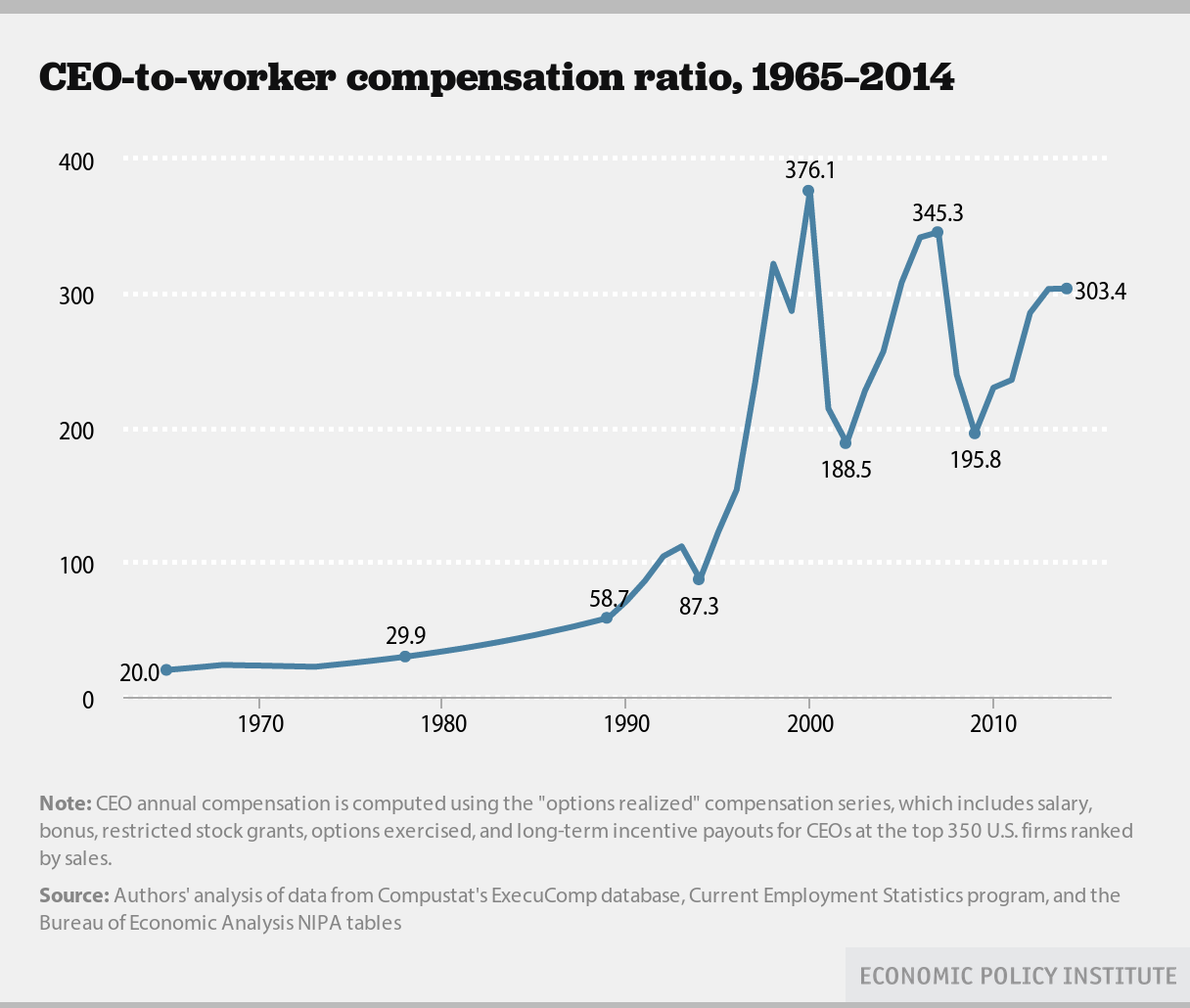
3. Crazy, crazy CEO pay - This research by America's Economic Policy Institute looks at how exploding CEO pay has contributed to America's income inequality and how it had very little to do with improvements in CEO productivity.
Here's what they say:
Over the last three decades, compensation for CEOs grew far faster than that of other highly paid workers, i.e., those earning more than 99.9 percent of wage earners. CEO compensation in 2013 (the latest year for data on top wage earners) was 5.84 times greater than wages of the top 0.1 percent of wage earners, a ratio 2.66 points higher than the 3.18 ratio that prevailed over the 1947–1979 period. This wage gain alone is equivalent to the wages of 2.66 very-high-wage earners.
That CEO pay grew far faster than pay of the top 0.1 percent of wage earners indicates that CEO compensation growth does not simply reflect the increased value of highly paid professionals in a competitive race for skills (the “market for talent”), but rather reflects the presence of substantial “rents” embedded in executive pay (meaning CEO pay does not reflect greater productivity of executives but rather the power of CEOs to extract concessions). Consequently, if CEOs earned less or were taxed more, there would be no adverse impact on output or employment.
4. Brace for it - Bloomberg reports on a UBS report suggesting that China's property market slowdown could hit demand for commodities globally. New Zealand dairy farmers are getting an early taste, albeit compounded by supply shocks from European and US farmers.
"As the multiyear Chinese property downshift continues to unfold beyond this year, we may see a longer-term decline in China's appetite for foreign industrial imports,'' the analysts wrote in a report June 22. "Commodity, reprocessing, and developed country exporters alike should brace themselves for the impact of weakening China demand this year, irrespective of whether U.S. or EU imports pick up.''
5. The power revolution - The New Yorker has a long and detailed piece on the changing economics of solar power for homes in America. It looks in particular at the role some power companies are playing in financing the upfront investment in solar arrays, insulation and heat pumps.
Most of the technology isn’t particularly exotic—these days, you can buy a solar panel or an air-source heat pump at Lowe’s. But few people do, because the up-front costs are high and the options can be intimidating. If the makeover was coördinated by someone you trust, however, and financed through your electric bill, the change would be much more palatable. The energy revolution, instead of happening piecemeal, over decades, could take place fast enough to actually help an overheating planet. But all of this would require the utilities—the interface between people and power—to play a crucial role, or, at least, to get out of the way.
Power utilities now face uncertainty of a kind that traditional phone companies faced when cellular technology emerged. A few utilities welcome the challenge; others are resisting it; and the rest are waiting for someone to tell them what to do.
6. A world without work? - The Atlantic has an indepth piece on the future of work which asks some uncomfortable questions about what happens when the robots do the work.
The end-of-work argument has often been dismissed as the “Luddite fallacy,” an allusion to the 19th-century British brutes who smashed textile-making machines at the dawn of the industrial revolution, fearing the machines would put hand-weavers out of work. But some of the most sober economists are beginning to worry that the Luddites weren’t wrong, just premature. When former Treasury Secretary Lawrence Summers was an MIT undergraduate in the early 1970s, many economists disdained “the stupid people [who] thought that automation was going to make all the jobs go away,” he said at the National Bureau of Economic Research Summer Institute in July 2013. “Until a few years ago, I didn’t think this was a very complicated subject: the Luddites were wrong, and the believers in technology and technological progress were right. I’m not so completely certain now.”
7. Chinese buying galore - In America. Jamil Anderlini looks at how Chinese investors bought US$28.6 billion of US residential property in the year to the end of March. There's more where that came from.
With the Chinese economy and real estate market slowing dramatically and a vociferous anti-corruption campaign in full swing at home, Chinese buyers have been scrambling in the past few years to buy real estate abroad.
As a group they have become the biggest buyers of housing in many major western cities, including New York, London, Sydney, Vancouver, Toronto and Auckland.
Houses in English-speaking democracies with good education systems, excellent quality of life, strong rule of law and strong property rights are regarded by Chinese buyers as excellent stores of wealth.
In the year to the end of March, Chinese buyers spent more than three times the average American buyer, paying an average of $831,800 per property, compared with the national average transaction price of $255,600.
8. And it's technically illegal - As Jamil Anderlini points out...
Since China has strict capital controls that limit individuals to transferring just $50,000 a year out of the country, it appears that most of the money flooding into global property markets is technically illegal.
While there are legal ways to transfer larger sums, several major banks in Beijing told the Financial Times they had never conducted such transactions for offshore real estate buyers.
People involved in the market say the vast majority of money for overseas property purchases is transferred out of China illegally.
10. Totally Clarke and Dawe on Australia's immigration policy...hilarious.

We welcome your comments below. If you are not already registered, please register to comment
Remember we welcome robust, respectful and insightful debate. We don't welcome abusive or defamatory comments and will de-register those repeatedly making such comments. Our current comment policy is here.