

Here's my Top 10 items from around the Internet over the last week or so. As always, we welcome your additions in the comments below or via email to bernard.hickey@interest.co.nz.
See all previous Top 10s here.
My must read is #1. It helps explain why all sorts of unusual people, including the US military, are worried about the effects of climate change. #5 on Mexico's sugar tax is almost as good.
1, Climate change and the global economy - The narrative in recent years around measures to address climate change has been the economy can't afford the sorts of carbon taxes needed to reduce emissions.
So it's been fascinating to see the change in thinking over the last year or so towards looking at climate change as an economic risk. Insurers have been thinking like this for years, but many fund managers and companies are beginning to think the same. The politicians and voters have yet to catch up.
This paper just published in Nature estimates that global warming will reduce average economic output by 2100, vs the output if the climate did not change.
If future adaptation mimics past adaptation, unmitigated warming is expected to reshape the global economy by reducing average global incomes roughly 23% by 2100 and widening global income inequality, relative to scenarios without climate change
2, 'We get some big numbers' - The paper above was written by Stanford and Berkeley economists Marshall Burke, Solomon Hsiang and Edward Miguel.
Burke has written this handy blog post to explain how they came up with the result. They looked at the relationship between temperatures and economic output in various countries. It seems cool countries grow faster than hot countries until they get to around 13 degrees celcius. So already cool countries do better as climates change, but already hot countries do much, much worse. So when everyone gets hotter...
Here's Burke explaining the research:
We then combine historical results with global climate model estimates of future warming to come up with some projections of the potential future impacts of warming.
We get some big numbers. Looking historically, we see that output in both rich and poor countries alike has been shaped by changes in temperature, and that temperature appears to affect growth rate of per capita GDP and not just the level of GDP (which matters a whole lot when you do the projections). Importantly, we don't see big differences between rich and poor countries in how they respond to changes in temperature historically. Differences we do see across countries appear driven more by countries' average temperatures than by their average incomes, with cooler countries growing faster on average during years that are warmer-than average for them, and hotter countries growing slower.
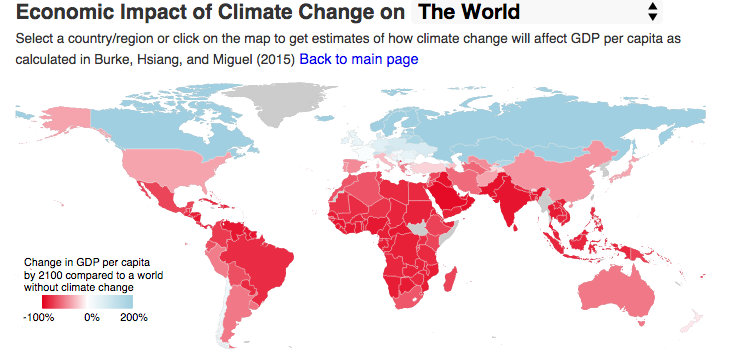
3. New Zealand does much better than Australia - The researchers then produced an interactive map showing how individual countries do in their forecasts. New Zealand does better than most because it's cooler than most to start with. NZ GDP is 9% under what it would have been by 2100 with no change, while Australia is down 53%.
Click on the map. It's the most fun you'll have in a long time. (Note to self: get out a lot more)
4. A black swan event - This Berkeley write-up of the paper also provides some useful context.
“These results provide the first evidence that economic activity in all regions is coupled to the global climate,” the analysis reports. The team applied the results to standard scenarios of the 21st century to understand how the global economy might be affected by climate change.
They find climate change is likely to have global costs generally 2.5-100 times larger than predicted by current leading models. The team’s best estimate is that climate change will reduce global economic production by 23 percent in 2100.
“Historically, people have considered a 20 percent decline in global Gross Domestic Product to be a black swan: a low-probability catastrophe,” Hsiang warned. “We’re finding it’s more like the middle-of-the-road forecast.”
5. Mexico's sugar tax - This piece from Tina Rosenberg on how Mexico managed to pass legislation to impose a sugar tax, overcoming the powerful lobbying of Coca Cola, is a fascinating long read.
It turns out we all have Michael Bloomberg to thank for it.
Vicente Fox, who in 2000 became the country’s first democratically elected president, had earlier been president of Coca-Cola Mexico and then head of the company’s Latin American operations. The symbolism was noteworthy: soda companies – particularly Coke, which controls 73% of the Mexican market (compared with only 42% in the US) – have amassed extraordinary influence over health policy in Mexico.
In 2011, Bloomberg’s charitable foundation, already a major funder of tobacco control programmes in low- and middle-income countries, decided to take on soda. Mexico was alluring, especially since a new president was about to take over. The foundation, called Bloomberg Philanthropies, looks for strong local organisations to partner with, and Calvillo’s group was an obvious choice. “Experts around the world talked about Alejandro and how strong El Poder was,” said Kelly Henning, who runs the foundation’s public health programmes. “He really looks to the evidence, and is a very good collaborator with others.”
In 2012, Bloomberg Philanthropies began a $10m, three-year programme in Mexico to reduce soda consumption. For the first time, the financial power of Mexico’s soda industry faced a serious challenge.
6. The anti-Libertarian - The Telegraph reports the outgoing boss of British upmarket supermarket chain Waitrose, which is also employee owned, has taken a few parting shots at the rawest forms of capitalism.
The Waitrose boss said engaged employees would result in a 20pc improvement in productivity, around 150pc improvement in company earnings per share and a 28pc reduction in wastage, quoting statistics from research firm Gallup.
"Smart societies cannot be created without fairness, equality and enfranchisement and business has a crucial role to play here," said Mr Price. " Society, quite rightly, expects a lot in return from business for the privileges it is afforded. It's time we all delivered the goods and, in return, we will all benefit from significantly improved performance."
The retail veteran said that according to JLP's own research, over half of Waitrose's customers believe that business only cares about money and nothing else; 56pc think that business culture is dominated by greed and selfishness and 61pc agree that staff are seen just as "resources" rather than human beings.
7. Politics and the new machine - This piece from Jill Lepore in The New Yorker on the science of polling in modern politics is fascinating.
It finds that response rates to polls have slumped and their usefulness is dropping, yet polls are more important to politicians than ever.
Still, data science can’t solve the biggest problem with polling, because that problem is neither methodological nor technological. It’s political. Pollsters rose to prominence by claiming that measuring public opinion is good for democracy. But what if it’s bad?
The best and most responsible pollsters, whether Democratic, Republican, or nonpartisan, want nothing so much as reliable results. Today, with a response rate in the single digits, they defend their work by pointing out that the people who do answer the phone are the people who are most likely to vote. Bill McInturff, of Public Opinion Strategies, told me, “The people we have trouble getting are less likely to vote.” But the difficulty remains. Surveying only likely voters might make for a better election prediction, but it means that the reason for measuring public opinion, the entire justification for the endeavor, has been abandoned. Public-opinion polling isn’t enhancing political participation. Instead, it’s a form of disenfranchisement.
8. Chinese consumers going online - This FT piece from Patti Waldmeir on how Chinese consumers are using their phones to buy everything and get it delivered, including fresh food, provides a real insight into how the world is changing. Are New Zealand exporters ready and planning for this?
Chinese consumers can (and do) swipe smartphones for almost everything. Breakfast, lunch and dinner? With a wave of the iPhone wand, it arrives on a motorbike, delivered often for free and usually at a discounted price, from food delivery apps such as Ele.me (meaning “are you hungry?”). Wave it again, and a taxi appears, ready to offer a discounted ride. Wave it once more, and there’s a doctor ready to diagnose any ailment by phone for only Rmb9.9 ($1.5) per call.
It’s called O2O, or “online to offline” , and is forecast to grow at a compound annual rate of 63 per cent between now and 2017, to Rmb42bn, according to Credit Suisse. The marriage of online and offline will soon come even to that most traditional of venues, the neighbourhood wet market, where Shanghainese will be able to swipe a phone to buy anything from a haircut to a tooth extraction to a fish head for supper.
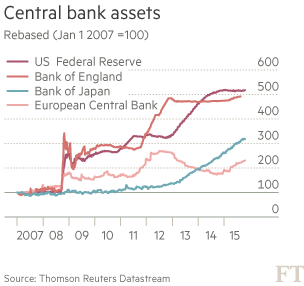
9. Time to make them less independent? - The FT takes a good look at the growing questions about the power and independence of central banks. This resonates here too.
In this febrile atmosphere, some experts say central banks’ cherished independence is at risk. “Central bankers are punching well above their weight,” says Willem Buiter, chief economist at Citi and a former member of the BoE’s Monetary Policy Committee. “This could lead to a backlash and to central banks losing their operational independence, even where this independence makes sense — in the design and conduct of monetary policy, narrowly defined.”
Ricardo’s ideal of central bank independence — the ability for a central bank to set monetary policy without interference — has taken hold only in recent decades. The attractions are clear. Keeping interest rate-setting at arm’s length from politics, rates are set in the name of low and stable inflation, not short-term political convenience.
Until the crisis, it looked like they had hit on a magic formula. For much of the 1990s and 2000s leading economies enjoyed low and stable inflation, along with relatively steady growth in an era known as the Great Moderation.
Those conditions turned out to be a chimera. In the 2000s, most central bankers failed to highlight — or even acknowledge — the risks building up in the banking system, an omission that had disastrous consequences when a financial collapse triggered the world’s worst post 1945 recession. Yet ironically, central banks emerged from the crisis more powerful than ever.
The question being asked on both the left and right is whether central banks’ policy fiefdoms have become too expansive. Many say the monetary authorities should concentrate on their core task — keeping inflation on target — an objective they are struggling to meet.
10. Totally Clarke and Dawe with Billy the naughty schoolboy.
We welcome your comments below. If you are not already registered, please register to comment
Remember we welcome robust, respectful and insightful debate. We don't welcome abusive or defamatory comments and will de-register those repeatedly making such comments. Our current comment policy is here.