

By Bernard Hickey
This week's report on 'The Future of Jobs' for the Davos economic talkfest in Switzerland has refocused the world's attention on whether the wave of technology change now sweeping around the globe will actually make most people richer.
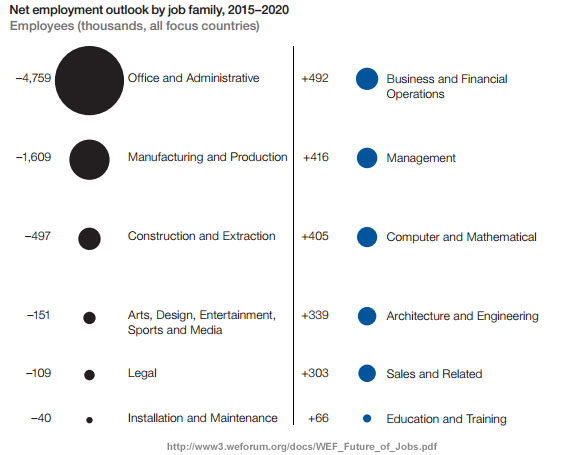
The unsettling conclusion from the report is that a Fourth Industrial Revolution will destroy millions of white and blue collar jobs over the next four years alone, but create far fewer new jobs in their place. It will also create downward pressure on wages for many of those remaining lower skilled workers who have the jobs robots can't do -- yet. It poses some deep questions about how we educate, train and retrain our young and old, how we tax the winners who take all, and how we support those who can't get jobs in this brave new world.
It also forced me to look more into the history of an insult. I remember being called a 'Luddite' at various times over the last couple of decades by my geekier friends who saw me as a late adopter. I like to think I have most of the gadgets so it was insult that stung, but it was an insult that I didn't really understand until I looked into the history of the word.
No one is quite sure who the Luddite movement was named after, but the legend is that a unemployed young weaver from the North of England called Ned Ludd smashed a mechanical knitting machine in 1779 in a fit of rage after being whipped for idleness. Artisans and skilled craftsmen adopted the legend of 'Captain Ludd' to inspire them in their protests against rise of mechanisation from 1811 to 1817. They organised themselves into groups to break into factories to smash the machines that had cost them their jobs. There were riots and on several occasions the British Army had to be called into put down the revolts.
As the industrial revolution progressed over the following 200 years, hundreds of millions of new jobs were created in areas that no one had thought possible. Some of those artisans changed jobs and their children, once educated, went on into new skilled jobs that eventually made them richer. Some never recovered and sank into poverty and the first industrial revolution's progress towards prosperity for most was no smooth process. Just read any Dickens novel or look at the history of revolutions and wars through the 1800s and 1900s to see that. Eventually the industrialised world settled on a mixed economy model where the state provided education and other social safety nets to make sure the sons and daughters of those weavers were trained and healthy and able to participate in (and vote on) the techno-future.
The debate over whether new technology is a net creator or destroyer of wealth and jobs appeared to be over. It certainly was during the 1990s and 2000s when to be called a 'Luddite' was to be accused of being out of touch and some sort of King Canute-ish figure trying to hold back the tide of inevitably enriching progress.
Fast forward to 2016 and now the question is being asked again: does all this technology change make most of us richer most of the time? The question is not about whether to try to stop the progress because that is impossible, but it is about how to adjust our education systems, our training regimes, our tax systems and our benefit systems to adjust.
The Future of Jobs report concluded from a survey of HR people from 350 global companies with 13 million employees in 15 countries that this Fourth Industrial Revolution would destroy 7.1 million jobs by 2020 and only create 2.1 million jobs. That forecast net job destruction of 5 million jobs forced the report's authors to recommend new training and education regimes, but it stopped short of looking at tax rates or benefits.
These will be the debates of our age. How do we include all our citizens in this brave new world and ensure firstly that they have a decent wage to support themselves, and if they don't, that it is provided from the taxes paid by the hyper-wealthy who are accelerating away from the rest with the proceeds generated by this new winner-takes-all global economy.
The other report to dominate the debate at Davos was from Oxfam. It showed the world's richest 62 people now have the same amount of wealth as the world's poorest 50% or 3.5 billion. Just five years ago the ratio was 388 to 3.5 billion, and over that period the wealth of the world's poorest lower half dropped by 41%.
The Luddites may be as wrong in 2016 as they were in 1811, but this new winner-takes-all global economy could do with a few tweaks.
A version of this article has appeared in the Herald on Sunday. It is here with permission.
We welcome your comments below. If you are not already registered, please register to comment
Remember we welcome robust, respectful and insightful debate. We don't welcome abusive or defamatory comments and will de-register those repeatedly making such comments. Our current comment policy is here.