

Here's my Top 10 items from around the Internet over the last week or so. As always, we welcome your additions in the comments below or via email to bernard.hickey@interest.co.nz.
See all previous Top 10s here.
My must read is #6 on redistricting.
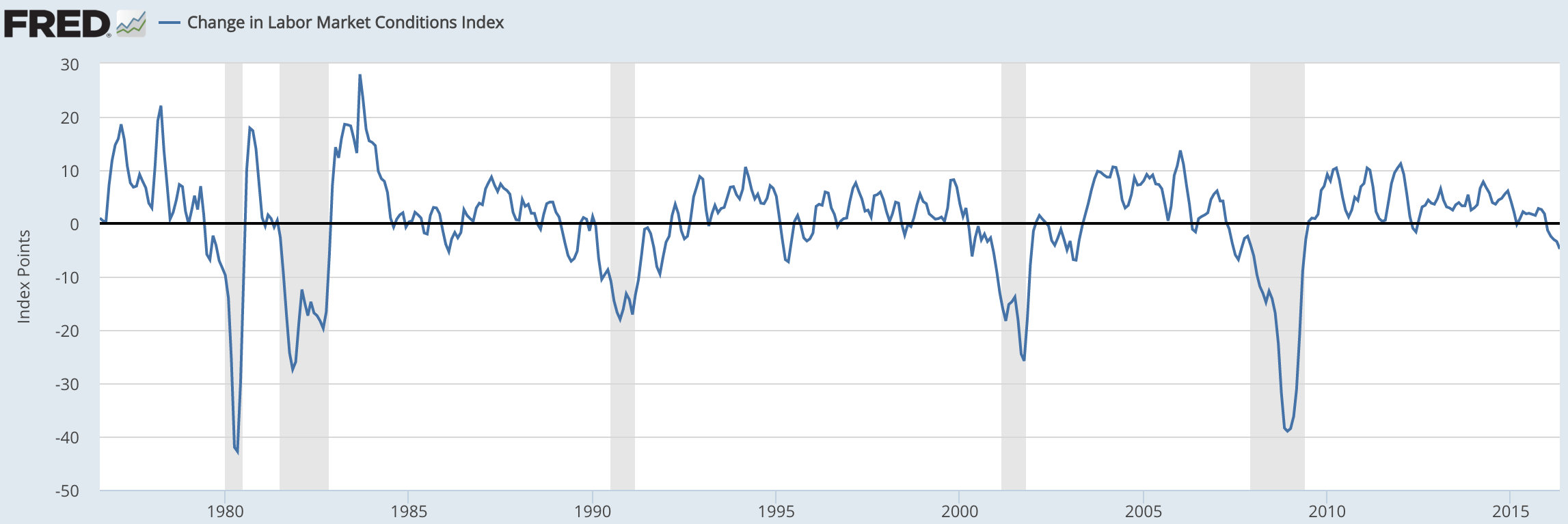
1. US recession coming? - This chart below from the US Federal Reserve showing the changes in its Labor Market Conditions Index helps explain why something funny is going on in the bowels of the US economy. The Labor market is just not doing what it should, which means the Fed is finding it difficult to put up rates.
Every time this conditions index has dropped this fast for this long, there's been a recession just around the corner.
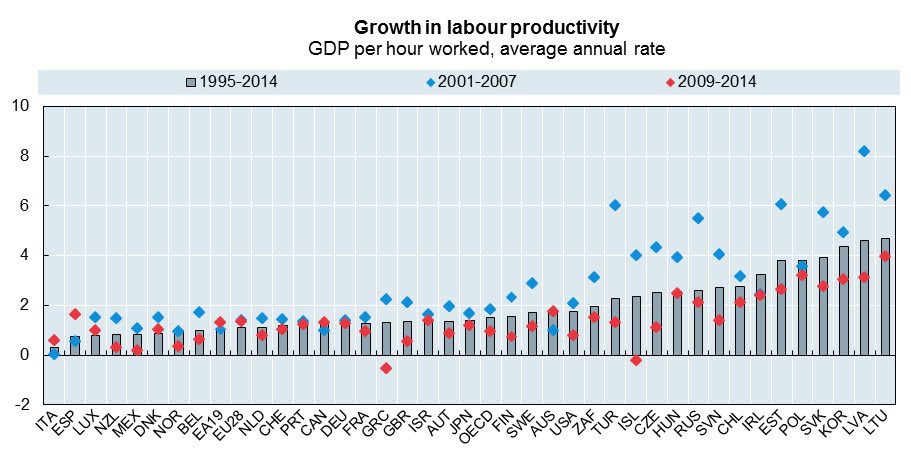
2. Where's the Productivity growth? - One of the big puzzles globally right now is the strange absence of productivity growth around the world, despite all this amazing technology.
Even Janet Yellen from the Fed is worried, and said so in a speech this week.
The latest readings on the labor market and the weak pace of investment illustrate one downside risk--that domestic demand might falter. In addition, although I am optimistic about the longer-run prospects for the U.S. economy, we cannot rule out the possibility expressed by some prominent economists that the slow productivity growth seen in recent years will continue into the future.
3. NZ's woeful productivity record - This OECD chart tells the story of New Zealand's awful productivity record over the last 20 years. We are the fourth worst in the OECD over that period and we were the third worst over the last five years. We were way, way worse than Australia.
Lots of people are patting themselves on the back these days for economic growth, but unless we can lift GDP per hour worked then real wages are going nowhere fast.
4. Pathetic export performance - One of the big reasons for that woeful productivity record is our inability to grow the export part of the economy, thanks I would argue to our obsession with tax-free capital gains on property.
This chart (thanks to Michael Reddell at Croaking Cassandra for an excellent series of posts on this) tells the story. Its awful.
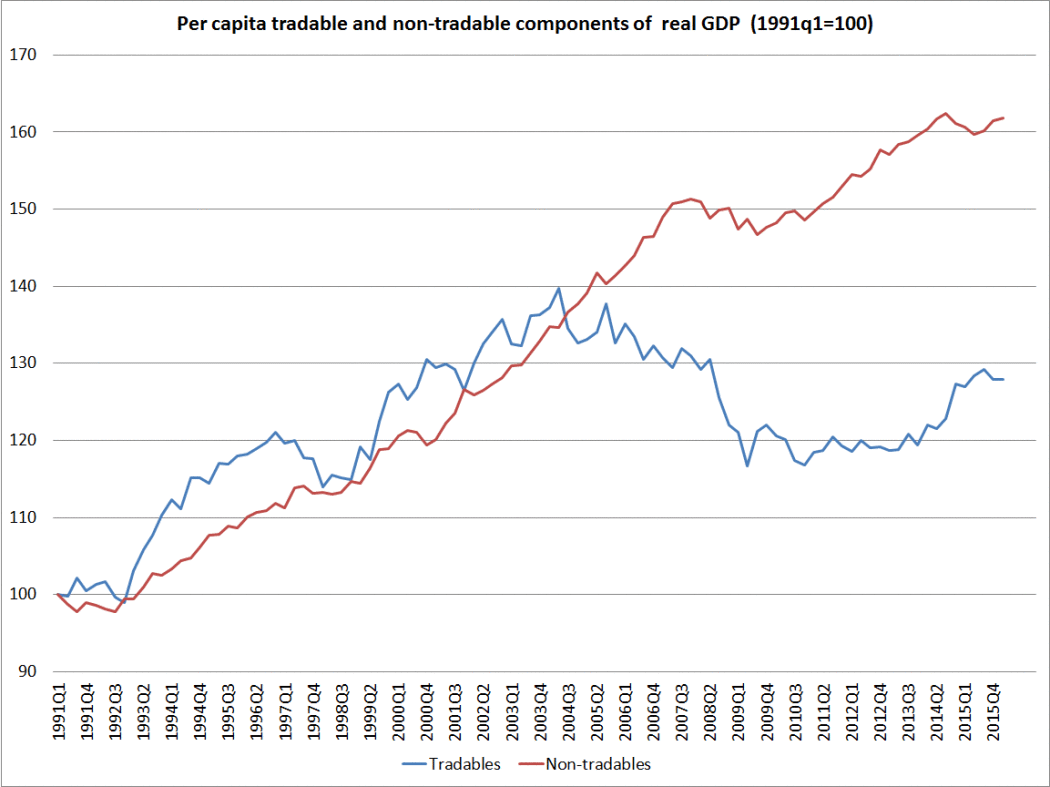
Successful economies, building on a sustainable footing, do so by selling more and different stuff in competition with the best the rest of the world has to offer. That doesn’t describe New Zealand at all – under this government or its predecessor.
We have
- no productivity growth
- a continuing high unemployment rate
- ruinous house prices, and
- a tradables sector that has achieved no per capita growth for 15 years.
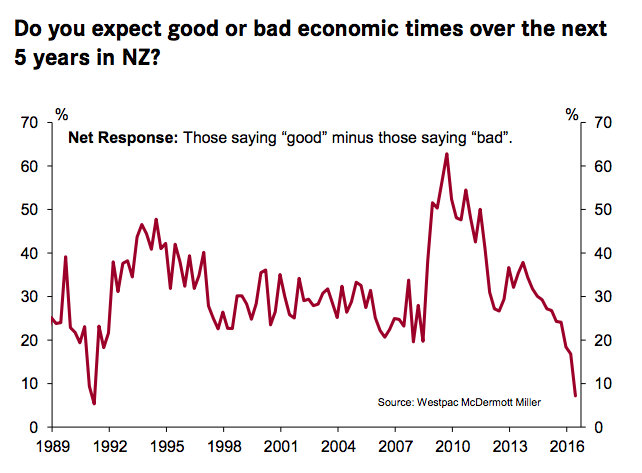
5. Is this why people don't really believe? - This chart showing consumer confidence in the wider economy over the next five years has collapsed in the last six months to 25 year lows suggest a few people are working out the model is not working.
6. Wondering how Donald Trump happened? - You really need to understand how redistricting works to get a real handle on it.
Here's the New Yorker with a great summary of how the Republicans pursued a deliberate strategy of redrawing boundaries of congressional districts -- we'd call it Gerry Mandering -- to turn the map from blue to red.
The result, David Daley argues in “Ratf**ked: The True Story Behind the Secret Plan to Steal America’s Democracy” (Liveright), is a system so rigged that it hardly matters anymore who’s running for office.
Much of “Ratf**ked” is devoted to a Republican scheme optimistically called redmap, for Redistricting Majority Project. redmap was created in early 2010, at a point when the country’s electoral map was largely blue. In twenty-seven states, Democrats held the majority of seats in both houses of the legislature, and in six more they held a majority in one house. The Presidency, the U.S. Senate, and the House of Representatives were all in Democratic hands. To describe their own party, Republicans were using words like “wounded” and “adrift.”
And, as bad as things looked at the time, the G.O.P.’s prospects down the road looked even worse. In 2011, new census figures were due to be released, and this would trigger a round of redistricting. Republicans, Daley writes, were facing “a looming demographic disaster.”
7. Insane working hours - This piece in The Week takes a look at how the idea that working very, very long hours was a status symbol.
Research by the Center for Equitable Growth's Heather Boushey and Bridget Ansel, released last month, highlights something rather remarkable: access to longer hours has become a sign of privilege in American society.
The jobs where people are most likely to work over 40 or 45 hours a week are highly-paid professional positions like lawyers, business management, engineering, and finance. Low-income service jobs in health care, office support, the food industry, and the like are where people are the least likely to work long hours.
8. Perovskites - Vox reports on the great new hope for solar power.
In the future, solar power won't just come from bulky blue panels on rooftops. The solar panels of tomorrow will be transparent, lightweight, flexible, and ultra-efficient. We'll be able to coat shingles or skylights or windows with them — and it'll all be as cheap as putting up wallpaper.
And these solar cells will be made from a new material called perovskite.
9. Here's John Oliver on Brexit:
10. Totally Clarke and Dawe with some advice for Malcolm Turnbull.
We welcome your comments below. If you are not already registered, please register to comment
Remember we welcome robust, respectful and insightful debate. We don't welcome abusive or defamatory comments and will de-register those repeatedly making such comments. Our current comment policy is here.