
By David Hargreaves
Well, with Auckland building consents figures having hit the magic 12,000 on an annualised basis, we are now at the stage of finding out whether this can be as good as it gets - or can the construction industry gear up and take us further?
That's a pertinent question because Auckland in particular needs at least for a while to be producing more than 12,000 a year, since this figure will only really match - and probably not quite - the demand stemming from Auckland's fast rising population.
A couple of years of even 20,000+ dwelling units a year wouldn't go amiss, I think, in terms of starting to play catch up - depending on what happens with Auckland's rate of population growth and whether there's any reversal of the recent strong immigration.
The May consents figures out last week were strong around the country but particularly so in Auckland.
I've done a bit of a crunch with some of the figures to try to show where we are at the moment relative to historically in terms of building activity, particularly in the largest city.
Stats NZ has been providing a regional breakdown of consents figures since 1991.
In that time Auckland's maximum building activity has come in at just a bit over 12,000 a year.
That's where were are again now as the table below breaking down 12-month periods to May back to the last peak levels of activity in 2002 shows.
| Building consents for dwelling units by region (Annual-May) | ||
|---|---|---|
| Year | Auckland | All NZ |
| 2002 | 9,296 | 22,309 |
| 2003 | 12,200 | 28,549 |
| 2004 | 12,459 | 32,193 |
| 2005 | 10,126 | 28,762 |
| 2006 | 7,357 | 25,698 |
| 2007 | 6,623 | 25,958 |
| 2008 | 6,096 | 24,455 |
| 2009 | 3,390 | 14,455 |
| 2010 | 3,525 | 15,894 |
| 2011 | 3,447 | 13,917 |
| 2012 | 4,202 | 15,132 |
| 2013 | 5,102 | 18,521 |
| 2014 | 6,779 | 22,853 |
| 2015 | 8,195 | 25,114 |
| 2016 | 9,434 | 28,387 |
| 2017 | 10,379 | 30,645 |
| 2018 | 12,274 | 32,628 |
So, both Auckland and New Zealand as a whole are now running at historically high levels.
But of course in the past Auckland's population was not growing like it has in the past few years.
So a faster rate of building is definitely now warranted - particularly when you look back at the under-building that went on after the Global Financial Crisis of 2008.
I would be a little bit cautious about the May building consents figures.
As far as Auckland is concerned, the May figures - particularly in respect to stand alone houses - showed a very sharp jump.
We may need to see June's figures before deciding if perhaps there was some distortion through the timing of Easter in the latest figures.
Undoubtedly though as the below graph from Stats NZ shows, the trend is up for Auckland and has been in the past few months after looking as though it was flatlining a little late last year and earlier this year.
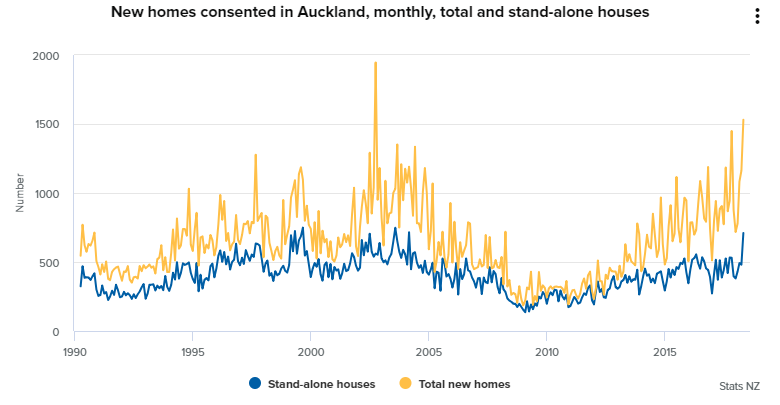
In terms of year-to date figures, Auckland has consented 5,272 dwelling units in the five months to the end of May. That compares with figures of 3,865 up to May 2017 and 3,512 for the five months to May 2016.
The figures so far for 2018 do then suggest that we could be on track for a record number of new dwelling unit consents in Auckland this year - certainly since Stats NZ started breaking down the figures in 1991.
This is how the recent calendar year consents figures have looked for Auckland.
| Auckland dwelling units Building consents (Annual-Dec) | |
|---|---|
| Year | Number |
| 2002 | 12,182 |
| 2003 | 11,307 |
| 2004 | 12,115 |
| 2005 | 7,707 |
| 2006 | 7,210 |
| 2007 | 6,110 |
| 2008 | 4,308 |
| 2009 | 3,475 |
| 2010 | 3,603 |
| 2011 | 3,772 |
| 2012 | 4,582 |
| 2013 | 6,310 |
| 2014 | 7,632 |
| 2015 | 9,251 |
| 2016 | 10,026 |
| 2017 | 10,867 |
You can extrapolate from the above figures that in 2016 the last seven months of the year saw a bit over 6,000 consents for Auckland, while last year about 7,000 were consented in the last seven months.
So, even if the last seven months of 2018 only match the last seven months of 2017 then this calendar year is going to well and truly break the 12,000 and likely will be a record high since the breakdown of figures was commenced by Stats NZ in 1991.
What comes next then is the big test.
How much higher, if at all, can those figures be pushed?
The KiwiBuild initiative should help, though clearly, getting traction for that has proved harder than this Government was foreseeing. And there remains the question of how much genuinely 'new' activity Kiwibuild might promote and how much will simply replace existing private sector building initiatives.
I think if you look closely at the figures, particularly from the trough of activity back in 2009, the clear thing that comes to mind is just how long - far too long, I would say - the rubber band has taken to wind up and get the industry producing big volumes of houses.
We are talking nearly 10 years from the pit of the GFC to now a point at which the activity is close to - but arguably not quite - keeping up with Auckland's rate of population growth. And keeping up with the population growth won't be enough. We need some serious catch up.
What lessons can we be learning from this - and from the very, very long time it has taken to significantly increase building activity?
These figures show you that the industry has not been responsive enough to demand in a timely fashion. It's been like an oil tanker turning around.
Sure, right now the emphasis has got to be on removing the existing shortage of housing, particularly in Auckland.
Avoiding in future
But parallel with this, I think we need to be thinking seriously about how such a situation can be avoided in future.
We need as a nation to find a way of both scaling up and scaling down housing construction in a timely fashion.
Having a nearly 10-year timeframe in terms of a trough in activity to now a new peak is just way too long.
KiwiBuild can't be the beginning and the end in terms of the Government's role in ensuring enough housing.
Ideally it would be good to see targets set for ongoing numbers of houses to be built annually - and with the ability to adjust the targets according to population demands.
Retain state involvement
It can't just be left to the private sector. How the Government does ensure a minimum number of houses is built every year is certainly problematic. But we do need to find a way.
Whether there is an ongoing, KiwiBuild facility/mechanism with production that can be scaled up or down according to requirements is maybe something that could be considered. The idea could be that if the pace of private sector development is for whatever reason flagging, the Government (AKA the taxpayer) can step in and step up housing production. Would it cost us too much? Well, there's a social price to pay for not having people properly housed. We might just have to find a way to afford it.
Maybe that all sounds like putting the cart before the horse given we haven't fixed the current housing shortage yet. But the point is, there's no reason why future solutions could not be looked at in tandem with fixing the present problem.
If we just stick a sticking plaster over the housing problem now then the problem will re-emerge again later.
As a nation we would be selling ourselves short if we allowed that to happen.
This should be the last time
Let the current shortage and housing crisis be the last time we have such a problem, that's what I say.
For now the building activity figures need to be watched closely to see whether the industry can be geared up further.
If the consents figures do start to lag again in coming months we will know that - KiwiBuild or no KiwiBuild - more action is needed.
Nobody is suggesting these issues are easy. But they do need to be tackled head on. That's something we've not done in the recent past and we are now paying the social price.
We welcome your comments below. If you are not already registered, please register to comment
Remember we welcome robust, respectful and insightful debate. We don't welcome abusive or defamatory comments and will de-register those repeatedly making such comments. Our current comment policy is here.