

Home loan borrowers were convinced in 2024 that future fixed rates would be lower.
And the turn lower of the OCR encouraged that view.
But history clearly shows that even though the OCR may fall, mortgage rates don't fall as fast.
So, if the OCR continues to fall in 2025 - and wholesale markets are suggesting that, absent new unexpected conditions that need to be prices in - then will fixed rates follow - but at a slower pace?
Despite the barbeque philosophy that "banks will conspire to keep them up", that in fact probably won't be the reason, just as it wasn't in earlier similar cycles.
Banks are constrained by regulation. They have core funding and mismatch regulations to meet. In turn that means they must raise an outsized share of their funds in the "non-market" sector (that is, from depositors). They will need to pay enough to stay competitive on the term deposit and savings account front no matter what the OCR is. And in 2025 they will have to start paying the deposit guarantee levy. (You can see our analysis of the term deposit sector here.)
And behind all that is the "market sector" where they raise wholesale funds. And at present, it seems clear that international rates will remain relatively higher for longer as some major economies are still struggling to tame inflation, especially the US.
Paying 'more' for local savings, and paying 'more' for wholesale funding, will inevitably mean fixed rate mortgages won't fall as fast at the OCR is expected to.
History also shows this. Prior to 2008, the difference between the one year fixed rate and the OCR averaged +1.25% over the six years we tracked. Then the OCR fell sharply as the GFC bit, and from 2009 to early 2023 that same margin averaged +2.70%. But then this latest trimming cycle for the OCR has gathered pace, and that difference has fallen to just over +1.50%. And that cycle is still far from finished.
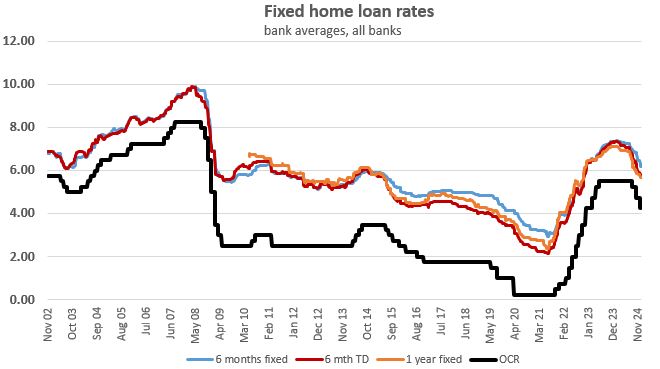
And if we just hone in on 2024, this is what it shows.
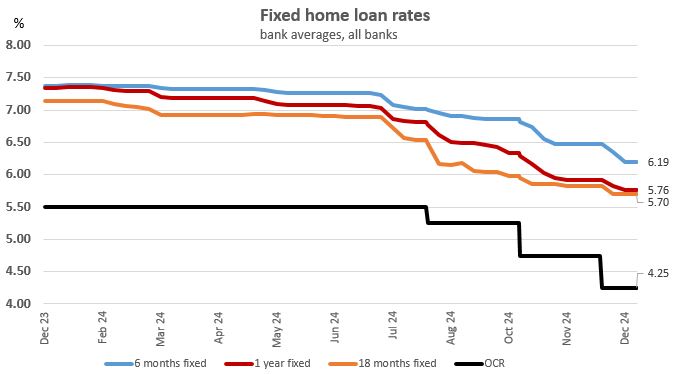
You should go into 2025 with your eyes open to the fact that fixed rates are unlikely to fall in lockstep to the OCR.
Of course, the average shift varied between mortgage lenders..
The following table tracks the net change from where we started the year, to where we finished.
| January 2024 | December 2024 | |||||
| carded rate offers | 6 mth | 1 year | 18 mth | 6 mth | 1 year | 18 mth |
| % | % | % | % | % | % | |
| Main banks | ||||||
| ANZ | 7.35 | 7.39 | 7.15 | 6.24 | 5.79 | 5.59 |
| ASB | 7.39 | 7.39 | 7.15 | 6.19 | 5.79 | 5.59 |
| BNZ | 7.39 | 7.35 | 7.15 | 5.99 | 5.79 | 5.59 |
| Kiwibank | 7.39 | 7.35 | 6.15 | 5.79 | ||
| Westpac | 7.39 | 7.39 | 7.19 | 6.19 | 5.79 | 5.69 |
| Challenger banks | ||||||
| Bank of China | 7.09 | 6.99 | 6.24 | 5.79 | 5.59 | |
| China Construction Bank | 7.19 | 7.09 | 6.89 | 6.24 | 5.79 | 5.59 |
| Cooperative Bank | 7.30 | 7.30 | 7.15 | 6.09 | 5.79 | 5.69 |
| Heartland Bank | 6.99 | 6.89 | 5.49 | 5.39 | ||
| ICBC | 7.19 | 7.05 | 6.95 | 5.99 | 5.79 | 5.59 |
| SBS Bank | 7.55 | 7.55 | 7.25 | 6.24 | 5.89 | 5.59 |
| TSB | 7.39 | 7.39 | 7.19 | 6.19 | 5.69 | 5.79 |
So then the question becomes, what will happen in 2025?
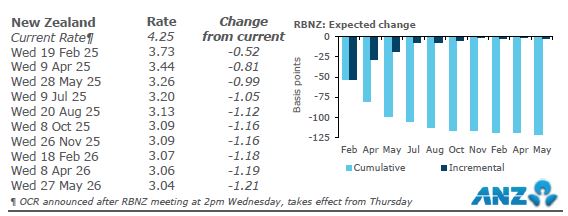
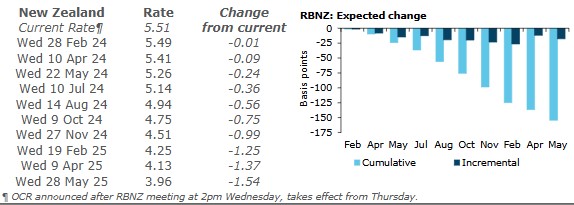
Regular readers will know that we don't predict or forecast future rate levels. But the financial markets do, by setting forward pricing. This isn't infallible, and as each circumstance changes, that pricing is adjusted (as it should be). In 2024 there were many adjustments, so what these markets priced for 2025 at the start of 2024 turned out to be quite different to what they priced at the end. No-one should be surprised. That is just how financial market pricing works, and always has done. (We have extracted the January 2024 version of the table below to show just how much these "priced in" levels have changed since the beginning of 2024.)
This is what is priced in as at December 20, 2024, for the year ahead when looking at the OCR.
We can add that to our 2024 charting. That might help you think about what could be in store for fixed mortgage rates in 2025. Stay short? or go long from here? Nobody knows the future, especially spruikers pitching their products. Your judgment will be as good as anyone's, and probably better than anyone conflicted by salesmanship. If it seems to good to be true, it almost certainly is.
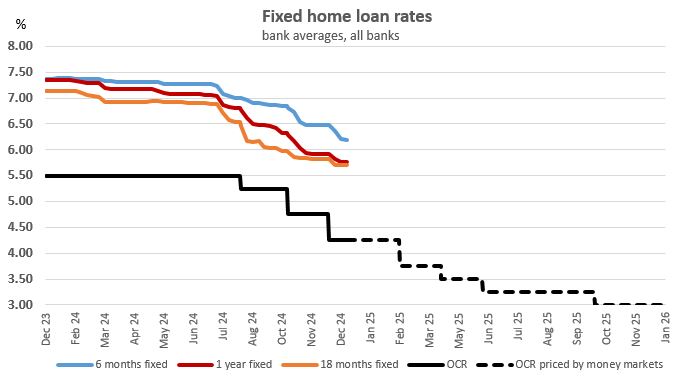
Just remember, international events have a big influence on the New Zealand cost of money. The RBNZ's OCR isn't the banks' cost of money. It is the actual deposit and wholesale funding (and capital) that makes a bank's funding base, and not the OCR. The OCR has an influence on these things, especially at the very short end (less than one year funding). And even then, it is only one influence.
By going or staying short, you are gambling that your current judgment will still apply when you next need to make a mortgage rate decision. By then the wholesale money markets will have re-priced their positions. You could be facing the quite different outlook, even if the OCR has fallen more.
And as we saw above, at very low rates, the OCR has even less influence on the cost of money for banks. Fixed home loan rates will track the OCR less and less as the OCR falls.
For reference, here is what was priced in at the start of 2024.
We welcome your comments below. If you are not already registered, please register to comment
Remember we welcome robust, respectful and insightful debate. We don't welcome abusive or defamatory comments and will de-register those repeatedly making such comments. Our current comment policy is here.