

If re-elected into government, the ACT Party wants to remove tax on qualifying investment earnings inside KiwiSaver funds, saying this will allow returns to remain invested and compounding tax-free.
This policy would also apply to non-KiwiSaver superannuation schemes too.
And alongside this, the party says it will end the KiwiSaver government contribution for members receiving employer contributions “and replace it with substantially greater tax relief inside their KiwiSaver accounts.”
ACT leader David Seymour made this election policy announcement on Sunday at the party’s 2026 election campaign launch.
Currently if the KiwiSaver scheme someone belongs to is a widely-held superannuation fund, their investment earnings are taxed at 28%. And if a person's KiwiSaver scheme is a Portfolio Investment Entity (PIE), their investment earnings are taxed at a Prescribed Investor Rate which can be 28%, 17.5% or 10.5%.
KiwiSaver has been a hot topic this election with Labour, National and New Zealand First making sweeping promises to change up the savings scheme.
“Other parties want to force your money into KiwiSaver, then tax you. ACT says it should be your choice, but if you save for the future we will let you get the full benefit of compounding returns instead of taxing you every step of the way.”
The party’s policy document says because KiwiSaver earnings are taxed every year, this doesn’t just remove the tax paid today. “It also removes every future return that money could have earned.”
“Sensitive rules will be put in place to protect the integrity of the tax system and ensure that KiwiSaver remains a genuine retirement savings vehicle and not a way to shelter large existing investment portfolios from tax.”
Seymour says other parties at this election want “to make New Zealanders put more money into their KiwiSaver, leaving less in their back pocket to fund today’s cost of living.”
“ACT is the only party proposing to stop taking money out of their KiwiSaver through taxes.”
He says ACT’s proposed changes mean more of people’s investment returns stay invested and more money is left to compound over someone’s working life.
“This policy would help a 20-year-old builder earning $60,000 save an extra $209,486 by the time they turn 65. A 50-year-old office manager earning $80,000 will have an extra $20,878 by the time they turn 65,” Seymour says.
“We would also end the KiwiSaver Government Contribution for members who receive employer contributions, replacing it with the new tax treatment inside their accounts.”
At the moment, people contributing to KiwiSaver between the ages of 16 to 65 and making an annual taxable income of $180,000 or less can receive a maximum government contribution of $260.72. To get this government contribution, people must contribute at least $1042.86 of their own money between July 1 to June 30 each year.
ACT’s policy document says: “The only real winner from this money-go-round is the bureaucracy that clips the ticket along the way. ACT would rather stop taking the money in the first place.”
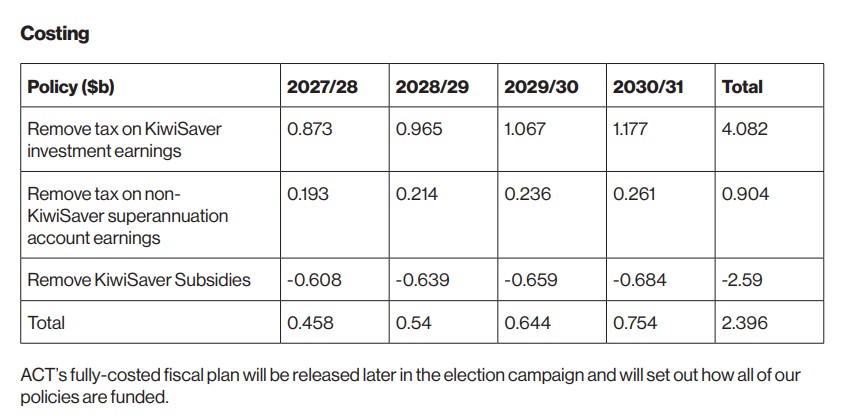
Though ACT has yet to release its fully costed fiscal plan, the party estimates that removing tax on KiwiSaver investment earnings would be $873 million in 2027/2028, $965 million in 2028/2029, $1.067 billion in 2029/2030 and $1.177 billion in 2030/2031 - totalling $4.082 billion.
By removing tax on non-KiwiSaver superannuation account earning, the party’s policy document suggests this would cost $193 million in 2027/2028, $214 million in 2028/2029, $236 million in 2029/2030 and $261 million in 2030/2031. This amounts to a total of $904 million.
ACT also estimates that by removing KiwiSaver subsidies, this would have a negative costing of $2.59 billion over the forecast period.
The total costing for this policy over the forecast period totals $2.396 billion.
“A country builds wealth when more people own assets, have savings, invest in productive enterprise and have the confidence to think decades ahead," Seymour says.
Speaking to an audience of party faithful at ACT's campaign launch, Seymour says the policy was part of its fully costed Alternative Budget.
“We declare it will reduce Government revenue by around $1 billion per year. We will show in that budget how this is achievable.”
ACT's alternative budget is expected to be released in the coming weeks.
ACT to campaign 'like the future of this green and pleasant land is hanging in the balance, because it is'
Seymour also called this year’s election, the “productivity election.”
“A productivity election is a different election. In a productivity election, we ask a different question. Where does wealth come from?"
“In a productivity election, there is no point in Government attacking businesses. Consumers need them to succeed. We need them to invest and innovate. They need their government policy to uphold their rights, not be the biggest risk.”
“That starts with politicians understanding productivity,” he says.
For five weeks, Seymour says ACT will campaign “like the future of this green and pleasant land is hanging in the balance, because it is.”
“We will fill the halls, pound the pavements, stuff the letter boxes, and post on social media, to bring a message of hope," says Seymour.
“There is no reason why we cannot be the wealthiest on earth … We must overcome our self-doubt as a nation, and rediscover where wealth truly comes from, then set about solving our problems with calm, clear analysis until our troubles are overcome.”
Read the party's policy document here.
We welcome your comments below. If you are not already registered, please register to comment
Remember we welcome robust, respectful and insightful debate. We don't welcome abusive or defamatory comments and will de-register those repeatedly making such comments. Our current comment policy is here.