

A survey commissioned by Payments NZ suggests surcharges are now the main reason people decide not to use contactless payments, with enthusiasm for contactless payments declining among older people.
The latest iteration of Payments NZ's biennial consumer research, via a survey of 1,000 New Zealanders aged 18 and over, shows at least 84% of respondents use contactless payments at least sometimes. However, at 93%, surcharges have overtaken security concerns as the main reason respondents cite for not using contactless payments.
And the use of contactless payments among older people appears to be on the slide.
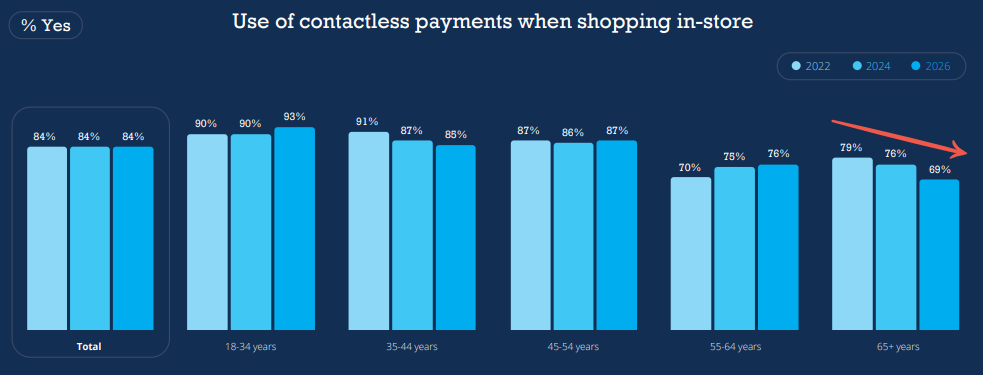
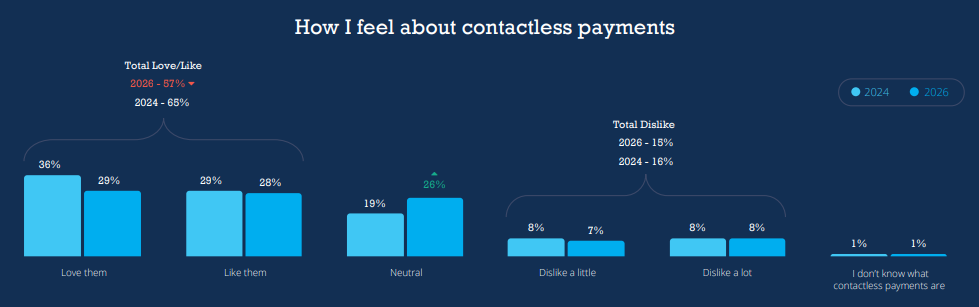
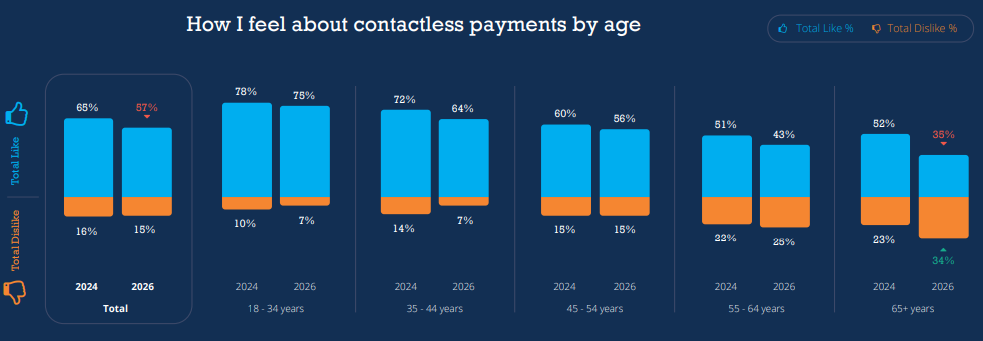
"Older respondents are less positive about contactless payments overall. Among those aged 65 and over, sentiment has declined since 2024, with 35% saying they like contactless payments and 34% saying they dislike them. Usage among respondents aged 65 and over has also declined, from 79% in 2022 to 69% in 2026," Payments NZ says.
"This may reflect growing awareness of surcharges, or it may indicate that contactless payments are increasingly seen as an expected part of the payments experience rather than something people feel strongly positive about."
"The contactless findings show how convenience, affordability and trust intersect. Contactless is valued because it is fast and familiar, but surcharges are changing behaviour and softening sentiment. This matters for the future payments system because payment options that are easy to use may still lose consumer support if people see them as adding cost or reducing control," Payments NZ says.
A surcharge is an additional fee levied on a purchase to cover costs not included in the original price of a product or service. They're commonly charged to consumers using a payment method such as credit cards or contactless debit cards that are more expensive for a seller to provide than say, inserting or swiping a debit or Eftpos card.
Surcharging has been an ongoing area of political debate, with the National Party proposing to ban surcharges but failing to secure the required support in parliament to do so.
Business lobby groups have pushed back against a blanket ban on surcharges, suggesting they be capped instead. They say a ban would unfairly shift costs onto all customers, including those using low-cost payment methods such as Eftpos, and hit small and medium businesses hard. There've also been warnings that banning surcharges would see an even bigger slice of NZ payments go contactless, and be processed through Mastercard and Visa's overseas networks.
Aussie surcharge ban wobble
Meanwhile, Australia's surcharge ban has run into trouble with the Australian Taxation Office (ATO) announcing it would stop accepting credit card payments for tax bills from December in response to the ban on surcharges. The ATO said, as a government agency, it wouldn't be appropriate for the cost of credit card merchant fees to be transferred to the community. The ABC reports the ATO argued it would cost about A$200 million a year to absorb the fees and said only 5% of small businesses used a credit card to pay their tax bill.
The ATO now says, after talks with the Government and "the provision of transitional funding," it'll continue accepting credit card payments for tax obligations until June 30 next year.
Payments NZ's consumer research began in 2020 and has occurred every second year since. This year's research was conducted through Yabble and Dynata online market panels in June. It says it surveyed a nationally representative sample of 1,000 New Zealanders aged 18 and over, balanced for age, gender, region and ethnicity.
Systems managed by Payments NZ, whose shareholders are ANZ NZ, ASB, BNZ, Citibank, HSBC, Kiwibank, TSB Bank and Westpac NZ, transact more than $8 trillion a year.
Interchange decision near
Separately, the Commerce Commission says it will publish its final decision and reasons paper on commercial credit card interchange fee regulation for the Mastercard and Visa networks later this month.
"As a result of submissions, the Commerce Commission has made the decision to regulate commercial credit card interchange fees," the Commission says.
"We have heard the feedback and wanted to provide assurance that there will be a six-month implementation period from the date of publication before the new requirements take effect."
Interchange fees are charged by the financial institution, typically a bank, on one side of a payment transaction to the financial institution on the other side of the transaction. A typical card transaction involves four parties; the cardholder, the cardholder's financial institution (the issuer), the merchant and the merchant's financial institution (the acquirer). For most card transactions, the interchange fee is paid by the acquirer to the issuer.
Visa and Mastercard point out, unlike their scheme fees, interchange doesn't generate revenue for them. However it underpins and grows their networks and is the biggest component of merchant service fees paid by merchants to their banks. The Commission says interchange provides a revenue stream incentive for entrance and expansion in supplying Mastercard and Visa cards. It acknowledges this revenue can also contribute to covering the costs of issuing credentials, including producing physical cards and investing in anti-fraud services and technology.
The charts below come from Payments NZ.
*This article was first published in our email for paying subscribers. See here for more details and how to subscribe.
We welcome your comments below. If you are not already registered, please register to comment
Remember we welcome robust, respectful and insightful debate. We don't welcome abusive or defamatory comments and will de-register those repeatedly making such comments. Our current comment policy is here.