

When interest rates are low, or lower than inflation, you need every advantage you can get.
Savers have an advantageous choice about how they save, using a PIE (portfolio investment entity), a unique Kiwi investment fund structure that pays tax on your behalf based on your Prescribed Investor Rate (PIR) rather than your standard personal income tax rate.
This type of managed fund is designed to encourage savings for retirement. They are commonly used by KiwiSaver schemes, but they are also widely used for bank savings. Some non-bank institutions offer them too.
Their basic advantage is that they will save you some income tax. Interest on term deposits is added to your other income and taxed at the rate that applies for your earnings level. (Tax is almost always deducted by the savings institution before you receive the interest earnings, but any variation between what is deducted and your actual end-of-year tax liability is still payable).
But in a PIE, the fund itself pays tax on the earnings, and distributes your share on a tax-paid basis. What you get from a PIE fund does not get added to your personal tax accounting with the IRD.
PIE funds pay tax at the company rate of 28%. (*See note below.)
So if you have a marginal tax rate above 28%, you are probably better off having your savings in a PIE from a tax viewpoint.
You'll often see PIE term deposit rates alongside 'equivalent returns' or something similar for the 30%, 33% and 39% tax rates. It's a point of confusion for many investors. So here is what those higher rates mean:
First, you will always get the tax-paid return in your bank account (the grey after-tax rate in the table below).
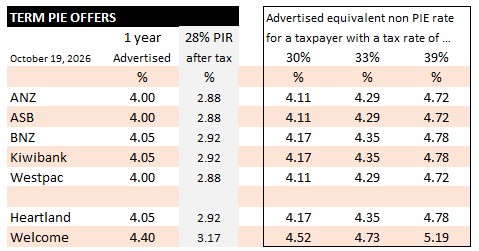
But, if you earned that tax-paid return when your marginal tax rate was 33% (say), then that is the same as having that investment paying a higher rate. In the ANZ example above, a 4.00% PIE term deposit will give you the same after-tax return as a 4.29% deposit that is not a PIE. In both cases the net tax-paid return is 2.88%, but the PIE version is equivalent to a 4.29% standard TD at a 33% tax rate.
Of course, the devil is in the detail. Rate comparisons get tricky when interest is paid or compounded differently between the two options. Tax is deducted every time interest is paid or compounded. The more often that happens, the simple "equivalent" calculation is distorted. That isn't material for small balances, but for large balances it can be noticeable.
Our table of Term PIE rate offers from financial institutions is here. For Cash PIEs, here.
The best way to work out in advance what your tax-paid results will be, and to compare a PIE with a standard term deposit is to use this calculator. Remember to set the term (period), reinvest and compound settings accurately.
Term deposit calculator
An even then, the calculator is only giving a good estimate. Only your bank can give you the definitive expected results.
Note: * If your marginal income tax rate is lower than 28% you can still use a PIE term deposit. Just make sure you advise the bank your correct PIR, which could be 10.5% or 17.5%. You can work out your PIR rate here. Even at these lower rates, your tax benefits could be significant. For example, if your marginal income tax rate is 30%, your PIR could be 17.5%. If your marginal income tax rate is 17.5%, your PIR could be 10.5%. These are savings worth having.
This is an explainer, and not advice to choose one type of term deposit over another. To make that assessment you should seek the counsel of a registered financial adviser.
Where the PIE fund invests in bank or registered non-bank financial institutions deposits (and all the PIE term deposits do) then the Depositor Compensation Scheme coverage applies. (Third-party managed funds are not bank deposits and are generally excluded from DCS protection.)
We welcome your comments below. If you are not already registered, please register to comment
Remember we welcome robust, respectful and insightful debate. We don't welcome abusive or defamatory comments and will de-register those repeatedly making such comments. Our current comment policy is here.