

Inland Revenue has released the latest update of the Government's Tax and Social Policy Work Programme setting out its priorities in tax policy. The programme's main priorities remain simplifying the tax system, reducing compliance costs, addressing integrity risks, improving fiscal sustainability and increasing productivity.
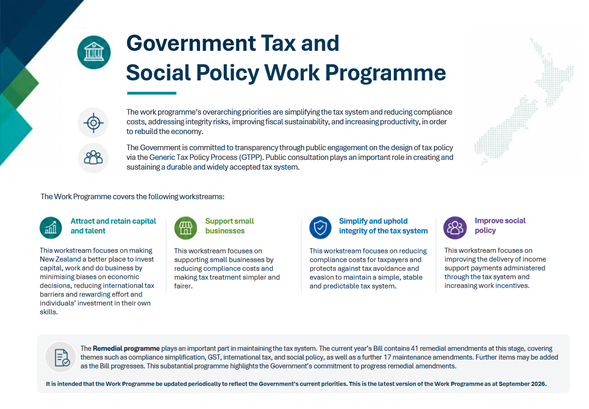
The update also summarises what progress has been made since the last update was issued last year and the future priorities under four main work streams. They are attracting and retaining capital and talent, supporting small businesses, simplifying and upholding the integrity of the tax system and improving social policy.
Attracting and retaining capital and talent
As examples of the initiatives in this area include refining and evaluating the investment boost, reviewing the foreign investment fund tax rules and the impact of financial arrangements rules on new migrants both of which are in this year's tax bill. A heap of new or renegotiated double tax agreements including with Austria, Germany, the Netherlands, Sweden, Chile, South Korea and the United Kingdom.
A big initiative (at least on paper) is work on “a multilateral solution to the challenges to the digital economy,” i.e. the United Nations and OECD Pillar One and Pillar Two work. There’s also reviewing the tax treatment of crypto assets where there has been a lot of Inland Revenue audit activity.
Simplifying and upholding the integrity of the tax system
In this space, the new tax bill includes changes to the taxation of charities and not-for-profits. Other initiatives include clarifying the income tax treatment of software development expenditure, reviewing the tax treatment of interest allocation for bank branches and the support of all-of-Government response to organised crime. (More on this below in relation to Inland Revenue’s annual report).
Supporting small business and improving social policy
In terms of supporting small business, there’s changes to simplifying fringe benefit tax and progressing some GST items coming out of the recent GST issues paper. Improving the tax treatment of expenditure and flood damage and land improvements is another objective along with improving the effectiveness of the Research and Development Tax Incentive.
And finally, in improving social policy, the intention is to “improve” FamilyBoost, including investigating a possible direct data feed with early childhood education centres. Also progressing Working for Families improvements.
This is all good, but I do think one of the problems with Working for Families and social policy is the interaction between the social security system, tax and the impact of abatements isn't being properly addressed. As I've said repeatedly, the result is that those receiving social assistance have some of the highest effective marginal tax rates in the country. There's nothing in this updated work programme which suggests this issue is going to be tackled.
Who knows all this may change if there is a change of government. If that happens most of this programme would get sidelined to deal with any major changes such as introducing a capital tax of some form. Such a major change would take up a lot of Inland Revenue's resources.
Inland Revenue’s Annual Report
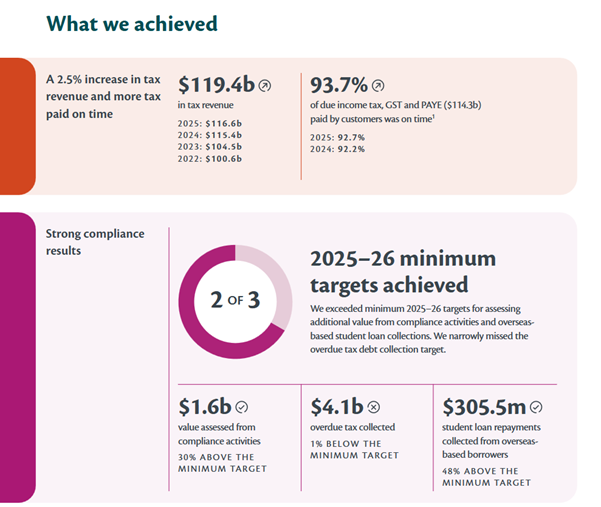
Speaking of Inland Revenue, its annual report for the year ended 30th June 2026 was released late last month. It comes in at a ‘slim’ 193 pages and as always there's plenty to digest. Pages 12 and 13 of the report, have a quick summary of the Department’s main achievements. The first headline is a 2.5% increase in tax revenue to $119.4 billion and 93.7% of all income tax, GST and PAYE due paid on time compared with 92.7% in the June 2025 year. Thanks to inflation and fiscal drag tax revenue will rise every year so the more noteworthy achievement is increasing the amount of tax paid collected on time.
“Strong compliance results”
Reporting “strong compliance results” Inland Revenue exceeded minimum targets for assessing additional value from compliance activities and overseas based student loan collections. For example, the $1.6 billion “value assessed” from compliance activities was 30% above the minimum target. However, it “narrowly missed the overdue tax collection target” with $4.1 billion of overdue tax collected which was just $57 million below its target. That said Inland Revenue exceeded the combined targets across the 2024–25 and 2025–26 years by $148.4 million. This included $305 million of student loan repayments from overseas-based borrowers which was 48% above the minimum target.
There are plenty more little headlines to note. Customers (that’s taxpayers to you and me) reported 74% satisfaction with their last interaction with Inland Revenue and 70% said they found it easy to deal with Inland Revenue. It now costs 47 cents to collect $100 in tax slightly up on 46 cents per $100 last way and considerably lower than the 80 cents per $100 back in 2015 prior to Business Transformation. Overall, Inland Revenue reports it met 87%, or 27 of its 31 output service targets.
Tax debt continues to rise, but more slowly
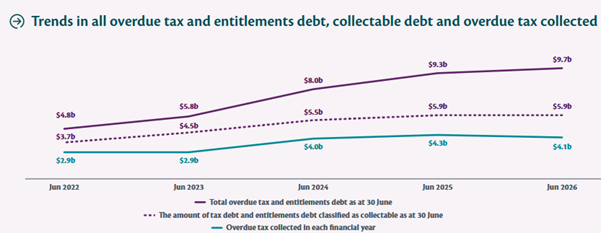
Managing tax debt is a key issue and as noted above Inland Revenue missed its target for collecting overdue tax debt. The amount of total tax debt rose from $9.29 billion as at 30th June 2025 to $9.66 billion by 30th June 2026. The key thing is that the growth in that debt has slowed down. For example, in the year to June 2025, the annual growth and overdue debt was 13.7%. This year it was 4%. And given that the economy has been in a prolonged slowdown, that's not a bad effort.
Slowing the trend in growth of overdue debt is itself a key achievement. The amount overdue has rapidly accelerated since June 2022, going from $4.8 billion then to just under $9.7 billion by June 2026. It’s interesting to see that collections of overdue tax rose from $2.9 billion in the June 2022 and June 2023 years to about $4 billion a year for the last three years.
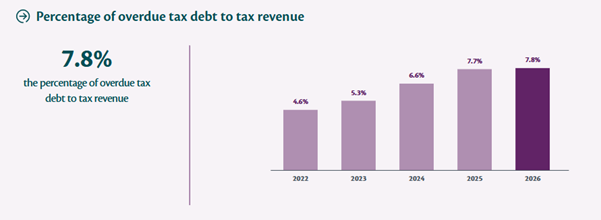
The growth in overdue tax debt also means the percentage of overdue tax to debt revenue is now 7.8% up from 4.6% in the June 2022 year.
A change of approach to managing tax debt
In terms of debt management, the report notes with over 500,000 taxpayers owing debt, Inland Revenue has had to revise its approach by looking to intervene earlier to prevent debt growing before recovery becomes more difficult.
“We have shifted our approach in recent years towards preventing debt from arising, resolving it earlier and taking stronger action when necessary. Early indicators show this is slowing debt growth and stabilising new debt levels.” [page 57 of report]
Inland Revenue has managed to reduce the total number of taxpayers with overdue debt from 527,000 in June 2025 to 524,000 many of whom are small businesses and sole traders. The focus has been on overdue GST and employer deductions, such as PAYE which represent 58% of overdue tax debt.
Sharing data with credit reporting agencies – from zero to 145
Inland Revenue has a lot of tools available to it. One is the ability to share tax debt information about a company with credit reporting agencies if the amount exceeds $150,000. According to page 58 of the report, although this option has been available since 2017, only 17 companies had been reported between introduction and 30th June 2025, and none were reported in the 2025 year.
The June 2026 saw a big change with 145 companies with debt reported to credit reporting agencies, in other words, reporting went from zero to 145. A total of 292 companies were either reported or received a letter of intent to report. This is one of the more significant change of tactics by Inland Revenue in recent years. As the report notes:
“Early indications suggest our reporting does affect a business's credit profiles and improves the information available to lenders and suppliers.”
Notifying credit reporting agencies could be seen as bit intrusive and a breach of privacy. On the other hand, if you're a small contractor dealing with a company that's behind on its tax debt, and you don't know, you could be throwing good money after bad. So, the policy has wider ramifications than just collecting tax.
Deduction notices
Inland Revenue is also picking up on the use of deduction notices. These can be issued under section 157 of the Tax Administration Act 1994 which enables Inland Revenue to issue a deduction notice to a taxpayer’s bank or some other person and require payment of an amount because the taxpayer has a tax debt. 106,870 such notices were issued during the year, up over 20% from the 88,380 issued in the June 2025 year.
Inland Revenue also has the ability to issue statutory demands, 1760 for the year and commence liquidation proceedings. In the 2026 year it referred 1,533 companies for liquidation up from 1,459 in the 2025 year. 734 liquidation orders were granted for the year compared with 650 for 2025.
“Non-collectable debt”
One final point about debt and one of the issues Inland Revenue may struggle with is the over $5 billion of debt more than two years old. By Inland Revenue’s own admission, the focus on more recent debt means older “non-collectable debt cannot currently be recovered because it is usually tied up in processes such as insolvency disputes or legal action.”
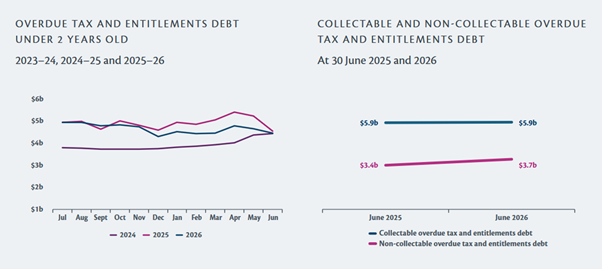
This issue is a hurdle Inland Revenue must get over in terms of its collection of overdue tax. In its own view, debt management needs a “sustained focus” and I agree. That said the current early intervention approach, promptly dealing with taxpayers with overdue GST and PAYE is very definitely the right approach.
Maintaining the integrity of the tax system – tackling organised crime
As mentioned earlier one of the Government’s priorities for Inland Revenue in terms of upholding the integrity of the tax system, was supporting the Government’s efforts to combat organised crime.
This is most clearly visible on page 31 of the report which shows the information sharing with the New Zealand Customs Service, New Zealand Police, Serious Fraud Office and other agencies.
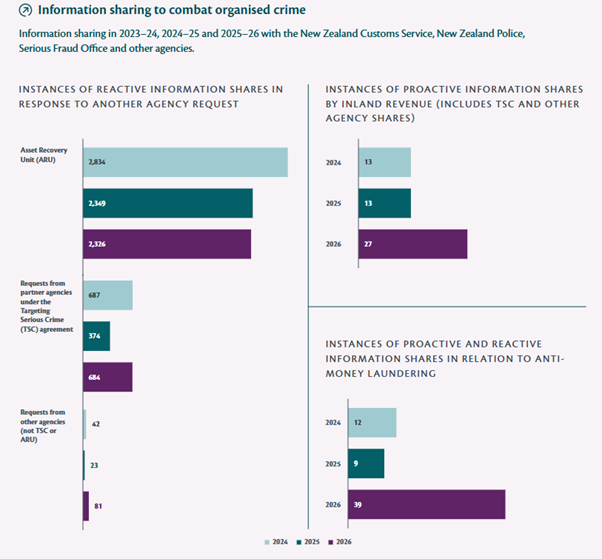
.
What the data shows is something I tell all my clients. Inland Revenue shares vast amounts of information not only with other New Zealand government agencies but also with other authorities around the world. I think people are just a little blase about what exactly all this might mean. But deployed effectively, information sharing should combat organised crime.
Information sharing in general
There are some interesting details about disclosures deep into the report. Page 182 has details of information sharing with New Zealand Police, New Zealand Customs and the Serious Fraud Office and the outcome of that sharing. For example, in 2026, the New Zealand Police made 740 requests for information, which was more than double the requests made in the 2025 year. Customs asked for 17 in 2026 compared with six previously. The SFO only asked for nine compared with 16 in 2025.
In the case of the New Zealand police, 165 requests resulted in prosecution, three more with a warning, and 312 were still under investigation.
The Ministry of Social Development is the agency with which most information is shared, unsurprisingly given the range of services includes NZ Superannuation, benefits, Student Loans, Child Support and Community Services Cards.
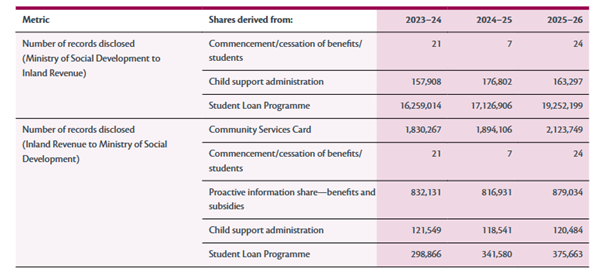
There were also 53 referrals in the year for suspected benefit fraud in relation to benefits. That’s up from 14 for the 2025 year and none for the 2024 year. The increase in referrals can be seen as part of the general crackdown on beneficiary fraud.
Improved Inland Revenue compliance activities
The 2024 and 2025 Budgets included additional funding for Inland Revenue for compliance activities. According to the report over the two years ended 30 June 2026, the value of excess assessed from compliance activities was nearly $3 billion or 34.6% above the two-year target. The overall return from compliance activities was $11.98 for every dollar spent. This is not surprising. It's well known that if Inland Revenue is given the resources, it will deliver the results.
On that point, I'm disappointed to see that Inland Revenue has been marked out for more baseline cuts going forward to meet the Government's financial targets. As a tax agent, I have to say that I've been disappointed with some of the issues that I've been seeing with Inland Revenue on this and access to agent account managers has become very difficult.
“Targeted, proportionate enforcement”
Page 55 of the report has some interesting commentary and detail about the targeted enforcement undertaken by Inland Revenue. For example, it closed 800 more audits than in the last 2025 year and identified $1.2 billion in audit discrepancies.
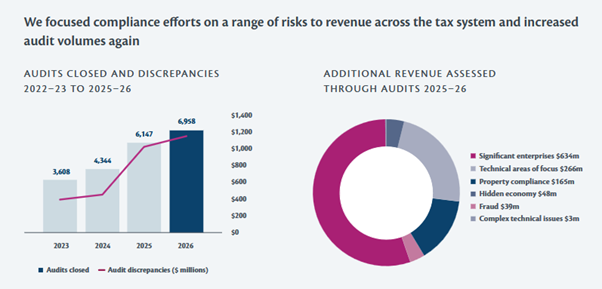
Property compliance activity focused on GST avoidance by property developers, Brightline transactions and undeclared rental income. The discrepancies identified through that programme total $261 million, up 32% on 2025.
It also targeted the hidden economy and in particular horticulture, which was,
“…a significant area of focus due to our identifying concerning practices, including cash payments to workers, complex labour contracting arrangements and failures to meet schedular payments obligations”.
As part Inland Revenue’s increased scrutiny of growers, contractors and subcontractors it opened 130 investigations into the horticulture sector during the year.
In the crypto area, there's a big ongoing review programme which has contacted 1,300 taxpayers and so far, has resulted in an additional $32.9 million assessed. This crypto review includes a number of very large disputes which Inland Revenue says involves tens of millions of dollars.
Increased workforce
Inland Revenue's workforce is now back up to 5,002, of which 4,875 are full-time equivalents with an average age of 44.2. The contractors’ headcount is 35, way down from 94 in 2023, which was the final year of the business transformation program.
However, there appears to be a fair amount of employee churn going on with total turnover said to be 9.9%. There were 846 new hires during the year, which is getting on for close to 15% of the workforce. And the average length of service has gone from 14 years in 2022 to 11.9 in 2026. I have mixed views about the staff changes. Refreshing the workforce is always necessary, but institutional experience going out the door could be a loss, particularly if, based on stories I've heard, some very experienced investigators have been allowed to let go.
Overall – a pass mark
Overall, I’d give Inland Revenue a pass mark for the year particularly given the difficulties the economy's had. It’s working much harder on collecting tax debt and is focusing on being proactive and intervening earlier. All welcome moves and in line with the Government’s objectives of maintaining the integrity of the tax system.
Hungary’s proposed wealth tax
Finally, this week, Hungary is proposing a wealth tax to apply to high-net-worth individuals, but also to assets within family-owned and cross-border asset structures. The tax will apply to net worth over 1 billion Hungarian Forints (approximately $5.5 million). An initial rate of 1% annually increasing to 1.5% on net wealth in excess of 100 billion forints (over $550 million).
It’s applicable on a global basis for Hungarian residents. Non-residents will be subject to the tax in respect of Hungarian real estate, and related property rights, as well as shareholdings in Hungarian companies and foreign companies holding Hungarian real estate. Quite apart from being the first wealth tax introduced in some time what’s also of note is it's expected to go into effect by the end of this year. It will be interesting to see how this plays out.
Anyway, that's all for this week. I’m Terry Baucher and thank you for listening. Please send me your feedback and requests for topics or guests. Until next time, kia pai to rā. Have a great day.
We welcome your comments below. If you are not already registered, please register to comment
Remember we welcome robust, respectful and insightful debate. We don't welcome abusive or defamatory comments and will de-register those repeatedly making such comments. Our current comment policy is here.