
Finance Minister Bill English says high income earners are now paying a bigger share of income tax than they were six years ago.
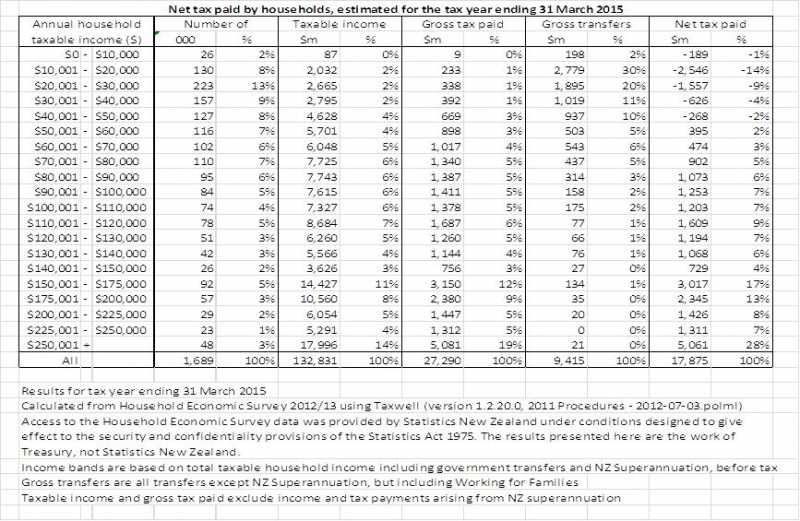
And he says that new data indicates New Zealand’s income tax and support system "continues to provide significant income redistribution, with households earning more than $150,000 a year forecast to pay 74% of net income tax in 2014/15, compared with 58% in 2008/09".
In support of his claims English produced the table below.
"Four years after the Government’s comprehensive tax reforms, latest data confirms that New Zealand’s income tax and support system significantly redistribute incomes to households in need," English said.
"It is now clear that higher income households are paying a larger share of income tax than they were in 2008."
English said the Government had maintained a redistributive income tax and income support system that supports low and middle income families and helps New Zealanders through times of need.
"So at any particular time, a large number of households effectively don’t pay income tax," English said.
"The amount these households pay in income tax is exceeded by the amount they receive from welfare benefits, Working for Families, paid parental leave and accommodation subsidies. That’s entirely appropriate for those families genuinely in need."
Using data from the Household Economic Survey, Treasury has updated information provided last year to include forecasts for the 2014/15 tax year.
The Treasury estimates that this year households earning over $150,000 a year – the top 15 per cent of households by income – will pay 49 per cent of income tax.
But when benefit payments, Working for Families, paid parental leave and accommodation support are taken into account, these 15% of households are expected to pay 74% cent of the net income tax. And that is before New Zealand Superannuation payments are counted.
It also excludes the impact of other aspects of the tax changes in 2010, including tightening property tax rules and compliance, and increasing GST.
By contrast, households earning under $60,000 a year – which is just under half of all households – are expected to pay 9% cent of income tax.
"When we take income support payments into account, as a group they will actually pay no net income tax at all," English said.
"That’s because the $2.5 billion of income tax they are expected to pay will be more than offset by the $7.3 billion they will receive in income support.
"It’s appropriate to maintain a tax and income support system that helps low and middle income households when they most need it.
"But people who call for even greater transfers to low income families, or who call for the top tax rate to be raised, need to be aware of how redistributive the tax and income support system already is," English said.
We welcome your comments below. If you are not already registered, please register to comment
Remember we welcome robust, respectful and insightful debate. We don't welcome abusive or defamatory comments and will de-register those repeatedly making such comments. Our current comment policy is here.