

By Elizabeth Kerr
There was once an era where you started work in an entry level position worked your way up through the organisation and eventually tipped out near the top and into retirement.
Your income grew as your jobs increased in seniority. It wasn’t discussed; it was just the way it was.
People under you looked forward to the day you announced you would be leaving so that they could jump into your spot. You didn’t discuss with anyone whether you wanted to retire or not it was just what you did once you reached that age. You were sent out to pasture regardless of how many racing years you still had in you for a life of walking the fairway or planting roses.
The perception was that you had done your time and now you deserved the quiet life. The secretary would organise an enormous cream cake. Everyone would down tools, gather in the staff room, sign a card, and clap jealously on your achievement. The boss would share a sincere speech before presenting you with an expensive gold watch; a symbol of your time being done.
Whatever savings you had collected, combined with the government's super scheme and the company pension scheme (if you had one) would be all that you needed until you became worm food.
Cut to the present day and that scenario is but a dream. The government super scheme is barely enough to pay for dry crackers and a breezy caravan on blocks. The newly skilled appear quicker, smarter and more excited about doing your job, and if you manage to survive the annual redundancy rounds until you are 65 you are considered blessed. The speech from your boss, cake and gold watch is replaced by a bulk email to all staff and a collection of loose change from your colleagues; enough to buy an unlucky lotto ticket.
The golden watch, aka retirement, is now pretty much your own responsibility and achieving your own golden watch is the penultimate in financial security. It need not be something you wait until your 60s to achieve. All it means is that you have enough money invested and can quite happily live off a portion of the returns until the end of time.
How much money you need for this has little to do with how much you earn and instead is mostly to do with how much you are spending. Because of this it is not restricted to time either. So why wait until you are in your 60s?
For example, If you earn $50k and save $15k (30%) each year then you can expect to retire much earlier than the person earning $150k who can only save 20k (13%) because your expenses as a percentage of your income are smaller. In this scenario you have made choices and designed a lifestyle which requires less money to manage than the person earning more.
| Person A | Person B |
| Yearly income - $50,000 | Yearly income - $150,000 |
| Yearly expenses - $35,000 | Yearly expenses - $130,000 |
| Golden watch savings - $15,000 | Golden watch savings - $20,000 |
| Percentage saved - 30% | Percentage saved - 13% |
| Years until early retirement - 28 | Years until early retirement - 43 |
Even though Person B saves more each year they have to save and invest for much longer to create a money machine that pays out enough to cover yearly expenses of $130k each year. They are going to have to curse their alarm clock, get up, make lunch, say goodbye to the kids and work for an additional 15 years before getting to live the free life!! 15 freaking years!! Person A could potentially sail around the world dozens of times before getting a chance to invite Person B along for the trip.
For those who are righteously saving just 10% of their income, as per popular budgeting advice, it will take you almost 51 years to achieve your own golden watch. There’s no easy way to say this, if that’s you then you are going to have to lift your game… or consider putting a down payment that caravan now.
In the book Early Retirement Extreme by J.L Fisker (average book in my opinion but I wanted to share his graph - see below), there is the following illustration which demonstrates how early you can leave the paid workforce based on how much of your individual income you can save.
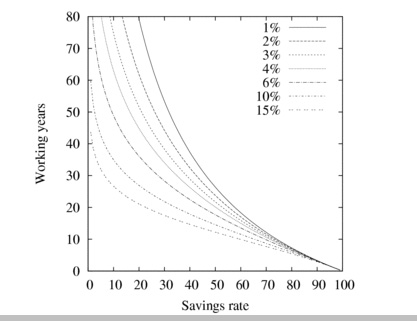
The interest rates on savings are listed at the top right hand side. I’ve assumed that Person A and B have been investing at just 5% over time. Where does your savings rate put you?
To summarise, your own golden watch/the penultimate in financial security is a mix of having money put aside AND creating a lifestyle which does not exceed your personal needs. It requires that you make active choices and design your spending to match your personal values, rather than bumping along this life and being emotionally manipulated into spending on things which are designed to keep you poor, employed and wanting for more.
In my opinion, there isn’t a piece of advice out there that will make you wealthier than what you have read here. I believe we have collectively taken our eye off the prize and been encouraged to look in the wrong direction to achieve financial security. We’ve been focussed and getting all giddy like a little girl on finding the best bargains, building a property empire, chasing the high interest returns, complaining about taxes and whinging about the system rather than just concentrating on what we do with the money we rightfully earn and then using it for our individual highest and best use.
It doesn’t matter if you’ve come to this late in the game or have just started your first job. For some of you these columns are going to totally play with your mind. So go and read the ground rules first and stick with me over the coming weeks as we explore more about my favourite topic – your golden watch!!
We welcome your comments below. If you are not already registered, please register to comment
Remember we welcome robust, respectful and insightful debate. We don't welcome abusive or defamatory comments and will de-register those repeatedly making such comments. Our current comment policy is here.