
By Katharine Moody*
One year ago, the Salvation Army released its State of the Nation Report, referring to the housing situation in New Zealand as having moved from crisis to catastrophe.
A particularly inequitable finding was that over time, increases in market rent have been the most severe in low-income neighbourhoods;
…looking at the percentage change over the past decade shows a worrying trend in rent increases. Communities like Fordlands in Rotorua (146%), Cannons Creek North in Wellington (100%), Huntly East in Huntly (91%), Highbury in Palmerston North (86%) and Papakura in South Auckland (83%) have seen enormous increases in rent over the past decade (pp. 35-36).
I looked at movement of market rents in the Hutt Valley (Dec 2020-Jan 2021) following the lifting of the COVID rent increase freeze. Plotting actual rent asking prices against the Lower Hutt median income (Census 2018) suggested that only three of the properties offered for rent could be considered affordable by households with median or lesser household incomes. I also found a 14% average rise in rental asking prices when compared with the previous six months bond data as provided by Tenancy Services.
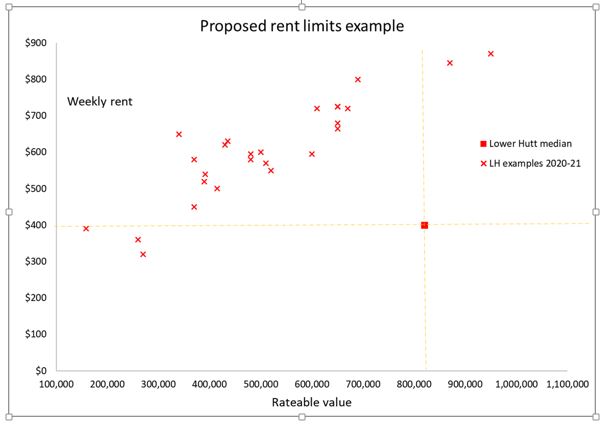
I subsequently considered whether there was a way to regulate the rental accommodation market whist avoiding the unintended consequences regarding overseas experience of rent controls.
Government measures to address housing affordability for renters
Following the Census 2018, StatsNZ reported that;
- Homeownership peaked in the 1990s, at 73.8 percent of households, but by 2018, homeownership had fallen to 64.5 percent of households. Homeownership rates have fallen in every region since 1991, with the largest falls in the Auckland region, which has well-documented affordability and supply issues.
- By 2018, just over 1.4 million people lived in houses they did not own [that number increased to 1.7 million in 2022], including 120,000 children under five years of age. Although private renting predominated for all age groups, almost one-third of renters aged 65 and over lived in social housing.
- Owners tended to have higher income levels and were more likely to be partnered than non-owners.
- Non-owner-occupiers had less security of tenure. They moved more often than owner-occupiers and were much less likely to have lived in their house for long periods of time.
- In 2018, the most common reason given by renters who had moved to another rental in the last five years was because their landlord ended their tenancy.
To address regulation of the private rental market, the current Labour government has focused on improvements to security of tenure; improvement to the health of homes; and industry tax changes (presumably with an intention to ‘level the playing field’ between investors and first-home buyers).
The latter tax changes have served to disenfranchise investors and hence (most likely) contributed to recent increases seen in rent prices.
These initiatives aside, successive government’s flagship, cost-of-living support for renters is the Accommodation Supplement. In 1991, the National government introduced the supplement, in concert with its abolishment of State Housing income-related rents. In 2000, the Labour government reinstated income-related rents for State House tenants (at 25% of household income). However the means-tested Accommodation Supplement has been retained by all governments since, as a transfer payment administered by MSD to qualifying households.
As rent prices have increased, the supplement has become insufficient to stem the affordability gap and it is suggested that in some regions, supplements need to double. Total expenditure in Vote Social Development for this line item, Accommodation Assistance was $2,411,065,000 (yes, billion) in 2021/22.
Further expenditure in Vote Housing and Urban Development relates to state (Housing NZ) and non-state (Community Housing Providers) monies appropriated.
Visualising the state’s total involvement in housing support is best illustrated as a continuum – from homelessness to home ownership. The Salvation Army’s recent publication, Tales from the Trenches: The realities of housing in New Zealand illustrates this (adapted from p. 2);

The statistics in the report provide detailed numbers and expenditures across these government-supported housing programmes. This ‘sharp’ end of housing deprivation is not well understood by the general public, and the data presented is eye-opening and confronting. For example, from page 4 in the report;
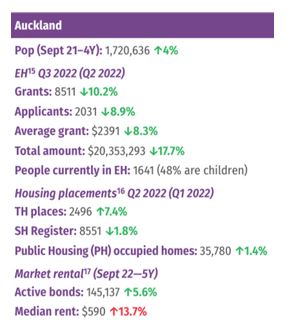
Clearly, as market rents increase, so do the costs of the Accommodation Supplement, as do the pressures from the NGO-sector to increase the amounts and thresholds, as they work to move individuals and families to more secure tenures on the continuum. I would suggest, these increases to the total welfare budget associated with accommodation support are unsustainable.
Our housing market for renters is no more affordable than homeownership in New Zealand – and rent prices are on the upside, whist house prices are dropping.
A circuit breaker is needed.
Principles of rental market regulation
Empirical studies from overseas have shown that designating particular properties as rent controlled is an inequitable solution to addressing unaffordability. Those tenants in rent controlled properties tend to stay put, whilst all others are subject to market forces. Implementing across-the-board caps, or freezes on rental price increases is also an unacceptable policy solution, as rents in New Zealand are already unaffordable, as demonstrated by the $2 billion dollar plus annual cost of the Accommodation Supplement.
The increasing costs of debt servicing, coupled with the recently introduced discriminatory tax treatment for rental accommodation providers, both add to upward pressures on rents.
In considering regulation of the rental market, I started with a set of principles to address current inequities for both tenants and landlords;
- Higher value properties should attract higher rent;
- Regulation should be universally applied to all residential rental properties (thus avoiding the unintended consequences as per overseas experience);
- Normal business taxation rules should be restored to residential rental accommodation providers to ensure equitable treatment between rental property and other commercial/business investment;
- Annual rent increases (or decreases) should match movements in the CPI basket for Household contents and services;
- The median-value property should be affordable for the median-income household (thus reducing the need for the accommodation supplement);
- Regulation should take into account that property values and incomes vary throughout the country;
Based on the above, I recommended that Parliament investigate a formula approach to rental market regulation.
Testing the formula approach

The starting point for the weekly rent maximum is the rateable value of the property in thousands …
… and this is reduced by a percentage for each region so that the weekly rent on a median-value property in that region is 30% of the median household income (before tax) in that region.
I refer to rateable value (RV) instead of capital value (CV), as it is a more widely recognised term within the general public. For the purposes of the formula, RV = CV.
The weekly rent maximum number is determined by looking up the median household weekly income for a region (I have used median wages and salary income). The rateable value of a property can be accessed using the Property Search tool here.
And so, by way of example, to calculate ‘x’ for the Auckland region: the equation assumes a median RV of $1,300,000, and uses 30% of $1,726 (the median weekly household income for the Auckland region), giving;
(1,300) – x% = $518/week, or as an algebraic equation,
1,300(1 - x) = $518/week
therefore, x = 0.6 or 60%.
- If applied to an existing property for rent in Grey Lynn with an RV of $2,475,000, the weekly rent maximum would be 2,475 reduced by 60% = $990/week, against a current asking rent of $1,170/week.
- If applied to an existing property for rent in Howick with an RV of $1,970,000, the weekly rent maximum would be 1,970 reduced by 60% = $788/week, against a current asking rent of $880/week.
- If applied to an existing property for rent in Northcote with an RV of $1,650,000, the weekly rent maximum would be 1,650 reduced by 60% = $660/week, against a current asking rent of $850/week.
- If applied to an existing property for rent in Massey with an RV of $1,300,000, the weekly rent maximum would be 1,300 reduced by 60% = $520/week, against a current asking rent of $800/week.
- If applied to an existing property for rent in Mangere East with an RV of $600,000, the weekly rent maximum would be 600 reduced by 60% = $240/week, against a current asking rent of $600/week.
What the formula approach demonstrates is that, as per the Salvation Army findings, rent increases have been the most severe in the most deprived neighbourhoods where property values are the lowest relative to the rest of the region.
And conversely, the properties valued well above the median RV, typically rent at a more realistic price-to-income ratio, based on a perceived market ‘ceiling’ for higher income households.
In short, the present rental market asking prices are out-of-sync with median incomes, and most markedly out-of-sync for lower than median income earners. Investors in median to low value properties rely on the taxpayer to subsidise their target customer market.
This taxpayer largesse needs to be curtailed, and to my mind regulation is the only way.
An affordability measure of no more than 30% of gross weekly household income spent on rent, is the most commonly used metric, adopted by a number of government entities. However, a government might choose to introduce a more incremental approach (say, a target of 40% of median income), while also retaining an amended, means-tested Accommodation Supplement.
On implementation of the formula approach, a weekly rent maximum ‘look up’ by address would replace the Tenancy Services Market Rent tool.
Based on the 30% affordability measure, check out this calculator tool to determine what rent you should be paying against this affordability metric.
*Katharine Moody is a senior tutor at Massey University's College of Humanities and Social Sciences in Palmerston North, who comments on interest.co.nz as "Kate". The views expressed in this article are her own and don't necessarily reflect those of Massey University.
We welcome your comments below. If you are not already registered, please register to comment
Remember we welcome robust, respectful and insightful debate. We don't welcome abusive or defamatory comments and will de-register those repeatedly making such comments. Our current comment policy is here.