
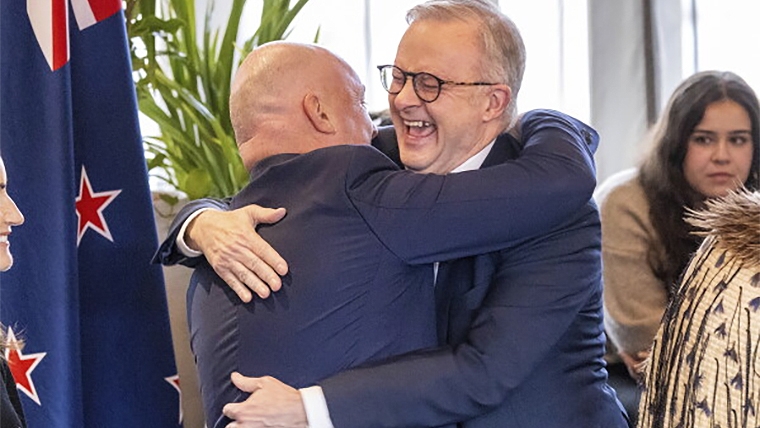
‘Australia has no closer friend, neighbour and ally than New Zealand. Our relationship is built on a rich shared history and generations of cooperation.’
That was the view of Australian Prime Minister Anthony Albanese earlier this month when kiwi PM Christopher Luxon crossed the ditch for the annual Australia–New Zealand Leaders’ Meeting.
But do ordinary Australians agree with that sentiment?
Apparently yes. At least according to the 2026 Lowy Institute Poll released this week.
The Lowy Institute is a highly regarded independent international policy think tank established in 2003 by businessman and Westfield founder Sir Frank Lowy. Its poll is a representative survey of more than 2,000 Australians conducted by the Social Research Centre.
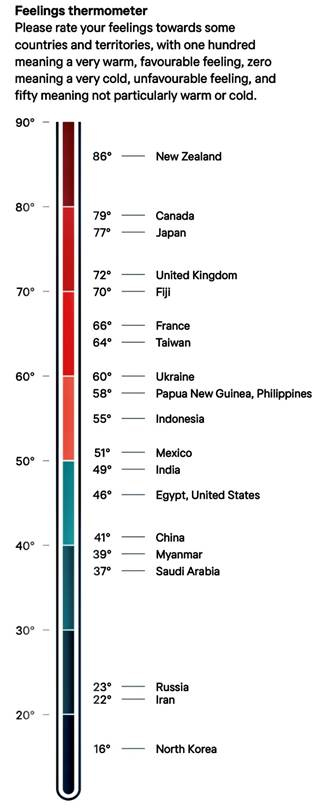
Poll respondents were asked to rate their feelings towards a range of countries. New Zealand was the clear favourite.
Source: Lowy Institute
And this is not a new position. New Zealand has topped Lowy’s ‘feelings thermometer’ on the previous 15 occasions this issue was tested.
Perhaps more consequential was the question of whether Australia should come to the defence of New Zealand if it ‘were attacked by another country’. A remarkable 94% of respondents answered that it should. (Would kiwis feel the same about defending Australia?)
By comparison only 55% of poll respondents thought Australia should come to the defence of the United States if the US was attacked.
This is surprising given Australia’s heavy reliance on the US as its primary security relationship. Not to mention its $368 billion investment in AUKUS, a trilateral security partnership with the US and the UK.
Christopher Luxon will have a personal interest in the Lowy Poll results given he featured in one of the questions. Respondents were asked about their level of confidence in 14 named ‘world leaders’ including Luxon.
The NZ PM was in second place with 65% of Australians expressing ‘some’ or ‘a lot of’ confidence that he would ‘do the right thing regarding world affairs’. He was pipped by popular Canadian Prime Minister Mark Carney on 66%.
Interestingly Ukrainian President Volodymyr Zelenskyy was not far behind on 62%.
Only 21% of respondents expressed confidence in US President Donald Trump to do the right thing in world affairs, the lowest level for a US president in the history of the Lowy Poll. Trump was at least ahead of his Vice President, JD Vance, on 20% and Russian President Vladimir Putin on 8%.
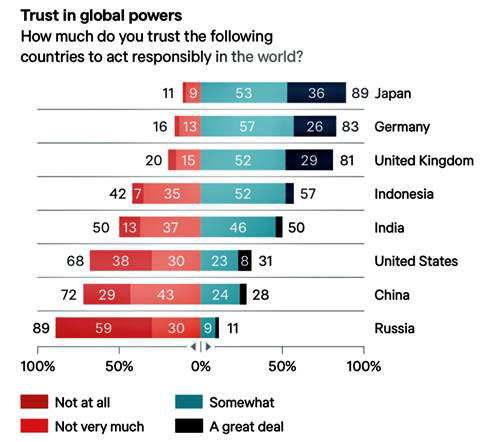
The negative perception of President Trump may partly explain why Australians do not have much trust in the US on the world stage.
Source: Lowy Institute
Only 31% of Australians trust the US ‘to act responsibly in the world’, not far ahead of China on 28%. That’s extraordinary given the US is Australia’s primary security partner. That level of trust in the US is another all-time low in the Lowy Poll.
Less noteworthy, but still interesting, is the fact that Australians express the highest levels of trust in Japan and Germany, the two countries that were Australia’s main adversaries in the Second World War.
The low level of trust the poll reveals in the US and its leader may be the reason why only a minority of Australians (47%) report feeling ‘safe’ or ‘very safe’ about world events. This is another record low for the Lowy Poll, and lower even than during the Covid-19 pandemic.
By comparison, 92% of Australians reported feeling ‘safe’ or ‘very safe’ back in 2010.
One of the most significant developments in Australia in 2026 has been the rise and rise of the populist right-wing political party One Nation. In recent polling it’s received higher levels of support than any other party, and its leader Pauline Hanson now polls as the nation’s preferred prime minister.
What has caused this dramatic shift in Australian politics? One explanation is that increasing numbers of voters see themselves as struggling financially and blame that on the traditional major parties, Labor and the Coalition.
The latest Lowy Poll certainly backs up the first element of that explanation. It indicates that 59% of Australians are now pessimistic about the country’s economic performance in the next five years. That’s 12% higher than last year and 46% higher than in 2010.
Economic pessimism has been trending upwards for twenty years and the rise has accelerated in the last five. Hardly surprising then that voters are dissatisfied and losing faith in the major parties.
Two other results in the Lowy Poll are relevant to One Nation. First, a record majority of Australians (55%) now say the level of migration to Australia is ‘too high’. Secondly, in the last two years the number of Australians who view cultural diversity as ‘mostly negative’ or ‘entirely negative’ has nearly tripled from 9% to 26%.
These trends are positive for One Nation, an anti-immigrant party that prefers monoculturalism to multiculturalism.
The good news is that, for the moment at least, a strong majority of Australians (73%) continue to view democracy as ‘preferable to any other kind of government’.
*Ross Stitt is a freelance writer with a PhD in political science. He is a New Zealander based in Sydney. His articles are part of our 'Understanding Australia' series.
We welcome your comments below. If you are not already registered, please register to comment
Remember we welcome robust, respectful and insightful debate. We don't welcome abusive or defamatory comments and will de-register those repeatedly making such comments. Our current comment policy is here.