
sign up log in
Want to go ad-free? Find out how, here.

QV says average dwelling values are dropping in most parts of New Zealand with buyers wary

Property / news
QV says average dwelling values are dropping in most parts of New Zealand with buyers wary
House in storm

Homeowners had little to cheer about over the three months to October, with housing values declining in most parts of the country according to Quotable Value (QV).

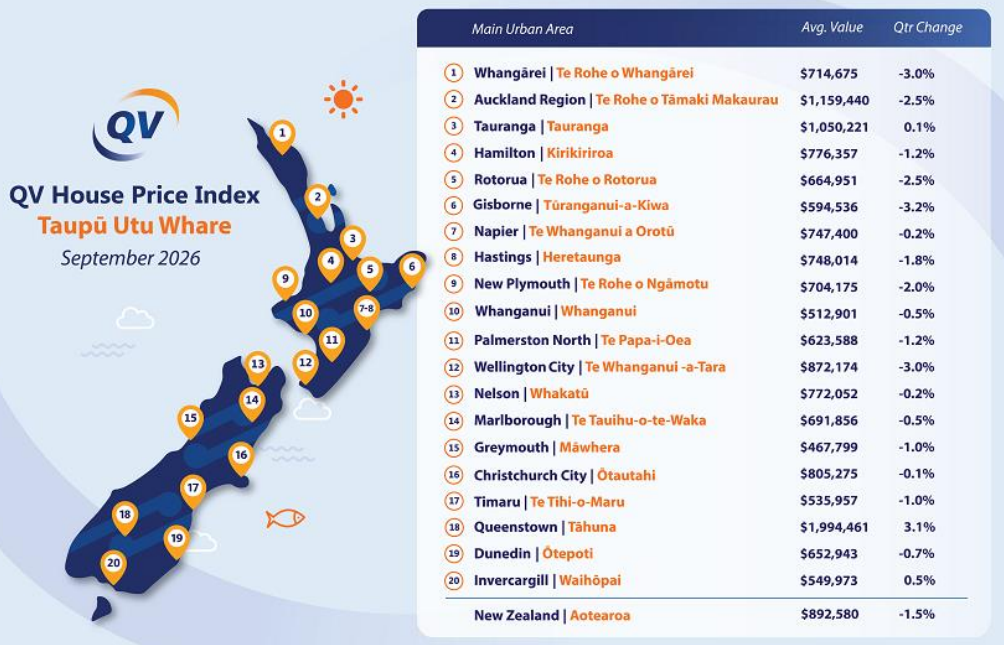
Nationally, the average dwelling value fell 1.5% according to the QV House Price Index.

The biggest quarterly decline of 3.2% was in Gisborne, which was previously one of the country's hottest housing markets but now appears to be cooling.

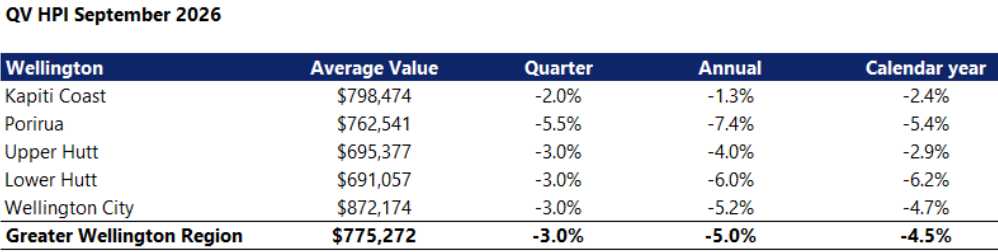
Other cities with a quarterly decline of 3% or more were Whangarei and Wellington City, with both down 3.0%.

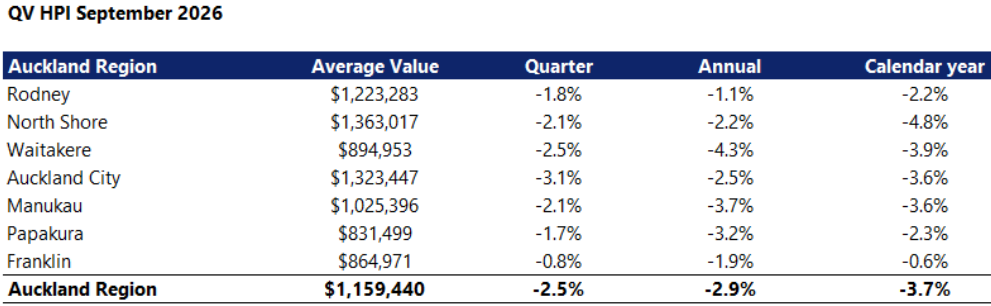
The Auckland Region and Rotorua weren't far behind with quarterly declines of 2.5%. The biggest decline within Auckland was in Auckland's central suburbs where the average value was down 3.1%%. 

The only centres to record average value gains over the three months to October were Tauranga up 0.1%, Queenstown up 3.1% and Invercargill up 0.5%.

Since the beginning of this year the national average dwelling value has declined 1.9%, with the biggest declines occurring in Taupo down 4.8%, Wellington City down 4.7%, Hastings down 4.1% Gisborne down 3.9%, Auckland down 3.7%, Whanganui down 3.5% and Whangarei down 3.5%.

QV national spokesperson Simon Petersen said the first month of spring had brought little evidence that a broad-based recovery was imminent.

"There's certainly no spring in the housing market's step," he said.

"Buyers remain wary, they've still got plenty of choice and there's very little sense of urgency given the wider economic and political context.

"Interest rates and the approaching election are giving people even more reason to take their time and negotiate hard and that continues to put downward pressure on home values in most parts of the country," Petersen said.

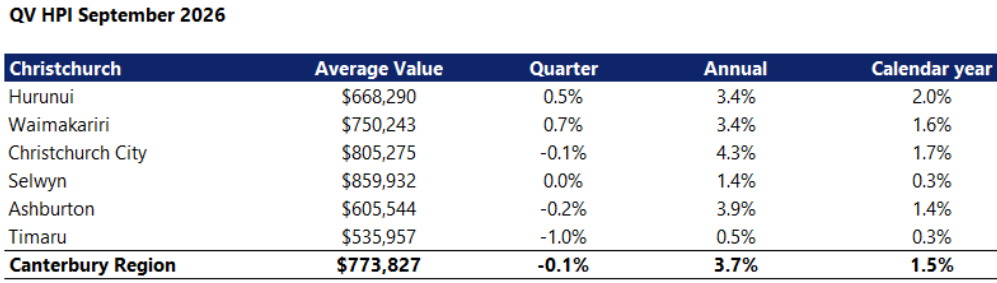
See the tables below for the full district figures with both quarterly and annual changes.

The comment stream on this article is now closed.


We welcome your comments below. If you are not already registered, please register to comment

Remember we welcome robust, respectful and insightful debate. We don't welcome abusive or defamatory comments and will de-register those repeatedly making such comments. Our current comment policy is here.

20 Comments

Our biggest debt fueled price bubble is deflating but leaving the noose of debt on bag holders. How long can banks turn a blind eye?

Meanwhile inlation and overseas energy wobbles continue. Debt is being repriced globally which wills arrive here. If a bank here or there fails after its gambling is exposed its the GFC all over again. 

🍿 

Up
7

You'd honestly have to be mad to think that there are any signs pointing toward a property 'recovery'. Quietly am very pleased with the fact that more and more 1st home buyers will be able to enter the market. This is good for the country. Long may it slide!

Up
11

Long may it slide

There is a risk that building dries up completely and the tradies head to Aus again. We must be close to the point where new builds arent viable. 


Up
1

Then if building dries up and we see a significant movement of tradies head off shore, then there is less demand for housing (eg thousands and thousands of builders, plumbers, painters etc leaving) and more supply of rentals and houses to buy on the market = lower rents and lower house prices.

I don't really see that we have a supply issue for housing in NZ - we just had a demand problem where it was too easy to get cheap credit to throw at a rental and compete with FHB the past 15 years or so. 

Further to that - on a walk around the neighbourhood this morning, most of what I see are people in their 60's, 70's and 80's with failing health, living in 3-4 bedrooms homes, many by themselves (widowed) - to which they will likely vacate in the next decade (even the next 5 years) - which will further add to the supply of 3-4 bedroom homes, suitable for younger people to buy to raise families - not for a single 75 year old to live in because they love living in a large house with 3 empty bedrooms and surrounds they are physically incapable of maintaining. The street I live in is approx 75% widowed women over the age of 70 living in 3-4 bedroom homes. It looks like there might be another one soon as the husband is in and out of hospital. Its not a sustainable situation (also without talking about all the empty houses and those just used for AirBnb etc)

I'm thinking our housing 'correction' is just getting warmed up - as we could see a huge volume of family size homes hitting the market the next decade - even if new build rates are excessive - its the dynamics of the boomer demographic ageing/dying combined with the end of an interest rate super cycle. (as I've said before, it wouldn't surprise me if our housing problems in this country die with the boomer generation - and I don't say this with malice - just simply the reality of the size of their cohort and their love for housing as an investment). 

Up
6

I don't think it was a demand problem, the rentals weren't sitting empty and people were homeless. But supply is much better now (particularly in Auckland), so you may be right. 

It does feel a bit like the GFC though when we stopped building anything because house prices dropped and we thought the problem was fixed only to end up with a massive issue. 

Up
2

What I am seeing, which is probably more a reflection on the immense cost of living pressures, is more and more properties with a mobile home, tiny home and the like plonked on the section. I guess probably for adult kids? Be interesting to know if this is happening to a wider extent? 

Our next generation not prepared to take on a lifetime of debt and pay for the previous generations retirement?  

Up
8

I'm seeing this too, and posts on community facebook pages by people of all age groups looking for some land to park their housebus, caravan etc. Perhaps a consideration is that people can collect rent without giving up space in their homes by doing this, to help with the cost of living, or for elderly parents to help prevent the care homes from extracting the family wealth.

Up
1

What is surprising is that building is actually continuing at high levels, - not the peak levels but close. And what that highlights is that in Auckland land prices were too high.  Many people thought supply would stop when prices dropped.  But even at current levels, as land prices drop people will keep adding supply to the market. And there is a shortage in the rest of the Country (other than Wellington) so people can build and sell for a profit.

Up
1

There is a much wider economic issue here than simply celebrating falling house prices.

New Zealand's SME sector relies heavily on property equity as security for business lending. That equity provides capital for business acquisitions, expansion, investment and working capital.

As property values decline, so does the security available to support lending. This potentially restricts the ability of the next generation to purchase existing businesses, while also limiting the capacity of established businesses to invest, expand and employ more people.

Improving housing affordability is important, but continually declining property values are not necessarily the economic win some commentators seem to think they are.

We need a stable property market, not another speculative boom, but equally not a prolonged decline that undermines business confidence, access to capital and economic growth.

Up
1

Having an economy that for several decades was effectively ‘a housing market with a few bits tacked on’ was always going to come with a heavy price. It was only a matter of when that would have to be paid and who would have to pay it.

Up
14

With this the problem is that much of the cost of a business is the land/building component - so as residential real estate prices fall, we may also see a repricing of businesses. 

The 'wealth' people thought they had was smoke and mirrors. e..g people telling me how rich they are/were because of their property wealth - to which I would say, well that is great, but you only have that capital value if you sell now and convert that wealth into something more liquid that can be used to pay for your necessities to live e.g. in the future you can't pay for your rates, your insurance, food, water, petrol if your house if worth $2 million but you have no savings and your weekly outgoings are great than the income your savings, super and other investments are generating. Are you going to have to sell your property to pay for your lifestyle? And what happens if a lot of people the same age as you are in the same position as you, and all try to sell their property at a similar time to convert their 'wealth' into cash so they can pay for their living expenses?

Up
5

The solution isn't to stabilise and hike house prices, it is for the banks to amend their lending practices away from housing as the biggest form of lending. Yes there is more risk, but so too is there in property these days. By focusing mainly on property, it's fine when things keep going up as they offload the risk to the customer and get their money back if they have to take the house and sell. If property was no longer as lucrative then they would have to put more actual effort into knowing their customers, the business sectors customers are looking to borrow for business for etc. A.k.a more skin in the game. 

Up
1

Ashley Church was recently arguing this - and agreeing with him is never a sensible option. 
 

I think there is a heap of equity in the existing housing prices, especially for the demographic who are looking to invest in businesses.  The only people with a problem are those that bought during the peak boom.


Up
0

Dilbert dance required as the DGMers were right all along and the Pollyanna Ponzi converts were WRONG

R.62ea53c23690d316df218ff71d596f61 (800×268)

So ... From here,  a grind towards valuing the home as a home, not your "only" retirement nest egg.   for the Polly Annas, I mean lower towards 3.5-5.5 x income averages at macro city levels.

Read what you want for how this impacts NZ

Up
0

"DGMers were right all along" 

That's debatable. Plenty of people have become rich from property, more so than the average DGM with their money squirreled away under their mattress. Likewise the "property will double every ten years" lot were pretty incapable of basic maths and economics. 

Probably the ones that were right all along were the ones that had property as part of a balanced investment portfolio. 

Up
0

I don't think the arguments against rising prices were for individuals but the net effect over society. Only ones "winning" were the banks with their 2% NIM. 

Up
1

That's purely looking at it from the point of view of the individuals.

Many DGMers were looking at it from a much wider view point. One that questioned the effects on Aotearoa as a whole and on all demographics. And they were damn right about how detrimental it has been and still is.

Edit.

Snap Snow.

Up
5

Nah the classic DGMs were the ones that predicted a crash every year, they were wrong for a very long time. And the classic PIs honestly believed prices would double every 10 years forever, fundamentally wrong. Everyone know it was bad for the country. 

Up
0

Stop it.

Ponzi chasers gave investors a bad name and made normal investing difficult. Banks just wanted endless debt so turned a bonus blinded eye. Debt stacking on interest only income chasing greater capital gains is gambling, not investing.

And when the worm turns you have a big problem. Those catching fire poured fuel on themselves, probably for a decade or more. 

For the social issue you created... burn.

Up
1

I didn't create it, I have only ever owned one house that I live in. You could argue I'm a victim. 

But saying that the DGMs were right is a bit of a stretch. Yes maybe they were right that house price inflation was bad (duh), but their continued predictions of a "crash this year guaranteed" probably put many people off buying and locked them out of the market. Even worse some of those people probably gave up on the DGMs and bought at the peak!

Saying house price inflation is bad is perfectly fine, but giving bad investment advise for decades then later claiming you were right is pretty bogus. 

Up
2