
By Ross Stitt*
The Australian housing market has turned down. And with a vengeance.
In the September quarter dwelling prices fell 4.3% across Australia’s capital cities. Sydney was the biggest loser down 4.9% in just three months. It’s now off 8.6% since February with no sign of a turnaround.
Perth and Brisbane, both big gainers in recent years, slumped 4.7% in the September quarter.
How far will prices drop?
National Australia Bank forecasts a peak-to-trough decline of 11% while the Commonwealth Bank predicts around 9%. But in the current febrile environment such forecasts are being regularly updated, usually downward.
Morgan Stanley has suggested that house prices could be down as much as 15% by 2027 which would make the downturn the most severe in decades.
The Australian Property Institute, the professional body for independent property experts, has recently released its Property Market Outlook for fourth quarter 2026. It’s based on a survey of 384 property professionals, three quarters of whom are valuers.
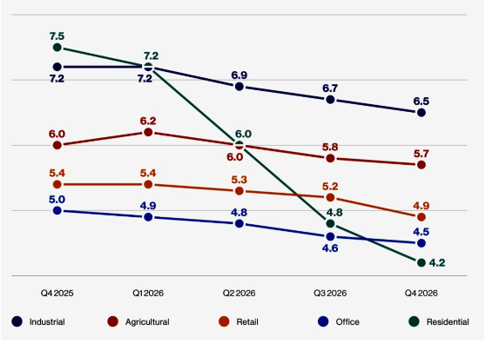
The report includes a review of changes in property market sentiment. The sentiment for all property sectors has declined over the last year but the slump for residential property has been dramatic.
Property market sentiment scores
Source: The Australian Property Institute.
What’s causing the weak housing market?
The primary factor is the rise in interest rates. The Reserve Bank of Australia (RBA) has hiked interest rates four times in 2026, from 3.6% to 4.6%. This has flowed through to a significant rise in borrowing costs.
Other factors include major adverse changes to the tax treatment of residential property investment, the previous substantial rise in house prices post-Covid, and declining consumer confidence in the face of a cost-of-living crisis and geopolitical uncertainty.
It doesn’t seem long ago that the market was driven by FOMO – the fear of missing out. The current vibe is more FOOP – the fear of overpaying. That is stoked by stories of recent house purchasers who now face the dreaded position of negative equity – their mortgage exceeds the value of their house.
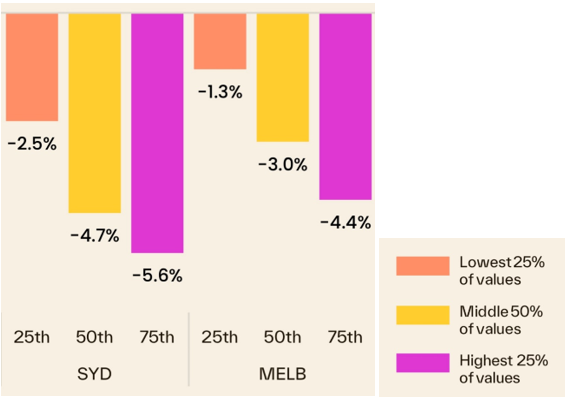
Interestingly, in many capital cities the current house price downturn appears to be greater in the higher value segments. Cotality compares price movements between the lowest 25% of values, the middle 50% of values, and the highest 25% of values. The differences in Sydney and Melbourne are considerable.
Sydney and Melbourne by value segment in September quarter
Source: Cotality Australia.
The falls in expensive markets translate into some significant numbers. Take the wealthy eastern Sydney suburb of Bellevue Hill. According to Cotality’s Mapping the Market, median values there are down by 6.9%, or around A$800,000 (NZ$1 million), in the September quarter.
But don’t feel too bad for Bellevue Hill property owners. That still leaves a median value of around A$10.8 million (NZ$13.5 million).
So is the plunging market good for would-be first home buyers?
Yes and no. House prices are down but frequently that benefit is more than cancelled out by the rise in the cost of servicing a mortgage.
And the position for borrowers is likely to deteriorate further next week. The Australian Bureau of Statistics has just released the latest inflation data. The Consumer Price Index rose 4.3 per cent in the 12 months to September, up from 4.0 per cent in the August year.
The trimmed mean inflation, the RBA’s preferred measure of inflation, increased from 3.5% to 3.6%.
Unfortunately for borrowers, the latest lift in inflation is expected to force the RBA to hike interest rates again next Tuesday. That will be the fifth hike for 2026. Once that hike is passed on by the banks, the servicing capacity of borrowers will decline further.
One of the risks with a falling housing market is the resulting negative wealth effect. Consumers feel poorer when the value of their home drops and that can lead to a contraction in their spending. That in turn translates into a decline in economic activity.
The scale of the risk is evident from the degree to which the wealth of Australians is tied up in residential property. Australian houses are currently worth around $12 trillion. That dwarfs superannuation assets of about $4.8 trillion.
All this is bad news for the Labor government as it’s seen as the primary driver of lower house prices. It’s changes to property taxation have reduced demand for housing as an investment and, its deficit spending has fed inflation which has driven up interest rates. (To be fair, Donald Trump’s war against Iran and the consequent spike in energy costs has also been a major factor in Australia’s inflation spike).
There’s a great irony here. For years, many economists, politicians, and business leaders have complained that Australian house prices are too high. They’ve argued that high prices make home ownership unaffordable for younger Australians and undermine investment in more productive sectors of the economy.
But now that house prices are sliding the general response seems to be widespread pessimism and alarm.
And no one is claiming ‘credit’ for it. Certainly not the Government.
*Ross Stitt is a freelance writer with a PhD in political science. He is a New Zealander based in Sydney. His articles are part of our 'Understanding Australia' series.
We welcome your comments below. If you are not already registered, please register to comment
Remember we welcome robust, respectful and insightful debate. We don't welcome abusive or defamatory comments and will de-register those repeatedly making such comments. Our current comment policy is here.