

sign up log in
Want to go ad-free? Find out how, here.

Cotality's latest Home Value Index shows ongoing declines in most parts of the country with even the South Island starting to show some weakness

Property / news
Cotality's latest Home Value Index shows ongoing declines in most parts of the country with even the South Island starting to show some weakness
SI
Even house values in the South Island are starting to show some weakness. Photo by Kishan Modi on Unsplash.

Housing values continued declining in most parts of the country in October, according to property data company Cotality.

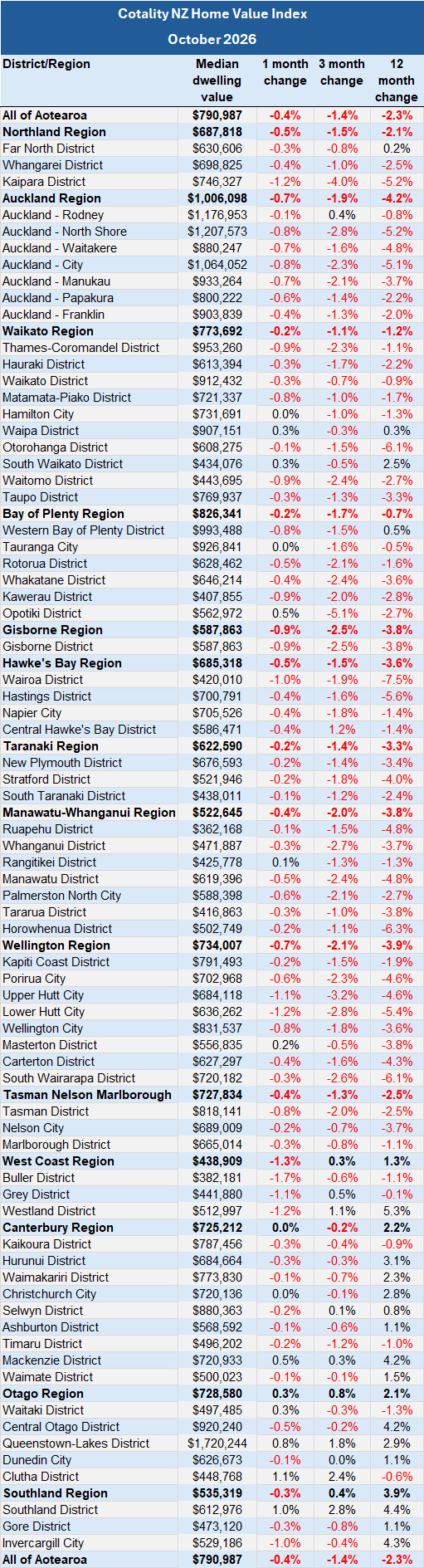
Cotality's Home Value Index shows median price movements in most urban districts from one end of the country to other, and the latest figures are a sea of red across the one, three and 12 month changes. (See the table below) for more detail). 

A notable feature of the latest figures is that the red ink is now starting to seep into the figures for the South Island, with value figures there starting to show some weakness.

Across the entire country, the median dwelling value was $790,987 in October, -0.4% compared to September, -1.4% compared to July and -2.3% compared to October last year.

The biggest annual median value declines were in Wairoa -7.5%, Horowhenua -6.3%, Otorohanga -6.1% and South Wairarapa -6.1%.

In Auckland the median value remained just above the million dollar mark at $1,006,098, which was down 4.2% compared to October last year.

"Agreed sales volumes have been drifting gradually lower throughout 2026 and with the seasonal spring uplift for new property listings now firmly underway, the stock of unsold dwellings on the market remains elevated," Cotality NZ Chief Property Economist Kelvin Davidson said.

"As such, provided that would-be buyers are confident about their own job security and can satisfy the bank too, they remain in a strong bargaining position," he said.

"There's no doubt that the balance of power still lies with buyers in most cases, and hence property values remain subdued in many parts of the country," Davidson said.

The table below shows the current median values for all urban centres around the country as well as their their movements in value.

 

We welcome your comments below. If you are not already registered, please register to comment

Remember we welcome robust, respectful and insightful debate. We don't welcome abusive or defamatory comments and will de-register those repeatedly making such comments. Our current comment policy is here.

12 Comments

But, but, but the new covid allowed immigrants will be buying, the Americans will be buying, the Aussies will be buying, now the Indians will be buying...... 
All these Real Estate agent and Mike Hosco narratives, have hit splat, against a Crashing NZ Housing Market. 

This sucka is going much further down and the bottom is sometime around the early 2030s. 

Offer only around the 2015 prices, or lower,  will be bad to face negative equity for many years, as values are only mid-hydroslide.

Up
5

I love the theatrics Gecko but 2015 prices are ridiculous when accounting for inflation. Auckland house prices are back to Q1 2021 prices. You could be cheeky with a 2019 offer. Can’t see anyone taking a lowball offer much lower than that 

Up
0

Hi Rampy,  I see many trsnsactions now in the 2017 to 2018 ranges in large NZ cities.....and we are dropping more as time rolls on.

Bigger drops are baked in the future cake, as mortgage rates rise.  Cannot defy gravity.

Up
4

Printed easy money, panic and a side of greed and kapow... bubble. Financial gravity is gaining traction, so its down down down in ponzi town.

Throw in the approaching tax apocalypse of the left and it is truely red eveywhere....

Up
4

Actually, it was always going to happen, for physics reasons. 

Firstly, exponential growth on a finite planet is impossible. Fact.

Secondly, exponential growth is tracked in terms of 'doubling-time. Fact. 

Some time back, perhaps even as far back as the 1970s/80/s, there came a problem matching doublings of proxy with the physical planet. 

So we started elevating the 'value' of already-existing items; collectibles, houses, whatever - all existing. And of course, the demands of 'doubling' (3% growth doubles in 24 years) meant we needed to increase those nominal 'values' exponentially, or near to. 

Clearly a reconciliation was inevitable - made worse by physics again; entropy means a house is really a decaying structure, needing ever-more maintenance with time, not an accruing asset - and the question is: Where is the floor? Answer - when an ordinary wage-earner (energy underwriting, again) can afford a house, without stress (as per 1950s, 60s). 


Up
1

You have to wonder how much lower prices could go, with interest rates still firmly in the inflationary zone, and set to rise...


The recent decision to delay treatment/hold rates may only increase the dose of medicine required.

Up
2

Agree. Imagine the noise if we get back to the longer term average of circa 7-8% (edit) interest rates.

Will the banks continue to prop up the over leveraged or start letting them go. TM today. "Mortgagee" is 88. "Banks demands" 93. "Must Sell" is 708. "Demands Sale" 1,798.

Up
2

Yep it is still insane out there i.e. many holding on for BAU to return.

There is a place up from me, been on the market for several weeks. It's a 1948 weatherboard, ex state house, semi detached. Original wooden windows, very average condition, 2 bed, 1 bath on a small section. The house it is connected to is in very poor condition with rotten weather boards all around. Wanting just under 500k and in the description states ".....as is where is". It's pure insanity!  

Up
0

Sounds like its worth at best 175 to 225k or the 2010 to 2015 historic price.

If the seller holds out long enough, stamping their feet in "I want 2021 again" expecting financial insanity pricing, they maybe completely juxtaposed into a rapidly repricing market for old dungers, -200k+ lower....self imposed boxing uppercut, you could say.

Up
1

Given the cost of consents and building work now, this adds in to the equation when considering an offer. Greater cost to fix things up = lower offer to compensate. Sellers will deny this to their grave, but they will only receive lowball offers as a result until they either must sell from necessity, or the place gets worth less over time and the offers start dropping even lower. 

Up
0

Agree. Imagine the noise if we get back to the longer term average of circa 7-8%. 

As long as credit growth keeps expanding at 7-8% pa for people to bid up house prices and consume, she'll be right. I agree that 7-8% mortgage growth doesn't necessarily "guarantee" that your suburban castle will increase by an equivalent proportion. But remember that we're at a relatively advanced stage of the Ponzi. For the Ponzi's vitality, what is needed is a cunning plan from the central bank, commercial banks, and the govts. To be honest, I don't know what kind of tweaks / adjustments they have in their bag of tricks. 

Ashley Church reckons that the Ponzi is the capital base for the nation's productive sectors. Maybe he's right. It's a kind of chicken and egg argument. I know that Aotearoans used to like to think that the Ponzi was a result of our superior socio-economic model and management. But you don't hear the ideas bouncing around the BBQs as much as you used to.      

Up
1

Ashley Church reckons that the Ponzi is the capital base for the nation's productive sectors. Maybe he's right. It's a kind of chicken and egg argument.

Amazing how the system implodes when the youth educate themselves and realise it was eventually doomed to fail, and refuse to buy into the system, literally. Now Oz is on the way down, however as usual they have minerals to mine, oil to extract and gas ditto. I had to laugh however when recently told that the pipe modules for the northwest gas project near Karratha were fabricated in 3 different countries, and arrived with pipes not aligning between modules all over by up to 1.5m. They're supposed to come kitset to line up, weld together etc and now they have to redesign and fabricate more piping to make it work, delaying the project further. Guess the new refinery project will keep the job market up there.

Up
0