
By David Mahon*
The Chinese Communist Party’s confirmation of Xi Jinping’s third presidential term was a foregone conclusion, yet the Western media view it with the refreshed consternation that China will restrict international access to its markets and regress to become a more authoritarian ideological Marxist state.
The core and the direction of the Chinese Government has not changed. Contrary to the views expressed by leading Western observers, most of those appointed to key positions in the politburo and the ministries are even more market-forces orientated than their predecessors. They are also more open-minded than their predecessors, having come of age in times of unprecedented growth and national prestige rather than revolution and want.
In both China and the West there is valid concern that as many newly appointed officials are Xi loyalists, he will hear from those around him echoes of his own ideas, rather than new and challenging ones. A singularly powerful leader may be able to lead his people to greatness, for he is unfettered by dissent, but that same leader can equally lead his people to ruin as there is no one to warn him of his errors.
The scene of former president Hu Jintao being ushered from the Great Hall of the People spawned conspiracy theories and speculation around the world. The 79-year-old appeared to have been angered by the content of a paper, taken from a folder, that listed senior appointments. Perhaps he realised for the first time that Xi had managed to appoint loyalists exclusively to senior positions. Perhaps he was just having a senior moment. Xi remained calm and somewhat dismissive as Hu was led out, which has been interpreted as cruel indifference by some and admirable composure by others. It must have been a shock to the Party that such a choreographed process as the National Party Congress was disrupted in front of the world.
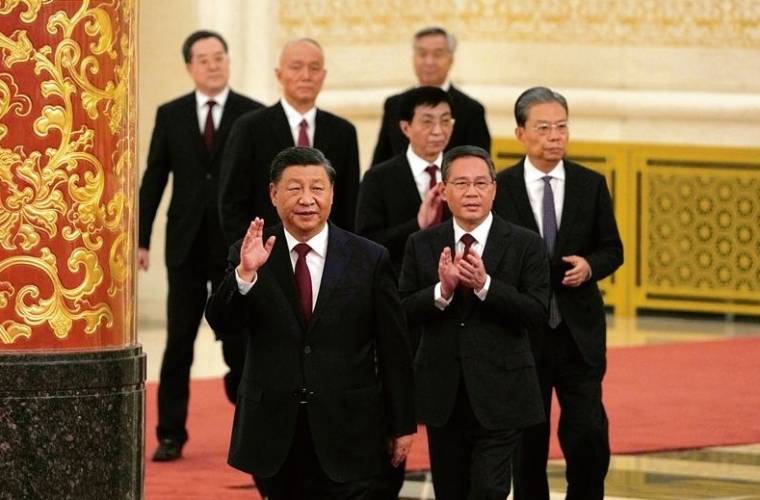
The president’s few men
China’s incoming premier, 63-year-old Li Qiang, is perhaps better qualified to manage the economy than outgoing premier Li Keqiang. Li Keqiang became premier after serving as party secretary of Liaoning province, a relative economic backwater, and therefore he lacked the experience and insight of those who had been responsible for economic development in the more dynamic coastal provinces. Xi Jinping took over most of Li Keqiang’s economic management responsibilities early in his second term. In contrast, Li Qiang was governor of prosperous Zhejiang province before becoming Party Secretary of Shanghai and is widely respected by the Chinese and foreign business community for his acumen.
Li Qiang was innovative in Shanghai, and his early approach to COVID Omicron management was perhaps bolder and more practical than many of his provincial peers, but he underestimated Omicron’s transmissibility, and cases surged more than in any other Chinese city. Earlier this year, the Chinese public and many senior officials predicted that Li Qiang’s career would either stall or fail, and there seemed little chance that he would rise to become China’s second most powerful man and possibly heir apparent.
A staunch and trusted ally of Xi for decades, he is likely to be an effective premier in ordinary times, but his mishandling of COVID in Shanghai showed he can make major errors in judgement in a crisis. Perhaps he will have learnt from Shanghai. At least he may be one of the few people who may speak truth to Xi’s power, for Li Qiang has worked closely with Xi in senior positions for longer than any other of Xi’s other trusted lieutenants.
His appointment certainly emphasises how more powerful Xi was than most realised, as he may promote whomsoever he pleases without fearing that his inner circle will be weakened by a candidate’s perceived failings.
Among the new ministers appointed, four are former Xi secretaries. The Politburo and Standing Committee are now all Xi loyalists. But Xi did not choose loyalty over ability, such is the competence of so many senior Chinese officials.
The incoming head of the People’s Bank of China, Yin Yong, was US educated and spent years on Wall Street specialising in currency and is an example of the importance Xi places on financial market experience.
While the Chinese Government’s commitment to free markets and globalisation is clear, the evolution of its political culture is less so. Some have characterised Xi’s placement of so many of his loyalists in senior positions as a ‘Great Leap Backwards’, fearing he will be less inclined to hear differing views on political and social management.
A hazmat administration
Xi’s strict zero-COVID policies are an example of perceived rigidity. To ensure compliance with zero-COVID measures, the Chinese Government has made its population more fearful of COVID than was necessary. Videos briefly circulating in social media of thousands of migrant workers breaking quarantine at the Foxconn factories in Zhengzhou City last week, walking along deserted motorways back to their villages in the small hours of the morning rather than be confined together in their living quarters, showed the depth of the fear of COVID among ordinary working people.
On the other hand, the educated middle class in China’s coastal cities have come to realise that the virus is less virulent. Most of those testing positive in their communities are asymptomatic, yet many districts required citizens to test every 48 or even 24 hours and apartment buildings are increasingly being sealed for unspecified periods of time on the grounds of only one or two positive Omicron results. The extent of public ire is apparent in the tone of protests posted in social media, and the government’s fear of protest is evident in the speed at which controversial comments are taken down.
I am presently undergoing a five-to-seven-day home quarantine because, despite having tested COVID-negative multiple times in the last week, cases occurred in locations where I had travelled – in Chengdu, and more recently in one city in Yunnan Province. Yunnan is almost twice the size of New Zealand and I travelled in remote mountain regions always more than 300 kilometres distant from where the few cases in the province occurred.
Most Chinese people expected COVID policies to relax after the Congress – on the contrary, they have been tightened. Before the Congress city districts reported case numbers and local lockdowns; this has largely stopped and there are now few details available to the public, a situation that has led to mounting chagrin and anxiety. While Xi and his new cabinet will fare well in the medium term, they may face social unrest in the short term. For the first time in decades, there is widespread public exasperation, a result of the often mindless and insensitive application of COVID policies. Daily, disturbing stories circulate: people dying due to being denied access to hospitals for manageable ailments; schools closing repeatedly and unexpectedly, placing huge pressure on working parents; businesses failing; and a growing urban understanding that the dangers of death or serious illness from Omicron are low. In the last week, 31,000 people were moved out of Guangzhou City to quarantine facilities in surrounding counties.
Tensions within and without
The long-term stability of the Chinese Government and wider society are not at risk, but if Beijing does not change its COVID policy direction, it will face a patchwork of defiance, social disobedience and possibly violent protests with potential to be catalysts for airing of wider grievances. This could delay China’s post-COVID economic recovery, further damage its already questionable international image and deter, or at least delay, many foreign investments.
On international issues, China will try to tone down its combative diplomatic style and strive to demonstrate to foreign investors that the domestic market offers good stable returns. It will endeavour to reassure anxious foreign governments that it is not seeking regional conflict.
There is no sign that China is changing its fundamental policies regarding Taiwan. It will try to preserve the status quo unless the US tries to garrison the island, or Taiwan takes concrete moves toward greater independence. The last thing China wants is to be pushed to invade. The Chinese Government’s biggest exterior challenge is to cope with Washington’s attempts to stunt its technological development and coerce America’s allies to help contain it. If the Chinese Government can stay its economic developmental course, listen more to the grass roots of its society, be more transparent, and react less to the harsh judgements of its trading partners, it can weather this period to prosper in the post-COVID era.
*Mahon also spoke to interest.co.nz recently for an episode of the Of Interest podcast. You can listen to this here.
*David Mahon is the Executive Chairman of Beijing-based Mahon China Investment Management Limited, which was founded in 1985. This article is here with permission.
We welcome your comments below. If you are not already registered, please register to comment
Remember we welcome robust, respectful and insightful debate. We don't welcome abusive or defamatory comments and will de-register those repeatedly making such comments. Our current comment policy is here.