

By David Skilling*
Russia’s new economic friends
The UN General Assembly voted again last week to condemn Russia’s invasion of Ukraine, by a margin of 141 to 7 with 32 abstaining. However, on a GDP or population weighted basis, the margin of international support is less compelling. These differences have been on show again at this week’s G20 Foreign Ministers meeting in India.
Another way to understand positioning on Ukraine, and geopolitical positioning more broadly, is ‘to follow the money’ by looking at trade patterns with Russia. Exports from Russia have been strong on high oil and gas prices. But exports to Russia have also remained relatively resilient over the past year: the IMF estimates that exports to Russia in November are down by just ~10% relative to the average over the several months prior to the invasion (recovering from an immediate drop). This is partly on the rotation of imports and exports away from economies sanctioning Russia towards other countries.
Exports to Russia from Western countries are well down over the past year, compared to before the invasion. Across the Eurozone, exports have halved with exports from countries like Germany, the Netherlands, France, and Denmark down by even more.
But Russia’s loss of these import sources has been replaced by exports from other economies: notably economies like China, India, Turkey, Kazakhstan, and the UAE. In these countries, exports to Russia are sitting at or about record levels.
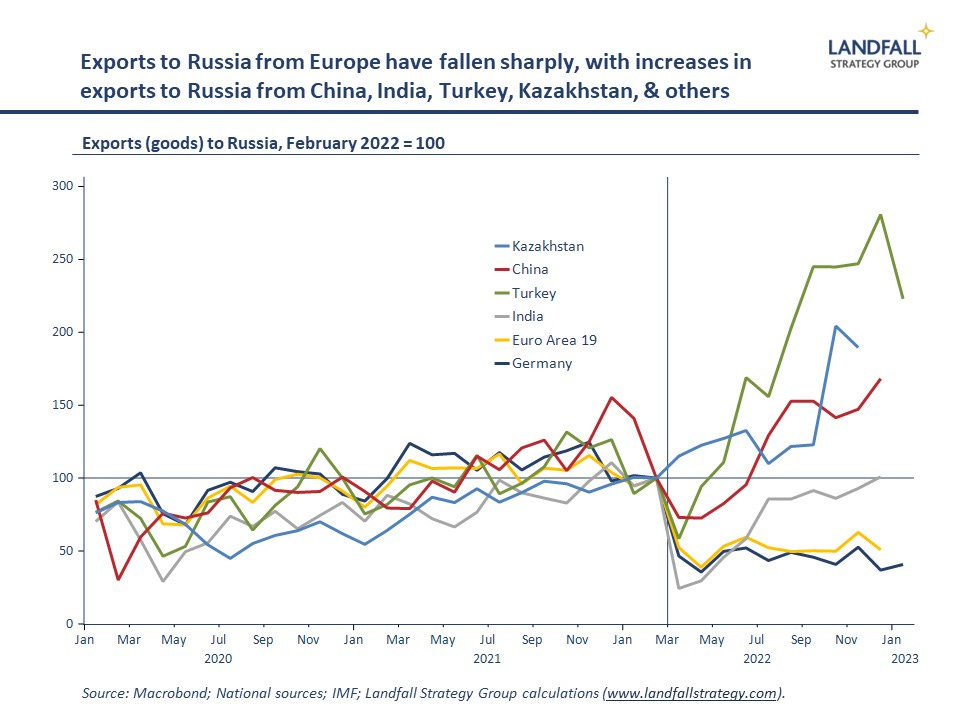
The non-universality of the economic sanctions has reduced the costs that they impose on Russia, although the costs are real and growing. There is also some evidence of sanctions-busting, where Western goods are being supplied to the Russian markets through these third markets: the UAE is under increasing pressure this week from the US, the EU, and the UK.
China’s economic statecraft
China’s economy is rebounding as it opens up after its zero Covid policies. This week’s PMI numbers were stronger than expected, the fastest pace of expansion since 2012.
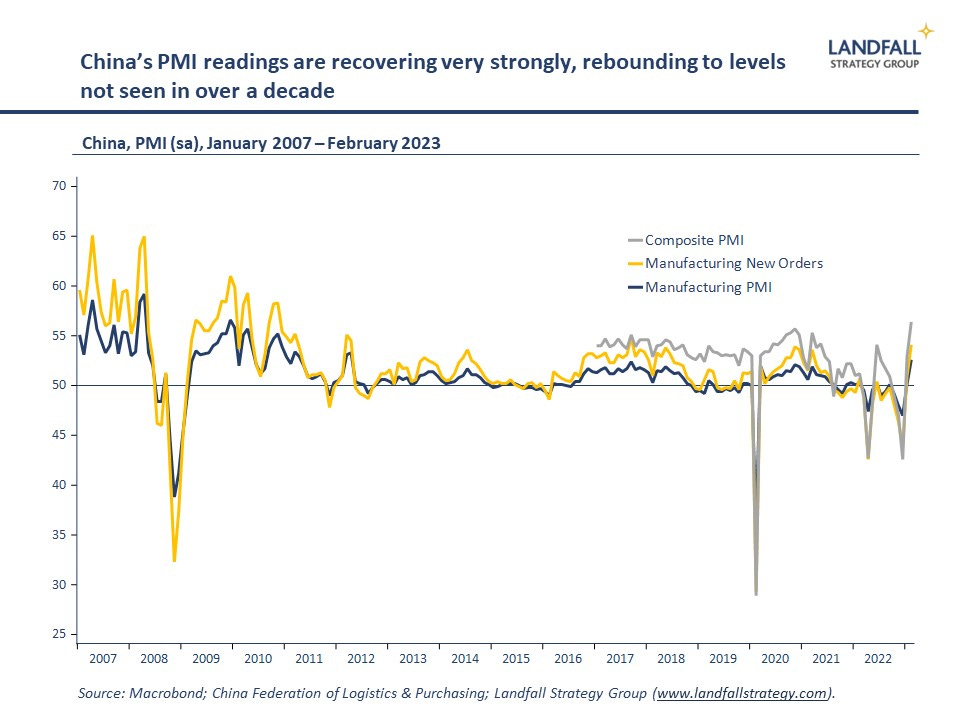
This recovery provides the basis for more active ‘economic statecraft’ in which China uses market access as a strategic asset. Chinese diplomacy has been increasingly active across Africa, Eurasia, and the Gulf.
This economic framing is also the context in which to assess China’s high level peace plan for the Russia/Ukraine war: it is best seen as a symbolic device to position China with countries (particularly in the global south) that simply want the war over. But unless China’s ongoing conversations with Moscow and this week’s state visit of the Belarusian President to Beijing are some sort of creative ‘Nixon in China’ move, the peace proposal is unlikely to go anywhere: Mr Xi has not spoken to Mr Zelenskyy since the invasion, and China’s peace plan is platitudinous rather than substantive.
There are also economic diplomatic efforts across Western economies: China looks to be moving to lift sanctions on a broad range of Australian exports, which it had imposed in 2020 after Australia called for an inquiry into the origins of Covid.
And the Chinese Foreign Minister and Chinese diplomats have been capital-hopping across Europe, looking to improve relations that have become particularly frosty since the Russian invasion of Ukraine. Visits by the leaders of France, Italy, and the European Commission to Beijing are planned over the coming months.
However, there are limits to China’s economic statecraft. The Chinese Foreign Minister’s recent speech to the Munich Security Conference was heavy on anti-US sentiment, which did not land well. Chinese efforts to exploit US/Europe differences on economic policy (such as on the Inflation Reduction Act) and Europe’s significant economic exposure to China are undercut by China’s ongoing coziness with Russia. Europe has become more hawkish on China over the past few years – and the Russian invasion has injected caution on economic engagement with geopolitical rivals.
Adults back in the room
This week’s agreement between the UK and the EU on the Northern Ireland Protocol demonstrates the moderate turn in UK politics after the turbulence of Prime Ministers Johnson and Truss, supported by changing public views on Brexit. The economic importance of the ‘Windsor Agreement’ is not so much in the specifics of the deal, good though they are (particularly for Northern Ireland, where significant new inward investment is now possible).
But it creates a platform for a more constructive engagement with the EU. Already UK participation in the EU’s Horizon research and innovation programme is back on the table. And there is potential for greater collaboration on economic and security issues; being a mid-sized country apart from other groupings is not a comfortable place for the UK to be in the current global environment. The GBP rallied on improved UK sentiment.
There is still a long way to go in normalising relations with the EU, but at least the UK is not shooting itself repeatedly in the economic foot. Brexit is not the only issue constraining the UK’s economic performance – the break in the UK’s economic trajectory happened earlier – but the meaningful Brexit drag on business investment, trade, and migration since 2016 has made it much harder to strengthen the UK’s performance. The UK has been the worst performing G7 country since the pandemic.
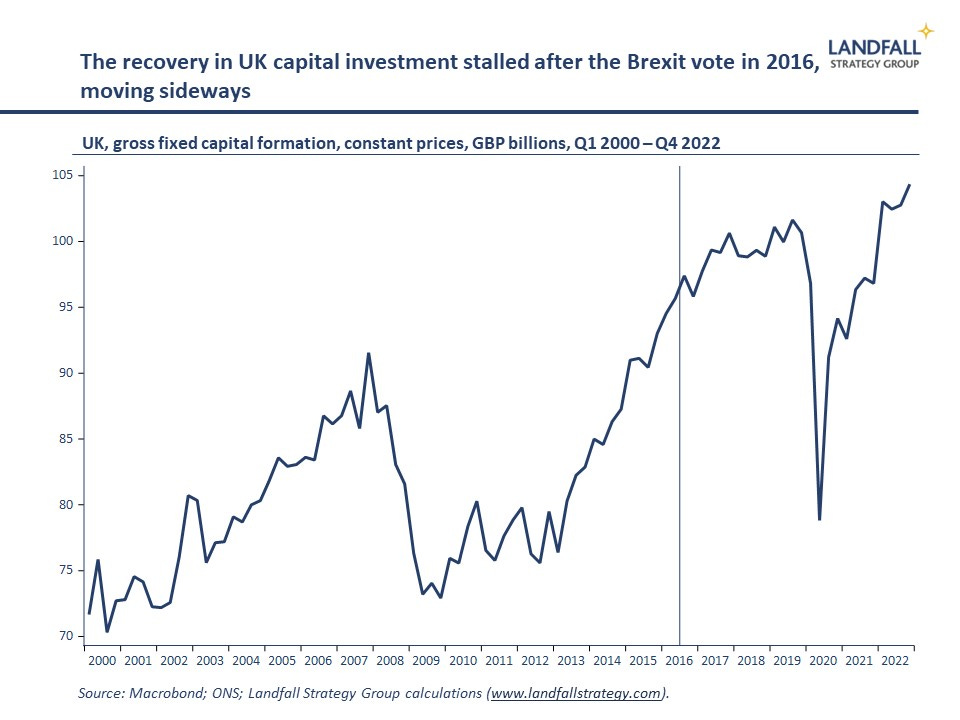
The UK needs to apply this newfound political seriousness to its structural economic problems: raising investment and productivity, strengthening public services and infrastructure, and much else beyond. This week’s rotation to substance away from performative politics is a good first step in what will be a long journey.
Sabotage in the North Sea
Economic war is broader than physical war, and countries should be prepared against broader exposures: from cyber threats to physical attacks on energy and communications infrastructure. The global economy is knitted together by undersea cables and pipes, which creates a series of invisible exposures.
Last week, a joint report from Dutch intelligence agencies warned that Russia was covertly mapping key energy infrastructure in the North Sea (wind farms, gas pipelines) in preparation for possible acts of sabotage. A Russian ship had been detected at a Dutch offshore wind farm, which was escorted away by the Dutch navy and coastguard.
And over the past several months, Norway has stepped up military surveillance of its oil and gas facilities in the North Sea after (likely) Russian activity around key offshore infrastructure. An annual security assessment released in February said that sabotage was ‘unlikely’ this year, but there were risks to Norway’s oil and gas assets if Russia decided to escalate beyond the war with Ukraine.
There is precedent of course. The Nord Stream 1 and 2 pipelines were blown up (near Denmark and Sweden) in murky circumstances last year.
And communication cables continue to be the source of espionage activity. Last year, Russian ships were repeatedly sighted off the Irish coast near undersea communication cables between the US and Europe.
The extension of hybrid war to countries beyond Ukraine is not likely imminent. But these recent experiences show that attacks on critical infrastructure remain a risk that needs to be guarded against; perhaps particularly by smaller countries. Europe is beginning to take steps (including through NATO and the EU) but these risks extend much further.
Hong Kong
Recent data shows that Hong Kong’s population continued to contract in the second half of 2022. This makes the sixth consecutive drop in population (reported every 6 months), with the population reducing by almost 200,000 to ~7.3 million since the end of 2019; a drop of ~2.6%. This is an unprecedented decline, after decades of strong population growth with only occasional drops (the last being in 2003 during the SARS outbreak).
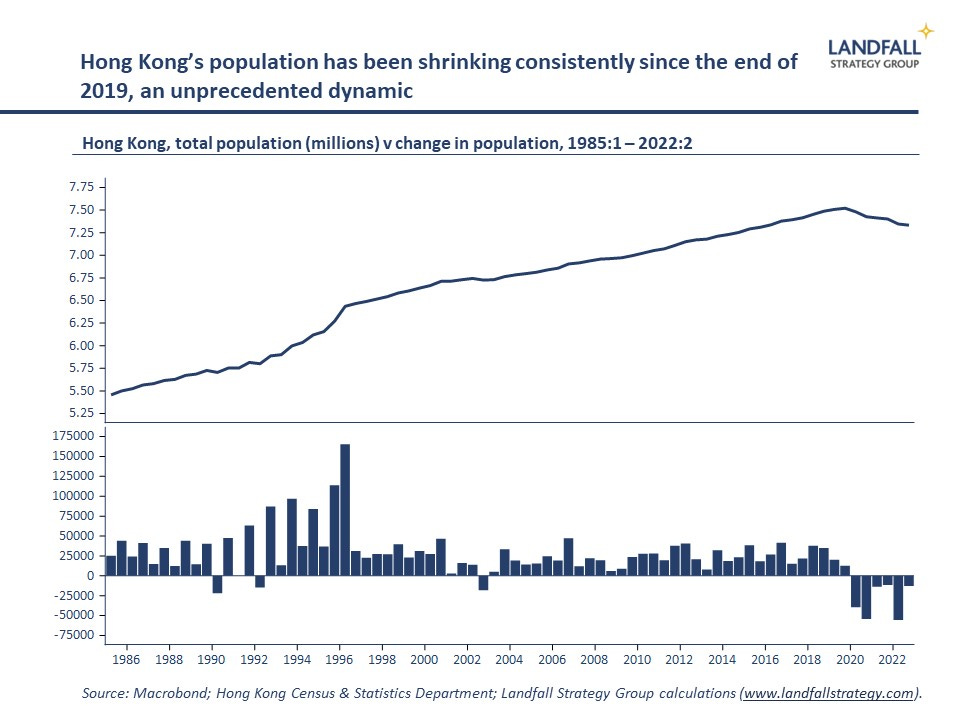
There are several reasons: the departure of people after the 2019 protests; China’s increasingly repressive measures, and the de facto ending of ‘one country, two systems’; the direct effect of the pandemic; the distinctively stringent lockdown measures through the pandemic (Hong Kong is only this week removing its mask mandate, after 945 days…); as well as an aging population.
Many Hong Kong citizens as well as expats have voted with their feet: the UK has received >140,000 Hong Kongers under a special migration scheme. And Singapore is attracting significant flows of people and capital that are coming from Hong Kong. Indeed, Singapore’s population growth has recovered to its pre-pandemic levels.
These respective demographic trajectories between the two city states are reflected in real estate and rental prices: Singapore’s prices are soaring, while Hong Kong’s remain under downward pressure. And more broadly Hong Kong’s economic performance remains sluggish, with both domestic and external sectors under pressure. The government has announced various stimulus measures (including offering 500,000 free tickets to Hong Kong), but the political context around Hong Kong has structurally weakened its attractiveness.
Other commentary…
And in other recent commentary, I recently recorded a podcast with the New Zealand Infrastructure Commission on global issues facing New Zealand’s infrastructure sector: available here. And a background paper I prepared for the New Zealand Productivity Commission’s latest Inquiry on strengthening resilience to global supply chain disruptions was released this week. I provide an international small economy perspective on global supply chain issues, and possible policy responses. The paper is available here.
*David Skilling ((@dskilling) is director at economic advisory firm Landfall Strategy Group. The original is here. You can subscribe to receive David Skilling’s notes by email here.
We welcome your comments below. If you are not already registered, please register to comment
Remember we welcome robust, respectful and insightful debate. We don't welcome abusive or defamatory comments and will de-register those repeatedly making such comments. Our current comment policy is here.