

This Top 5 comes from interest.co.nz's Gareth Vaughan.
As always, we welcome your additions in the comments below or via email to david.chaston@interest.co.nz. And if you're interested in contributing the occasional Top 5 yourself, contact gareth.vaughan@interest.co.nz.
121 years of electricity generation
— Lion Hirth (@LionHirth) March 9, 2023
The global generation mix 1900 to 2021 pic.twitter.com/mwrSOxomAO
1) How 'excuseflation' is keeping prices and corporate profits high.
Bloomberg's Tracy Alloway and Joe Weisenthal have written a fascinating article on how US businesses are using one-off disruptions as cover to raise their prices. They're calling this "excuseflation."
Basically the idea is that businesses can push through price increases under cover of news about a big shock to the economy because there’ll be less pushback from customers at such a time. With the Covid-19 pandemic and all it entailed including global supply chain woes, and Russia's invasion of Ukraine, there has been plenty of disruption around.
Of course here in New Zealand the North Island's been hard hit by floods and cyclones this summer, adding to the perma-crisis feel. In an already high inflationary environment the expectation is the recovery/rebuild from extreme weather events will be inflationary. But how much "excuseflation" is also going in in NZ?
Here's Alloway and Weisenthal.
The key question is, in an economy where the consumer continues to spend freely, how sticky this ‘excuseflation’ proves to be and how high the Federal Reserve will have to drive up interest rates to prompt businesses to lower prices, or at least stop raising them. At 6.4%, annual inflation is down from its peak last year but still well above the Fed’s 2% target.
“A lot of companies had these one-off or very, very rare excuses to raise prices and begin to find how much the consumer would take,” Samuel Rines, a managing director at Corbu LLC, says in the latest episode of the Odd Lots podcast. “Once you get that price push, once you figure out that the consumer’s willing to pay it, that is margin expansive over time, as you begin to have a normalization in your input cost.”
He cites a plethora of companies that are taking price over volume, or the ‘POV’ strategy, as he’s dubbed it. These include all-American favorites like PepsiCo Inc. and Home Depot Inc. and even two retailers long known for their discounted prices: Walmart Inc. and Dollar Tree Inc.
And while any company would naturally like to always be able to raise prices without taking a major hit to market share, in this environment of sub-3.5% unemployment and average hourly earnings growth running over 4% annually, consumers are by and large stomaching these price hikes. They’ve typically only sparked modest hits to customer demand. That explains why the Fed is so focused on cooling off the labor market — and wage growth, in particular — to get inflation back under control.
In the meantime, a defining factor of this excuseflation — and one potential reason it’s proving difficult to stamp out — is that it gives companies a cover to raise prices together, limiting in the process customers’ ability to vote with their feet by shopping elsewhere.
There's more in the latest episode of Alloway and Weisenthal's excellent Odd Lots podcast here.
2) Is there 'excuseflation' in Australia too?
Across the Ditch the Australian Broadcasting Corporation (ABC) has also looked at whether Australia's big corporates are "profiteering" in an inflationary environment.
Rising prices have seen margins improve for some consumer-facing businesses, such as Woolworths and Qantas, higher interest rates have boosted CBA's coffers, mother nature has helped insurers such as Suncorp, and energy producers such as Woodside have benefited from the war in Ukraine.
"Corporate Australia is still in a pretty good spot," noted UBS Australia equity strategist Richard Schellbach.
With the cost of just about everything going up, from milk to electricity to home loans, could it be argued that the biggest losers this profit-reporting season are consumers?
Despite higher fuel prices, labour costs, and flight capacity not yet getting back to pre-pandemic levels, the tourism sector, led by Qantas, has seen its profits soar.
Perhaps most telling, though, is its operating margin, or the amount of money it made on every dollar consumers spent with the airline, which rose to 15.6 per cent.
That margin was a loss of 36.7 per cent in the previous corresponding half, which isn't a surprise because of the COVID travel restrictions.
But notably its operating margin in the December 2018 half, before COVID-19, was just 10 per cent.
Thus the latest result represents more than a 50 per cent improvement on the margins it had before the pandemic.
"Absolutely, there have been additional costs passed on to the consumer," Tribeca Alpha Plus portfolio manager Jun Bei Liu said.
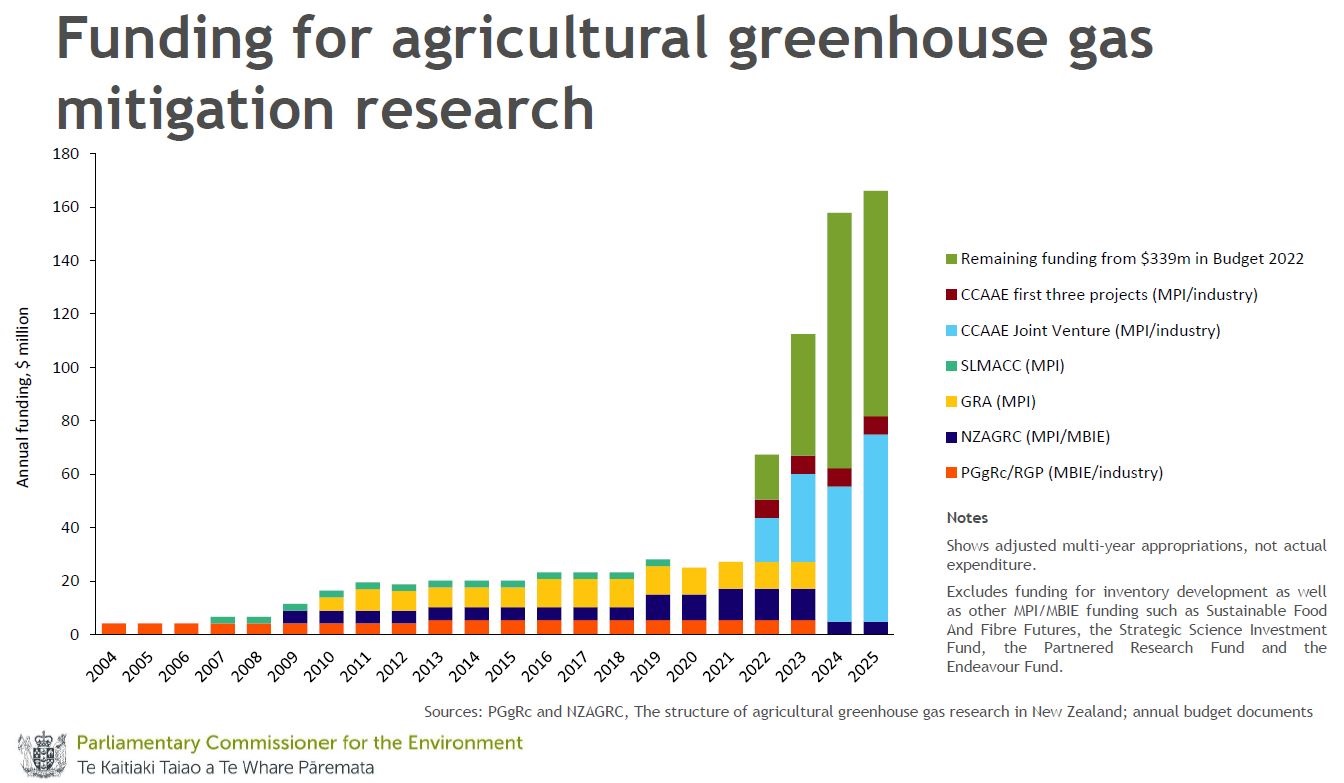
3) Simon Upton on 'pure self interest' in reducing livestock methane emissions & promising new mitigation technologies to help.
In a recent speech to the New Zealand Agricultural Climate Change Conference, the Parliamentary Commissioner for the Environment Simon Upton talked up "promising new mitigation technologies" to combat livestock methane emissions. But he also had a warning about potential large reductions in stock numbers.
Upton noted the current target of a 24% to 47% reduction in methane emissions by 2050, saying reductions in livestock emissions can be achieved by reducing livestock numbers, through lower stocking rates per hectare and land use change, and by reducing emissions per animal, through changes in management practices and using new on-farm mitigation technologies as they become available.
These [technologies] include methane and nitrification inhibitors, breeding low-emission sheep and cattle, low-emission feeds and feed additives, and of course, the Holy Grail, a methane vaccine. These mitigation technologies are all at different stages of development and each has its own particular set of challenges and barriers to overcome before it can be widely implemented in a New Zealand context.
But it is clear that without accelerated progress on some of these technical fixes, the only way we will meet our 2050 methane target will be through very large reductions in stocking rates. The work being undertaken by our science and research organisations on reducing agricultural emissions is therefore a critical component of New Zealand’s climate change policy. We must get this right.
Upton also hit out at the idea that because NZ's a small country there's no point in us doing anything.
Under the Paris Agreement, New Zealand has an international obligation to do as much as it can to keep the 1.5 °C global goal within reach. It is not a credible negotiating position to say that our largest contribution to warming is off limits when we have the option to reduce it. Neither, by the way, is it credible to say that global mitigation has failed so we may as well just get on with adapting. A 3–4 °C warmer world won’t be a very happy place for agriculture. As a little country we need to argue hard for international action and we have no credibility if we seek a leave pass for our largest contributor.
Neither should we be tempted by the argument that since we’re a little country it doesn’t make sense for us to develop the technologies needed to solve the world’s problems and that we should instead be a fast follower. That might be true of concrete or steel but when it comes to agricultural emissions, who are we waiting to follow? We have more skin in this game than others. We have serious research capacity. We have long congratulated ourselves on our productivity and resourcefulness. The logic all leads to the conclusion that we have to tackle this problem head on.
And there is pure self interest in this. We have an interest in continuing to sell products to high-income markets where consumers are taking an increasing interest in the emissions footprint of their food and drink. Being able to show that New Zealand products are associated with the lowest possible emissions will be essential if we are to continue to be a preferred supplier.
Upton's speech is here and the presentation accompanying it here.
4) Sarah Huckabee Sanders' Dickensian legislation.
You might remember Sarah Huckabee Sanders doing one of the most unenviable jobs going around; serving as Donald Trump's press secretary. These days Huckabee Sanders is Governor of Arkansas, a role previously filled by both Bill Clinton and her father Mike Huckabee.
In what sounds very Dickensian, The Washington Post reports on Huckabee Sanders signing off on legislation rolling back her state’s child labour protections.
It sounds like this issue might see another state versus federal government battle line emerging.
Arkansas Gov. Sarah Huckabee Sanders, a rising Republican star, on Tuesday signed legislation into law that eliminated age verification requirements for youth workers younger than 16 years old. A similar proposal is advancing in Missouri. Iowa legislators are considering a bill that would allow 14 and 15-year-olds to work certain jobs in meatpacking plants and shield businesses from civil liability if a child laborer is sickened, injured or killed on the job. A bill in Minnesota would permit 16 and 17-year-olds to work construction jobs.
Instead of making it easier to hire youths for dangerous work, governments should try to “increase accountability and ramp up enforcement” of existing laws, Labor Solicitor Seema Nanda said in statement. “No child should be working in dangerous workplaces in this country, full stop.”
Federal officials have pledged a crackdown on child labor law offenses after regulators discovered hundreds of violations in meatpacking plants, and after news reports emerged of children working in hazardous occupations around the country.
The Labor Department has observed a 69 percent increase in minors employed in violation of federal law since 2018, Nanda said. The agency in February fined Packers Sanitation Services, a subcontractor for meatpacking plants, $1.5 million for illegally hiring children, some of whom sustained chemical burns after working with caustic cleaning agents.
I'm not sure whether Arkansas has many chimneys the kids could be sent up to sweep. Hopefully not.
5) Good work if you can get it.
The Financial Times reports Ark Investment Management, run by high profile US fund manager Cathie Wood, has pocketed more than US$300 million in fees for its flagship exchange traded fund (ETF) since its launch nine years ago, while "wiping out" almost US$10 billion of its investors’ cash over the same time period.
Favouring risky technology companies, the fund hasn't been helped by a rising interest rate environment.
Ark has earned more than 70 per cent of its $310mn fees since the fund’s valuation plummeted by nearly three quarters from its high in February 2021, according to FactSet data. This year it has brought in an average of roughly $230,000 in fees a day as ARKK’s value recovered slightly, rising by a quarter.
“Investment fees have provided ARK and Cathie Wood a very good living,” said Elisabeth Kashner, director of global funds, research and analytics at FactSet. “Her investors haven’t been so lucky.”
The fund manager has amassed a devoted following for her punchy bets on fast-growing tech companies, which until early 2021 produced outsized returns for investors and drew eye-popping inflows.
According to the FT, Ark's fees are almost twice as high as what similar funds normally charge.
ARKK is unusually expensive — its annual management fee of 0.75 per cent of assets is about double the average for actively managed ETFs, according to FactSet.
The fee bill calls attention to ARKK’s unusually high investor retention for an ETF with such poor performance. Flows have remained resilient despite the fund losing $9.5bn in investor cash with Wood’s bold bets, according to Morningstar data.
“It’s extraordinary that investors who chased returns on the way up didn’t reverse course,” Kashner said. “The vast majority of investors have stuck with Cathie Wood.”
82 Comments
If there was a climate emergency then you would allow for the draining of swamps so that naturally occurring methane emissions would be reduced.
The last guy who wanted to “drain the swamp” made the situation worse.
We drained 500,000 ha of swamp. Farmers are still waiting for their carbon mitigation cheque though.
Deduct the flood bill and you get zero..
The last guy talking up the swamp problem was in fact the swamp problem, but in true right wing style, made an art form out of diverting the short attention span of minions while he dug the swamp deeper.
If?
Surely if we are in a global emergency, then the best place to start would be to halt trade (or severally tariff) with countries that are massive polluters, like China for example.
So the OCR and domestic Inflation to 30% for NZ then?
Because the replacing or tariffing imported Chinese products with local production, or even alternative sources, will see prices rocket.
I'm increasingly coming to the conclusion we would have to go all in, and walk away from large chunks of our societal model and face all the carnage that'd entail for 10-20 years.
At the moment we have all manner of domestic rules about labour, maternity leave, environmental and safety standards, etc etc, but blindly abandon them if the work can be done somewhere else, by someone else.
Everyone here would likely have less, from a material point of view. Plenty wouldn't like what that means. It's all really mincing around otherwise.
It's the right thing to do, but it's not the easy thing, and hard things don't win elections
Oh the country would be ripped apart, especially at first. Capital and human flight. Probably a considerable amount of state authoritarianism, with the possibility of despotism. Restriction of access to key resources.
And a lack of effective candidacy to actually do it.
Climate emergency is a bit like a student with a massive assignment due in a month. They know they need to start on it ASAP, but who wants to stop partying. But leaving it until the night before is a sure fail.
it’s a very slow train wreck
The climate emergency is more like the student who still believes in the tooth fairy and Santa Claus. Sorry Jimbo, someone had to tell you at some stage.
How much fossil fuel income are you going to declare this financial year profile?
The Chinese pollute less per capita than us.
Only if you include the convenient nonsense that our herd adds to the runaway global warming hypothesis. China's per capita CO2 emissions are higher than ours.
China 7.38 tonnes CO2/capita
NZ 7.14
https://www.worldometers.info/co2-emissions/co2-emissions-per-capita/
"Even more strikingly, if an individual herd’s methane emissions are falling by one third of one percent per year (that’s 7/2100, so the two terms cancel out) – which the farmers I met seemed confident could be achieved with a combination of good husbandry, feed additives and perhaps vaccines in the longer term – then that herd is no longer adding to global warming."
Yes, the FF industry have been very successful diverting attention from their own planet cooking activities. The vegan branch of the environmental movement have worked wonders for burners without spending a cent on astroturfing their own product. There are probably more people out there now believing farming livestock is a bigger problem than burning geologically stored carbon.
That’s because the first world service based economies have outsourced their manufacturing (I.e emissions) to china. If emissions were measured based on where a product is consumed not made it would be a lot different.
Think about it, How is the average Chinese person, on a fraction of the salary of a westerner, possibly going to pollute more? Except at the factory where they toil for our benefit.
'We're not making it worse right now"
Can imagine this getting worked into the radio ads "we're proud of our country, rivers and streams"
Well then, if its just a matter of population..
Yes , but the left never wants to talk about the to many people problem.... 90% of the ant hill needs to go
But the right are pro-life...(well untill they are born then good luck to you)
*conservative Christians* a much smaller percentage of the right in this country than the US thankfully
50% of leaders of our major political parties though...
True, the left don't want to talk about the issue. Not least because they are fully immersed in the exponential growth cliff dash. However the right aren't only working out how to accelerate the dash, they believe they are obeying gods imperative in doing so. The difference is the degree of zealousness. Between awful because of discomfort with truth, and divine mindless obedience to awful.
Only because of all their fake figures. Do they count all the pollution from their coal fired solar panel factories?
You definitely would not install speed humps on residential streets that unnecessarily make cars brake and accelerate multiple times on every trip.
Hmm? Not sure what you mean there. Drainage of peat land in order to farm the land, releases CO2 gases, not reduces them.
As explained here by the Waikato Regional Council;
Waikato Peatlands contain about 76 million tonnes of carbon. When peat is drained for development, the carbon in peat becomes exposed to air. The carbon is then able to bind with oxygen (O2) in the air (oxidation) to form carbon dioxide gas (CO2), a greenhouse gas.
It’s estimated that developed peatland releases about 1.3 million tonnes of carbon dioxide each year.
Correct for peat but not for mineral wetlands which made up the majority for drained swamps in NZ.
Are you sure about that? There are huge areas of peatland in Northland, Hauraki and Southland.
'Excuseflation' is a classic example of a Universal Pricing Signal in play. Simple theory: if an externality (war, pestilence, weather, locusts...long list), can be fingered then there can be no possibility of cartel, anticompetitive behavior accusations. Gubmints are rather prone to issuing UPS's, inadvertently of course. NZ example: Welcome Home Loans or whatever they are called this week. Ostensibly to 'Elp Der Poor, they act as a floor under house prices. Whoops.....
Quite right. And the biggest Pricing Signal of them all? The OCR.
Upton promulgates the lie that our herd adds to runaway global warming hypothesis. Farmings productivity gains in recent decades are easily hitting the 0.3% per annum goal.
"Academics can quibble (it’s what we do best) about the exact factors, but the fact that this formula is vastly more accurate than the traditional accounting rule is indisputable. ...Even more strikingly, if an individual herd’s methane emissions are falling by one third of one percent per year (that’s 7/2100, so the two terms cancel out) – which the farmers I met seemed confident could be achieved with a combination of good husbandry, feed additives and perhaps vaccines in the longer term – then that herd is no longer adding to global warming."
https://pcep02s1.blob.core.windows.net/cache/5/a/1/3/6/8/5a136842a51fbc…

https://www.newsroom.co.nz/ideasroom/a-climate-neutral-nz-yes-its-possi…
https://www.nature.com/articles/s41612-021-00226-2#MOESM1
That herd is no longer adding to global warming!!
So, if you only add as much poison to a poisoned well as is naturally dissipating, does the well become clean?
The cloud of methane we have shoved up into the atmosphere is contributing to climate change. We have to *reduce this cloud of methane* to reduce its impact - topping it up just enough to keep it the same size (or a fraction smaller) is not a serious strategy. If we take this nonsense into international negotiations we will be a laughing stock (pun intended).
The methane produced by ruminant animals cycles every 12 years. If numbers of animals are roughly the same as has always been, there is no net increase in atmospheric methane
"So, if you only add as much poison to a poisoned well as is naturally dissipating, does the well become clean?"
"Well" no it doesn't, but it does equate to net zero, which is what international treaties seem to believe is a sufficient goal. NZ production of meat products have a better chance at being carbon neutral than any other international production system. Remember it's CO2 molecules that can be driving warming for hundreds, to thousands of years.
The international treaties and our own domestic targets require us to *reduce* methane emissions - because having *less* GHGs in the atmosphere will reduce the climate chaos (net zero does not refer to the atmospheric concentration of gases!!!) Our reduction targets will doubtlessly harden in teh coming years too. I used to work in this field - the idea that NZ could sit in a trade deal discussion with the EU or at COP30 (or whatever) and make this pathetic 'we're not making our methane cloud any bigger' argument is simply ridiculous. See also: we have the most efficient polluting cows in the world.
BS. No treaty has been signed. It is voluntary pledge aka meaningless virtual signal at the expense of farmers. Ease up on the hysterical rhetoric - to suggest CH4 is a pollutant is nonsense and sorry to break it to you but you are stuck with "climate chaos".
"The climate system is a coupled non-linear chaotic system, and therefore the long-term prediction of future climate states is not possible."
https://www.ipcc.ch/site/assets/uploads/2018/03/TAR-14.pdf
https://www.beehive.govt.nz/release/nz-joins-global-initiative-tackle-m…
The carbon cycle isn't analogous to a poison well by any stretch of climate hysterics. Heard of global greening? By your tortured logic a glass bottle is contributing in infinitum to the runaway global warming hypothesis.
Allen doesn't even take in to account soil carbon, when this is added to the mix grazed beef is carbon negative. So cheer up, have a guilt free steak and unwring those hands.
"We demonstrated this based on measurements of soil C and cattle productivity at the Lake City AgBioResearch Center from 2012 to 2016, which indicates a sink during the finishing phase of −6.65 kg CO2-e kg CarcassWeight−1 which is similar to the results of Beauchemin et al. (2011)."
https://www.sciencedirect.com/science/article/pii/S0308521X17310338
Year 2003 9.7m cattle
Year 2021 10.1m cattle
As per figure.nz
Sheep numbers 2002 39.5million
2020 26 million
Sheep farmers are bearing the brunt of the methane tax but I dont know why.
I can only assume its because the sheep farmers are hated by this govt even more than they hate the cow farmers. They want to force the sheep farmers out of business.
Maybe because it is easier to pull the wool over their eyes.
Easier to fleece 😟
As a sheep farmer HW2, I have to say you need to keep comments rational. No one particularly hates us in political parties. In fact most like farming and give assistance when needed.
Yes but that doesn't answer my question. Clearly sheep are not the culprits of methane emissions. So why are you as a sheep farmer hit disproportionately
And on the topic of Tech:
Stablecoin USD Coin lost its dollar peg and slumped to an all-time low on Saturday after Circle, the U.S. firm behind the coin, revealed that some of the reserves backing it were held at Silicon Valley Bank.
So re below if fed get to 6 RBNZ may need to be 6.25 unless we want to see a lower NZD - 8% 1 year ouchy ouch - Summers sees near even odds Fed must lift to 6pc or higher
Christopher Anstey
Former Treasury Secretary Lawrence Summers said that the odds are now almost even that the Federal Reserve will have to raise its benchmark interest rate to 6 per cent or more to bring inflation back down to its 2 per cent target.
“My guess now is that it’s nearly 50-50 that we’re going to get to — and need to get to — 6 per cent fed funds, or above,” Summers said on Bloomberg Television’s “Wall Street Week” with David Westin.
Summers applauded Fed chairman Jerome Powell’s opening of the door to a 50 basis-point move at the March 21-22 policy meeting, in his congressional testimony this week. AP
Summers spoke shortly after the February US employment report showed a stronger-than-expected gain in payrolls, though the unemployment rate rose as more people came into the workforce. Average hourly earnings also slowed.
He said the mixed figures made it a “difficult” release to interpret, but the broader picture shows that the Fed’s current settings for rates “aren’t enough to really apply a lot of restraint”.
“Right now, it looks like the economy is strong for the near term — and that’s a very good thing, but it points to risks of inflation or a hard landing down the road,” said Summers, a Harvard University professor and paid contributor to Bloomberg Television. “So I think we’re still going above the speed limit.”
Summers applauded Fed chairman Jerome Powell’s opening of the door to a 50 basis-point move at the March 21-22 policy meeting, in his congressional testimony this week.
Some Fed watchers criticised that move as undermining Fed credibility, by calling into question the wisdom of having slowed to a 25 basis-point pace in the last meeting, but Summers disagreed.
“I personally don’t think it’s a mistake in this moment for the Fed to put some credibility in the bank by really trying to be as up-to-date and with-the-curve on inflation as they can be,” he said.
The Fed can form its “best assessment” for this month’s policy decision after reviewing next week’s consumer price index report for February, he noted.
As for where the Fed ends up taking the federal funds rate target, Summers said that if Powell is committed to the 2 per cent inflation target, as the chairman has repeatedly emphasised, then “you’re likely to need to see further rate increases from here, on a meaningful scale, and that would take you up at least close to the 6 per cent range”.
Meantime, Summers also cautioned about the need for Washington to come to grips with a stark fiscal outlook, given projections for the highest debt burden the country has ever seen.
“I do think we’re reaching a point now where — given interest rates and given upwards pressure on interest rates, questions of debt and the deficit are going to be looming much larger,” he said.
While the Biden administration’s budget proposal, released this week, contains “some good proposals”, and moves to raise revenues and contain healthcare costs, Summers said it underestimates the cost of federal borrowing over time.
“The Biden administration budget predicts that interest rates will be 2.5 per cent through most of the 2020s,” he said. “Maybe that’s what will materialise, but my guess would be that interest rates will be considerably higher, and that will cause more rapid debt increases.”
Bloomberg
Silicon Valley Bank: where the bond and tech crashes collide
Wall Street was on edge overnight with the news that Silicon Valley Bank would be forced to go cap in hand to investors to raise capital. The $US2.3 billion ($3.5 billion) injection was required to plug a hole in its balance sheet to cover losses on a fire sale of safe assets.
Shares in SVB’s holding company SVB Financial plunged 60 per cent on the news, but even some of Wall Street’s biggest banking names felt the reverberations with shares in other major lenders selling off.
Bank of America, Wells Fargo and JPMorgan were all 5 per cent lower overnight as reports that prominent venture capitalists like Peter Thiel were telling founders to get their money out.
Wall Street contagion: US bank stocks have been hit by the troubles at SVB. AP
But how this situation came to be tells us much about how messy the great unwind of cheap capital can get and how Silicon Valley Bank has found itself squeezed on both sides of its balance sheet.
Silicon Valley Bank carved out a niche as the trusted banker to the start-up world (including several Australian-backed ventures).
As tens of millions of dollars a quarter were raised by venture funds to invest in their start-ups, the money found its way into SVB accounts.
SVB in turn did what most banks do and invested its customer deposits in a combination of loans and safe interest-bearing assets, such as US government bonds.
As the money flowed in, SVB reaped the rewards, earning the difference between the near zero deposit rates it paid start-ups on their transaction accounts, and the modest but rising yields on its bond portfolio.
But, as we know, the party has stopped.
The scourge of inflation has forced central bankers to aggressively raise interest rates, and the increase in the cost of money forced sharemarkets to reconsider the companies that are only expected to make money well into the future. That in turn infected the VC world as moonshot venture bets have been rapidly scaled back.
The slowdown in venture fund raisings has meant less money flowing into SVB deposit accounts. But that’s not all. The existing SVB customers haven’t been able to slow their cash burns and that has further drained money out of the bank.
When a bank’s customer spends or withdraws money, that bank has to finance the withdrawal. In normal times, when the deposits are still coming in, new deposits can fund withdrawals.
But the withdrawals are overwhelming the deposits, and for a bank, that means it must liquidate the safe assets it holds specifically for this purpose.
That’s usually not a problem. But it is now.
The bank’s safe for-sale assets are held in a portfolio of short-term safe government bonds.
Bonds away
While there’s no chance these bonds will default, their face values have taken a hit as it becomes apparent the Federal Reserve’s inflation fight is not done yet, and interest rates are heading higher. (When interest rates go up, bond prices go down)
So a forced seller will have to take a loss, and SVB has been forced to sell $US21 billion of bonds which have an average duration of 3.6 years and a yield of 1.8 per cent.
That’s well below the 2-year yield of about 5 per cent, so it’s going to cop a $US1.8 billion loss.
(If you want to sell a bond that pays 1.8 per cent when the market rate is 5 you have to sell it at a much lower capital price so that the buyer earns the prevailing rate. To demonstrate a US 3 to 7 year bond fund has lost about 8 per cent in price terms over 12 months.)
SVB now needs to raise $US1.25 billion via a stock placement and another $500 million in convertible bonds to plug this gap. The plan is to reinvest the proceeds of the $21 billion of bonds at the current market rate, and it hopes to earn the current higher cash rate of 4 to 8 per cent.
The bank says it has $US212 billion of assets of which 62 per cent is in high quality fixed income securities and cash, and just 35 per cent in the form of loans to customers.
That means it actually has a much healthier loan to deposit ratio than other US banks, and its claims to have plenty of liquidity.
But the revelation of the bond losses and the need to raise capital has clearly spooked the market.
Should we expect that other big banks will face a similar problem?
It’s hard to see why. The woes of the venture world aren’t reflective of the broader US economy which is running hot and at near full employment. If anything they’re flush with deposits and aren’t likely to be forced into a liquidation of its bond portfolios.
The bank’s troubles say more about the state of venture capital portfolios, and the inability of start-ups to moderate their cash burn and make actual profits. That’s where the pain will almost certainly be felt.
Same thing will happen in the NZ Property Market if developers and big investors are forced to sell, the market will not pay the required amount and under they go....... be quick to sell if you need to. Most equity in a property portfolio must be pretty theoretical at this point.
Surely its already a given. Property related investments will mostly have withdrawals b hold
Drove through the mount this morning. Lots of properties for sale with low $values on the real estate signs and still no offers or visitors... quite strange to see coz only a year ago people were telling me house prices couldnt fall due to the massive pent up demand. If they cant give away existing houses i hate to think of the fate for overpriced new builds based on overpriced building materials..... pop.
Same thing will happen in the NZ Property Market if developers and big investors are forced to sell, the market will not pay the required amount and under they go.......
Re SVB, USD80 bio has been in mortgage-backed securities - about 97% of these were 10-year maturity MBS that SVB was to hold till maturity.
Schiff is on fire over more impending small/medium sized bank failures.
He explains it well here - basically the banks have lent out long term at low rates (great for US borrowers, bad for banks in the new environment) and are now locked in with loss making positions in low yield long term bonds they can't maintain to term because depositors will panic and withdraw, requiring the banks to sell and realise mounting losses. He expects runs on banks from Monday, and a Fed pivot to bail everyone out (driving more inflation, obviously):
(17) 🔴 Will the Fed Pivot to Postpone Another Financial Crisis? - Ep 877 - YouTube
Regarding inflation a friend of mine who owns a car dealership put it this way, she said when rates and car prices started to rise people where reluctant to buy new cars because they where waiting for prices to go down. Now consumers are eagerly buying because they think in future car prices and interest rates will be higher. If that's not an unanchoring of consumer expectations I don't know what is.
Will prices go down? Well many car companies are not taking orders on their more popular models.
Reserve Banks really have a lot of work to do now.
The fed is going to go 50 next meeting me thinks.
Without looking it up, what is the date of the next rate decision
Regarding car/ute prices, Mitsi and I think LDV are offering to pay the ute tax. I guess that's equivalent to a drop in price
Next Fed rate review is 22 March. What they do could change dramatically depending on whether we see bank runs in the US and bailouts. This has the potential to be the big pivot (even though that would be a stupid thing to do).
We need to watch the news on Tuesday to see if there are serious runs on US banks on Monday.
By your own logic, the RBNZ hiking rates higher and signalling that there are more to come will just make things worse, no?
The work that RBNZ need to do is on their broken theories and models.
I'd rather the RBNZ stopped trying to manipulate the price of money completely. The central banks have really fucked things up.
Was reading an interesting article last night about Sweden, where my brother lives, and how the once famous social democratic model has transitioned into a greed-based model based around a central bank-driven property ponzi (their interest rates were negative for several years).
It certainly does seem that central banks have been complicit the world over.
"Not a problem if the 16th largest bank in the USA goes down. We've got this"
Fair enough. But how would any of us feel if we had funds in the 17th largest, or 30th or 100th?
What with Inflation stalking the globe and bank jitters, would we take the cash off deposit and buy stuff - any stuff? Which will just add to Inflation.
And if The Fed et al. drop rates to calm the market, will we still leave our cash in the bank at reduced terms as prices rise?
Interesting times.
If you are retail you where protected up to 250k, the issue is that SVB was mainly smart startups, who ran because they where not covered..... Come Monday smaller holders up to 250k will be able to withdraw thier money from SVB or more likely it will be a shotgun marriage.
SVB does not deserve a bailout. A deep look at their financial statement reveals how horrific they were at risk management. And in my opinion incompetence explains only part of it. Moral hazard must have been at play. A thread.
If you are retail you where protected up to 250k, the issue is that SVB was mainly smart startups, who ran because they where not covere
This applies to <3% of SVB customers.
But to what percent of deposits?
I understand well over 90% of deposits are NOT covered by FDIC insurance.
Could it possibly happen over here... genuine question
1) How excuseflation is keeping prices and corporate profits high
There are so many monopolies and oligopolies in the US what do you expect
2) Is there excuseflation in Australia too
Ditto.
3) Simon Upton on 'pure self interest' in reducing livestock methane emissions & promising new mitigation technologies to help
The world is going to get taken over by synthetic meats and proteins eventually (there needs to be economies of scale to get the price down). NZ is on a hiding to nothing with meat & dairy farming, before even considering issues like methane and nitrogen levels in the water. We need to start employing capital more productively elsewhere.
4) Sarah Huckabee's legislation
More profits for the rich corporations - to hell with humans.
5) Ark Management fees
All fund managers should be banned from taking fees. They can take a % of the profit. That would soon remove the underperformers who are milking the system. Hey, I know lets set up a fund and clip the ticket.
#3
You may be right. Though it's been prophesied for so long now I wish they'd just hurry up.
But if you are it will still require enormous amounts of energy only supplied by FF so is a loss all the way.
Do you know that
1. synthetic lab meats dont have the nutritional value of genuine.
2. It also takes more synthetic fertilisers to produce the plant crops
3. Consumers are not buying it
"The world is going to get taken over by synthetic meats and proteins eventually"
It's amazing how easily humans can be convinced of what is considered a desirable new normal, just to avoid making a decision to control overshoot.
The world will , already is, eating meal worm protein etc... cows sheep are yummy but probably not effeicent way of getting protein
Dr Jacqueline Rowarth: Alternative proteins and the Snark Syndrome - NZ Herald
https://www.nzherald.co.nz/the-country/news/dr-jacqueline-rowarth-alter…
"Animal-derived foods meet essential amino acid needs up to 240 per cent more effectively than plant-derived foods."
It's gets worse:
"This means that vegans excrete far more excess N (possibly as much as 140 per cent) than carnivores, all of which is at some point oxidised to nitrous oxides, a GHG, in the atmosphere.... Vegans require supplements to stay healthy – and those supplements are not included in the environmental impact of diet calculations."
So keep eating the home kill
What if you've only got hamsters
Apparently Germans love Hamster. Just needs the right seasoning.
https://www.youtube.com/watch?v=cM-hvzHTtiA&t=76s&ab_channel=IvanDoan
I understand much of that insect protein is hidden in manufactured food and labeled with a duly incomprehensible acronym, only identified after a lengthy study of allowed additives? Suppose it's a step sideways from using powdered chicken feathers to increase the protein levels of flour used in bread? Glad we bake all our own bread actually. Needless to say, I don't tend to salivate over the prospect of a dish of powdered insect for my next protein fix. Efficiency isn't really an appetite motivating factor either. Does anyone actually choose the most "efficient" dish on the menu?
A number of commentators who would like to see NZ agriculture screwed into the ground. Simon Upton one of those who will give death by a 1000 cuts over the next 5-10 years. Any changes need to be spread over at least 25 years and the govt whether Nats or Labour need to compensate for herd reductions, aka the taxpayer.
I am glad to have enough land to keep eating sheep and beef
It won't be like that nigelh, so long as we do what is required on the marketing stage and meet the demands of the customers who can afford to buy our stuff we will be fine.
Remember NZ only provides a small range of goods that can be produced elsewhere.
Mmmm a money market mutual fund..... https://youtu.be/-DT7bX-B1Mg
only from South Park. Might not be too far off the mark these days
We welcome your comments below. If you are not already registered, please register to comment
Remember we welcome robust, respectful and insightful debate. We don't welcome abusive or defamatory comments and will de-register those repeatedly making such comments. Our current comment policy is here.