
This Top 5 comes from interest.co.nz's Gareth Vaughan.
As always, we welcome your additions in the comments below or via email to david.chaston@interest.co.nz. And if you're interested in contributing the occasional Top 5 yourself, contact gareth.vaughan@interest.co.nz.
Adam Smith, commonly acknowledged as founding father of modern economics, on the role of wages and profits for price increases. pic.twitter.com/e0KLIDWdz3
— Isabella M. Weber (@IsabellaMWeber) June 1, 2023
1) The big inflation rethink.
Isabella Weber, Assistant Professor of Economics at the University of Massachusetts Amherst, must have been one of the most influential economists in the world over the past year or so. Her work on both profit margin-led inflation, or sellers' inflation as she puts it, and strategic price caps on the likes of sky rocketing energy prices in Europe after Russia's invasion of Ukraine, has been very influential.
As Zachary Carter notes in the article featuring in 2) below;
She’s now living something like the public-intellectual dream: shaping German energy policy one day, testifying before Congress the next. Her portrait is on the cover of a recent issue of the German-language magazine Institutional Money, the Financial Times writes about her academic work, the Washington Post wants her op-eds, and Bloomberg can’t stop hosting her on its flagship podcast. Analysts at the French investment bank Société Général and the European Central Bank now take much of Weber’s analysis for granted. In January, Krugman—who apologized to Weber as the fracas peaked—even argued that price controls might be a useful piece of inflation management after all.
Weber promotes an interventionalist approach in a time of overlapping crises rather than just leaving things for the market to resolve. It'd be interesting to know whether many among New Zealand's economists, the Reserve Bank hierarchy, Treasury's boffins and politicians have read her work.
Weber has just appeared, again, on Bloomberg's excellent Odd Lots podcast. It was one of the early places she shared her research and ideas, and Weber was back explaining them further in this episode, helped by some good questions from hosts Tracy Alloway and Joe Weisenthal.
She likes to talk about how we are living in an age of overlapping emergencies, which requires deep thinking about the challenges we face.
What I'm thinking about here is a form of economic disaster preparedness so that we have shock absorbers where shocks to these systemically important things like grain, like energy can be absorbed locally so that we don't even get this gigantic impasse in the first place.
Central banks hiking interest rates is "too blunt of a tool to deal with frequent extremely sectorial shocks," Weber says.
A supporter of windfall profit taxes, Weber was asked how one would fight inflation.
It's a mechanism that takes away the incentive to do the price over volume strategy. Because price over volume makes sense if you can increase prices so much that even when you are selling less you still end up making more money because you have hiked prices so much. Now there can be times when price over volume happens to just protect profit margins, so a windfall profits tax would not help with that. But we have seen situations where firms actually have managed to quite dramatically increase their margins with this kind of pricing behaviour. So it would cut off the edge of that process. It would cut off amplification. So you have this initial shock and this shock is not just propagated through your system, but it's amplified as it coordinates these additional profit increasing price hikes.
In an article for The New Yorker, Zachary Carter writes about how Weber went from heretic to feted economist in little more than a year.
The heretic part came after an article she wrote for The Guardian in late 2021 led to it, and her, being savaged by other economists.
In a matter of hours, Weber, who was thirty-three years old, had transformed from an obscure but respected academic at the University of Massachusetts, Amherst, into the most hated woman in economics—simply for proposing a “serious conversation about strategic price controls.” The uproar was clearly about something much deeper than a policy suggestion. Weber was challenging an article of faith, one that had been emotionally charged during the waning years of the Cold War and rarely disputed in its aftermath. For decades, the notion of a government capping prices had evoked Nixonian cynicism or Communist incompetence. And Weber was making her case in a climate of economic fear. Although the most acute disruptions of the pandemic seemed to be over—businesses were reopening and jobs were coming back—supply chains remained snarled and prices were rising faster than they had in forty years. Fringe fantasies of hyperinflation and economic doom were starting to go mainstream.
But Weber’s argument was carefully grounded in history. Price controls, she argued, had been an essential element of the U.S. mobilization strategy during the Second World War. And there were several striking similarities between the economy of the nineteen-forties and that of the present day, including very high consumer demand for goods, record corporate profits, and production bottlenecks in important areas. Back then, the Office of Price Administration simply prohibited companies from raising prices above certain levels. Violators could be sued, or worse. In 1944, Montgomery Ward, the department-store chain, refused to accept the terms of a collective-bargaining agreement—a cap on the price of labor—brokered by the government. President Roosevelt ordered the National Guard to seize the business and remove Sewell Avery, its chairman, from its headquarters.
The O.P.A. program was born of necessity. The traditional inflation-control tactic—jacking up interest rates—would have reduced employment and industrial activity, making it harder for the military to obtain the supplies that it needed to fight. Industry-specific price controls contained consumer costs while encouraging companies to boost profits through higher sales volume. The initiative worked. During the First World War, inflation had run rampant. During much of the Second, it was close to two per cent. And yet factories were operating at peak levels. If contemporary policymakers could do the same thing, Weber argued, they could limit inflation without inducing layoffs and wage cuts.
Today, in a host of key sectors, that’s more or less happening. The European Union is regulating the price of natural gas, the Biden Administration is regulating the price of oil, and the G-7 is enforcing a global cap on the price of petroleum products produced in Russia. Inflation appears to be cooling, and by nearly every measure we are living in the best labor market in a quarter century.
Weber talks about "trying to develop a stabilization policy that grapples with what is really happening in the economy instead of what the old textbooks say should be happening." It's an interesting read well written by Carter, who is also the author of a superb book on John Maynard Keynes.
3) The Banking Code of Practice & Mickey Mouse's bank account.
This is an interesting take on financial scams by Janine Starks on Stuff. Basically she says banks need to do better by their customers.
New Zealand banking regulations are not keeping up with international trends to provide better protection for customers involved in financial scams or fraud.
It’s time for urgent change and more onus on financial institutions to repay stolen money. Banks are hiding behind the buyer-beware excuse and not taking responsibility for their own failures in the under-investment of technology and commercial risk taking, which we are forced to accept.
Starks goes as far as calling for retrospective action from regulators, where account-name checking could've flagged a fraud warning. Banking Ombudsman Nicola Sladden, she argues, should demand the power to over-ride the Code of Banking Practice, as a signal for banks to take action.
It is our banks and counterparty banks who process these fraudulent transactions. They know the real account name and authenticity of the recipient of the money. It’s a surprise to most customers to find the account name you type in for an online payment is not cross-checked against the official name on the account. Type “Citibank” and the real account could be in the name of Mickey Mouse. No warning is triggered.
In the latest scam, what’s the likelihood the ASB account used to accept the deposit was in the name of Citibank? It’s far more likely to be a Smurf (money mule) who claims to have no idea their account was being used to swiftly transfer funds offshore.
In the UK, names have been cross-checked with online payments since mid-2020 to counter fraud. This week I made a payment and didn’t type the business name correctly. Barclays online banking flashed up “the name on this account is [company name Limited], do you still wish to proceed?”.
New Zealand banks have failed to implement this and continually delay. We are now a target for international crime rings. Banks point the finger, “it’s your fault”, then scurry behind the banking ombudsman who is obliged to apply outdated laws.
4) Regulating 'civilian tanks' out of existence.
In the Financial Times Simon Kuper argues if we’re serious about "keeping the planet liveable, we have to regulate and tax huge cars out of existence."
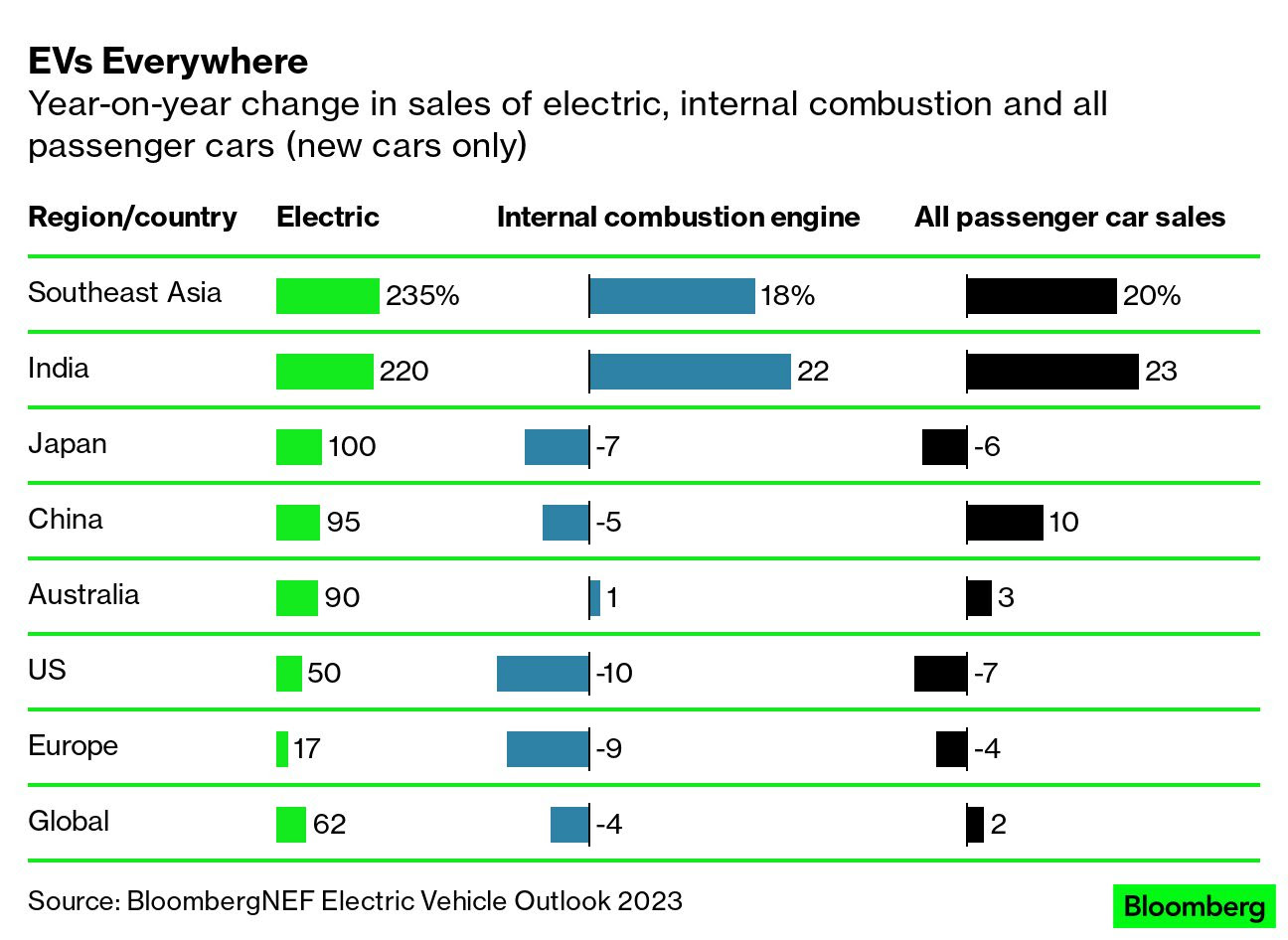
Kuper notes in 2022 SUVs accounted for a record 46% of global car sales, they're mostly driven by the rich, consume one-fifth more oil than medium-sized cars, electric SUVs won’t do much to prevent climate change because they need outsized batteries, and SUVs are lethal for pedestrians.
It'd be fair to say he's not a fan of SUVs. I wonder what he'd think of NZ city dwellers driving utes?
In short, we need to legislate away huge cars such as the Ford F-series truck, the US’s bestselling passenger vehicle for 41 years running. After all, we ban other dangerous substances, and sometimes even not very dangerous substances, such as marijuana. We already regulate cars themselves in all sorts of ways. Jurisdictions from California to France have scheduled the end of sales of new internal-combustion-engine cars, while cities like London bar dirty cars from certain zones. In the US, efficiency regulations apply to the range of vehicles sold by a manufacturer. But why not limit the size and emissions of individual car models? Some European countries already tax big cars, but in a climate crisis we need more radical action.
It’s true that regulating away huge cars would be a restriction on freedom. Many people want huge cars. Psychologically, an SUV is a second home. But eliminating these civilian tanks wouldn’t exactly be green authoritarianism. Even with smaller cars, people could still drive wherever they wanted, as quickly as before. SUVs hardly qualify as a necessity compared with two other big emitters, planes and cows. If we banned planes, which account for only about a quarter of the emissions of passenger vehicles, longer-distance travel would practically cease. Banning cows will become a serious option once we can deliver large quantities of cheap, nutritious plant-based milk and fake beef, but we aren’t there yet.
5) Using sport to sanitise a country’s reputation.
Saudi Arabia may have effectively taken over men's golf this week, but I'm a football tragic and have no interest in golf. Thus I'm much more interested in what the oil rich country's doing in the world of jogo bonito, the beautiful game. It's quite a bit and involves huge sums of money. The kingdom’s Public Investment Fund (PIF) already owns 80% of England's Newcastle United, and this week acquired 75% stakes in four Saudi clubs.
In January fading Portuguese superstar Cristiano Ronaldo moved to ply his trade in the Saudi Arabian league. Now French World Cup winner Karim Benzema has joined him, with his international teammate N’Golo Kanté and other high profile players poised to follow. Lionel Messi, the biggest name of them all and already a well paid Saudi tourism ambassador, did turn down a massive Saudi offer to move instead to Inter Miami from the Qatari owned Paris Saint-Germain.
By the time you read this, the Abu Dhabi controlled Manchester City, fighting 115 charges of breaching the English Premier League's financial rules, may have won the European Champions League for the first time.
But back to the Saudis. Writing in The Guardian Will Unwin argues the recent moves are:
part of a plan to use the sport to sanitise the country’s reputation.
He adds:
There is a long-held ambition in Saudi to host the World Cup, with a potential bid for 2030 being worked on. Reports have claimed talks were held with Egypt and Greece over a joint bid. The country’s leader, Mohammed bin Salman, can see the political gain in hosting the event after being marginalised by other nations for Saudi Arabia’s actions, including the murder of Jamal Khashoggi, the bombing of Yemen and restrictions of women’s rights.
Saudi Arabia is attuned to how sport could improve the country’s profile and draw positive attention. PIF first ploughed money into LIV golf and now that has merged with the PGA Tour and DP World Tour. World title boxing has been hosted but there is no legacy to the bouts. Ditto with Formula One. Football could be its most effective tool. Whereas golfers are participating in Saudi-backed tournaments, footballers are living in and conspicuously attached to the country.
Saudi Arabia has seen what Qatar’s hosting of the World Cup did for its reputation, but also how the team failed. The Saudis aim to create a team that can make it to the knockout stages by 2030. By defeating the eventual winners, Argentina, in Qatar, Saudi Arabia showed their potential. Talks have been held with European clubs to help create pathways for young players.
We welcome your comments below. If you are not already registered, please register to comment
Remember we welcome robust, respectful and insightful debate. We don't welcome abusive or defamatory comments and will de-register those repeatedly making such comments. Our current comment policy is here.