
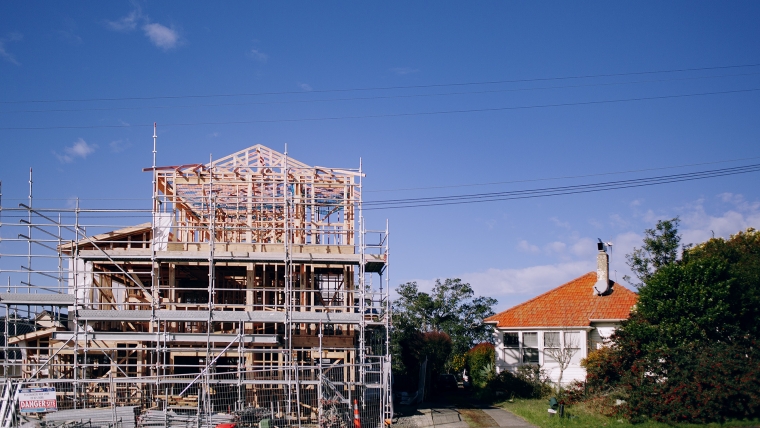
The Act Party hopes to tackle the housing crisis by requiring residential property developers to seek permission from 70% of the neighbourhood before building medium-density units.
It would also incentivise local councils to approve new dwellings by sharing the revenue earned from GST, and create an alternative consenting process based on private insurance.
In a policy document released on Sunday, Act leader David Seymour said New Zealanders needed to “build like boomers” to make up for a significant shortage in housing.
Successive governments had focused on demand-side measures—such as tax changes, first home grants, and the foreign buyer bans—but the real problem was the supply of houses.
Research from Auckland University, a joint-agency housing research group, and Treasury’s chief economic advisor have all reached this same conclusion.
Act used estimates from the New Zealand Initiative when forming its policy. The free-market think-tank has forecast that between 20,000 and 40,000 homes will need to be built every year to meet demand.
A paper written by the Initiative’s Leonard Hong said the only way to fix unaffordable and overcrowded housing was to free up supply.
“Politicians should stop blaming the housing crisis on migration, land banking investment, and speculation, and instead find policy solutions to free up urban development and housing supply.”
Not in my backyard
The paper name-checked “NIMBY-ism” and “cultural heritage activists” as being among a range of factors that had discouraged urban development.
But local and central governments had helped to ease some of the restrictions through Auckland’s Unitary plan and the National Policy Statement on Urban Development.
“Up-zoning brownfields for apartments, townhouses and greater density is critical for improving affordability,” Hong wrote in the paper.
Rather than giving developers the greenlight to build medium-density housing, Act’s policy would empower local residents to approve or permit bigger buildings.
The party would replace Medium-Density Residential Standards (MDRS), which allows for three-story multi-unit dwellings, with the much more restrictive Mixed Housing Suburban Zone.
Auckland Council says buildings in this zone were usually one or two story, stand-alone homes, that were set back from the site boundaries and had landscaped gardens.
The Act Party would amend the Resource Management Act to default to giving property developers permission to build bigger buildings, but allow neighbours to object.
Developers would have three pathways to build outside of zoning laws: getting 70% of a street or block to approve a change in zoning rules, negotiating approval directly with neighbours, and finally through a Planning Tribunal.
The Tribunal would be able to exempt the developer from planning restrictions, provided they pay compensation to anyone affected by the new building.
A problem shared is a problem halved
To counteract these more restrictive rules (relative to the MDRS) the Act Party would incentivise councils to consent more homes by sharing the tax revenue earned from property developments.
The GST revenue earned from new builds currently goes to the Government, despite local councils footing the bill for the infrastructure required by the homes.
Hong suggested a similar policy in his paper, saying it made “little sense” that councils should bear the cost of new development while the central government gets the revenue.
“Burdened by infrastructure financing costs, councils have little incentive to build,” he wrote.
“Localising decision and veto rights without offering corresponding benefits of growth incites anti development sentiments as locals bear the costs without generating the revenue”.
Act’s policy hopes that local councils would be more willing to consent homes and relax zoning laws, if doing so earned them money to use on upgrading roads and water connections.
Half of the GST revenue earned from a new build would be redirected to local councils, which Act estimated would be worth about $1.2 billion each year.
“That provides a very good environment for approving more homes, allowing for more consents and enabling builders to build without more delay,” the policy document said.
The final plank in Act’s housing plan would be to create an alternative to local council consenting process that would rely on private insurers instead.
“The scheme would require builders to purchase insurance for all new dwellings from an insurance company regulated by the Reserve Bank. Insurance companies could choose not to cover a given builder if they used risky materials or was otherwise too risky of a client for them to take on.”
This would give homeowners certainty, as the insurer would be on the hook if their home turned out to have been poorly-built with shoddy materials.
Act said because insurance companies would be earning money from each consent, they would be incentivised to approve development and accept innovation.
“This avoids the overly skittish approach of present council inspections. Insurance companies could, for instance, have ‘trusted builder’ programmes, where builders using certain standard materials and with good track records and certifications could be subject to fewer inspections than other builders”.
We welcome your comments below. If you are not already registered, please register to comment
Remember we welcome robust, respectful and insightful debate. We don't welcome abusive or defamatory comments and will de-register those repeatedly making such comments. Our current comment policy is here.