
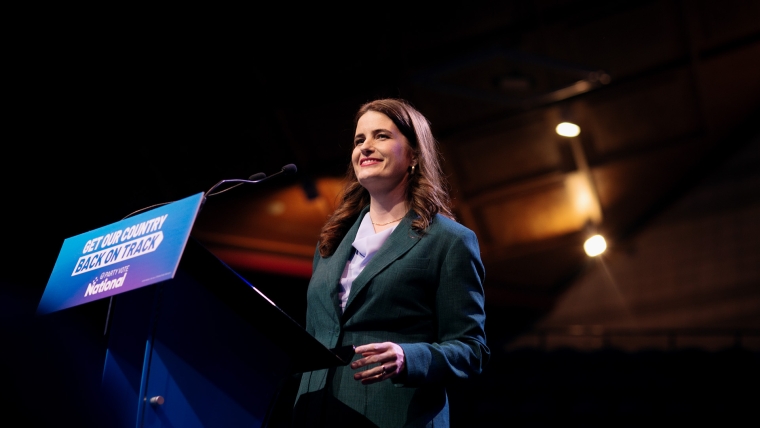
The National Party has released a fiscal plan which would reduce New Zealand’s public debt by about $3.4 billion by 2028.
It includes lower the operating allowances than Labour used in the pre-election update, increasing benefit rates more slowly, and means testing the free prescriptions policy.
National would cut about $300 million off each of the next four operating allowances ($400m in 2025) to save $3.3 billion, which would be used to pay down debt.
The operating balance would return to surplus in 2027—the same year as Labour—but would be $800 million bigger. The following year’s surplus would be $1.4 billion bigger.
This lower debt track doesn’t make much difference to net debt as a percentage of gross domestic product. It would be 19.1% instead of 19.8% at the end of 2028.
But Nicola Willis, the party’s finance spokesperson, said even a small reduction in spending would result in a better fiscal position over time.
“Small savings now build up to be significant savings over time — the opposite is also true,” she said.
The plan leaves $9.9 billion of unallocated money in the operating allowances to spend on unforeseen costs, other new initiatives, or demands from coalition partners.
National’s lower spending track has been made possible by indexing most benefit payments to the rate of inflation instead of wage growth.
This will save about $2 billion across the forecast period and would continue to accrue overtime. Superannuation, the largest benefit, would still be indexed to wage inflation.
Another $317 million in savings would come from targeting the free prescriptions policy.
The biggest cost cuts were announced in the Back Pocket Boost tax plan and remained unchanged in the fiscal plan.
Adjusting income tax brackets is the party’s biggest policy, at a cost of almost $9 billion across the four years or a little over $2 billion each year.
It will save the median wage worker $25.50 each week and the average household $51 a week.
Restoring interest deductibility for landlords would cost $2.1 billion across the forecast period, or about $525m.
Government departments would be asked to cut 6.5% of their budgets, saving an estimated $8.3 billion across four years. This would be used to help fund $14.5 billion in tax cuts.
The other half of the funding comes from new revenue initiatives, including the foreign buyers tax which has been questioned by economists. It was unchanged in the fiscal plan.
If the tax revenue did fall short by $500 million each year, as alleged, that would wipe out almost two-thirds of the $3.4 billion debt reduction National has promised.
Assuming all the revenue did arrive as forecast, then net debt would peak at $102.8 billion in 2025 and finish the forecast period at $97.6 billion — only slightly lower than Labour.
Willis said this comparison presumed that Labour would stick to its spending commitments, something she likened to “believing in the tooth fairy”.
The party has kept most of Labour’s funding precommitments and estimates of cost pressure increases.
We welcome your comments below. If you are not already registered, please register to comment
Remember we welcome robust, respectful and insightful debate. We don't welcome abusive or defamatory comments and will de-register those repeatedly making such comments. Our current comment policy is here.