
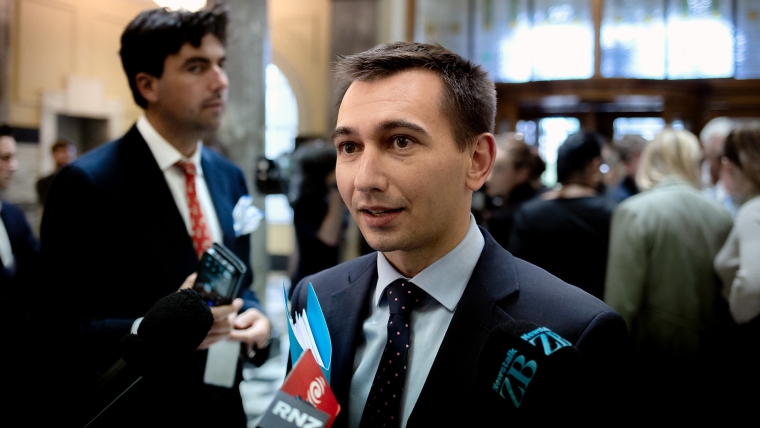
Local Government Minister Simeon Brown has been a passionate advocate for localism and devolution in Parliament this week.
“Councils know what is needed for their communities and should not be forced or mandated to take a one-size-fits-all approach,” he said during a debate on Tuesday night.
These are core National Party principles which form the basis of Prime Minister Christopher Luxon’s belief about how the Government should work.
He likely enjoyed hearing Brown say: “This is about providing flexibility to councils, not just simply telling them what to do or mandating them, like the former Government did”.
These comments were made during the third and final reading of the bill repealing Labour’s water reform and kicking responsibility for water management back to local councils.
Brown argued that “many aspects” of the previous Government’s reforms were “top down and not driven by local communities and local councils who best know their communities”.
While he made these localist statements in the debating chamber, back in his Beehive office he was attempting to strong-arm a city council into obeying his edicts.
Brown, and his coalition partners, have decided to repeal the Auckland Regional Fuel Tax and are demanding that any leftover money be spent on Central Government priorities.
Mayoral resistance
Auckland Mayor Wayne Brown is unhappy about having a key revenue stream scuppered in the middle of developing the council’s Long Term Plan.
In retaliation, the mayor has told Auckland Transport to halt all work on anything that was funded from the fuel tax while the council works out how to proceed.
This included asking for advice on “deferring, cancelling, or rescoping” the Eastern Busway, a pet project for Simeon Brown which is popular in his Pakuranga electorate.
“Auckland Transport must not assume that RFT funding will simply be replaced by higher council rates or debt,” the mayor wrote in a letter to Auckland Transport.
This prompted a response from Minister Brown who said he would write into law which projects the remaining fuel tax money must be spent on.
In a statement he said: “In repealing the Auckland Regional Fuel Tax, we’ll be legislating to ensure that any remaining funds are spent on these priorities.”
Mayor Brown said now that there was not enough money for all planned projects, it was for Aucklanders to decide which ones to build and which ones to scrap.
“Aucklanders need to have a greater say over the region’s transport programme. We are the only council in the country that cannot set its own transport plan, and that is just ridiculous”.
Localism, when it suits
Chris Hipkins, leader of the Labour Party, said the minister was being hypocritical.
“Simeon Brown seems to be saying that he’s all for localism unless the local decision making is something that he doesn't agree with and then he’s just going to legislate over the top of it”.
“That isn’t localism,” he said.
Simeon Brown said he had a “positive relationship” with Mayor Brown and had spoken with him about where the remaining fuel tax money should be spent.
“We're going to legislate to ensure that those funds are available and required to be utilised for those projects,” he said.
He did not answer a question about whether the mayor supported those selected projects.
Matt Lowry, author of urbanist blog Greater Auckland, said the regional fuel tax only collected about $150 million per year but unlocked $4.3 billion in total funding over a decade.
Congestion charging, which has been pitched as a possible replacement for the fuel tax, was designed to change when people travelled, rather than to earn revenue.
“More importantly, even if today the government passed legislation to enable it, it will still take a number of years for the system to be designed and start to be rolled out — and in the meantime, that still leaves Auckland with a giant funding gap,” he wrote.
A Ministry of Transport briefing to Minister Brown said ambitions for transport investment had outgrown the country’s capacity to fund and deliver it.
Debt-funded Crown contributions to land transport funding had increased over the past two decades, as user charges had fallen behind these “investment ambitions”.
The ministry said a new approach to paying for land transport, such as value capture, congestion charging, toll roads, and using private funding to lower overall costs, was needed.
We welcome your comments below. If you are not already registered, please register to comment
Remember we welcome robust, respectful and insightful debate. We don't welcome abusive or defamatory comments and will de-register those repeatedly making such comments. Our current comment policy is here.