
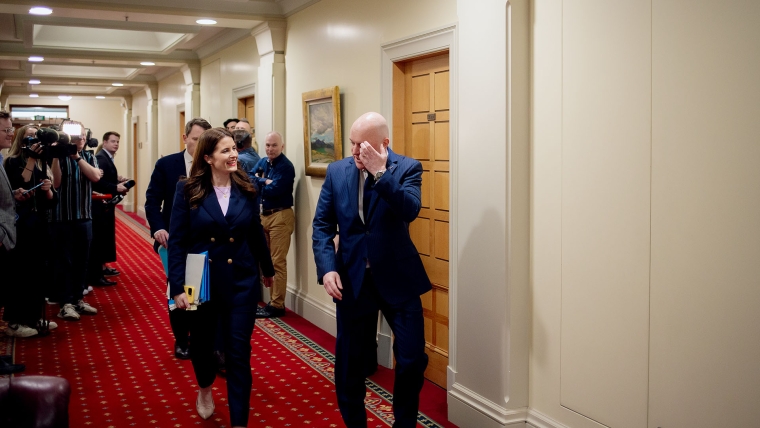
Update: On Tuesday morning, Finance Minister Nicola Willis told reporters there would not be new taxes or fee increases in the budget. She said the tax plan would still be fiscally neutral but didn't reveal details.
Earlier on Monday, Prime Minister Christopher Luxon was unable to rule out introducing new taxes following reports the coalition may need to find billions of dollars to balance its budget.
A number of fiscal challenges have left the Coalition Government more than $5 billion short relative to the draft fiscal plan put forward by National in the election campaign.
The cost of restoring interest deductibility for landlords will be $800m more than expected, while the revenue from the online gambling tax will pull in $500m less than planned.
Indexing benefits to inflation was supposed to save $2 billion, but that estimate has been revised down to a measly $670m.
But the largest chunk of missing money comes from the plan to invite foreign buyers back into the top end of the housing market and tax them for the privilege.
National and its advisors at Castalia forecast it would bring in $3 billion—a number that was met with skepticism—but the policy never made it through coalition talks.
Since then, Finance Minister Nicola Willis has been warning updated Treasury forecasts show the economy has weakened, having a multi-billion impact on the Crown accounts.
Some shortfall in revenue could be absorbed by unallocated budget allowances, but that money would also be needed to fund coalition promises and cost pressures.
In light of these fiscal pressures, Interest.co.nz asked the Prime Minister if Cabinet was considering any revenue raising replacement for the scrapped foreign buyers tax.
Luxon said the details would be revealed in the May budget, which would contain a “fully funded” tax relief package, as promised.
“It'll be a combination of revenues. Those revenues may look slightly different than what it was before the election. They might look the same”.
When pushed to confirm there would be no new taxes on working people, the Prime Minister wouldn’t do so.
“Just wait for the budget, coming very shortly. But what we're dealing with is the dynamics of economic circumstances, and a massive determination to deliver tax relief to lower middle income New Zealanders”.
Elsewhere in the press conference he said the tax package would be funded partly through “revenue raising measures” and partly through “savings that have been identified”.
Carbon-based problems
To make matters worse, the Climate Change Commission has cast doubt on whether $2.3 billion of revenue from the Emissions Trading Scheme—earmarked for tax cuts—could be counted on.
It has recommended a drastic reduction in the number of available units from next year in an effort to soak up an oversupply in previous years.
Commissioner Catherine Leining was asked on Monday how that advice might impact the price of units and therefore revenues earned from the scheme.
She said the scheme was not designed to generate revenue, but the money it did bring in was a result of both the price and volume of units sold at auction.
Economic theory might suggest a lower supply of units would lead to a higher price, therefore offsetting the fiscal impact of offering less units. But Leining wasn’t so sure.
“What we consider is that we aren't actually reducing supply, we're actually correcting for an oversupply in the market and trying to keep supply parameters in line with emissions budgets”.
“So it is really hard to predict exactly what the impact will be on the auction revenues that come out,” she said.
There were also other costs to be considered, including the debt liability which appears on the Government’s books when a unit is issued and the cost of buying offshore carbon offsets to meet our international obligations — which are stricter than the domestic ones.
She also said one possible way to boost the unit price would be to reduce the free industrial allocations.
We welcome your comments below. If you are not already registered, please register to comment
Remember we welcome robust, respectful and insightful debate. We don't welcome abusive or defamatory comments and will de-register those repeatedly making such comments. Our current comment policy is here.