
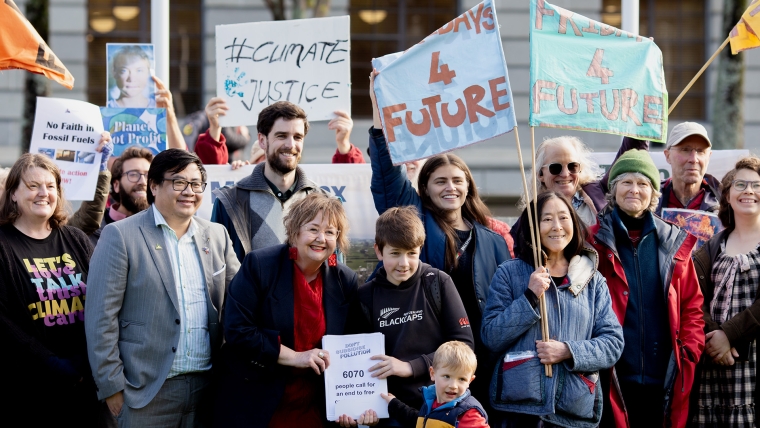
More than 6,000 New Zealanders have signed a petition asking Parliament to phase out the free carbon credits given to protect some high-emission industries.
Megan Woods, a former Energy Minister, accepted the petition on behalf of the Labour Party at Parliament on Tuesday and promised to consider the idea for the party’s 2026 manifesto.
The policy could help New Zealand reduce its emissions faster and possibly relieve some of the cost pressures on any households that are exposed to carbon costs more than average.
But it would also risk pushing some economic activity out of the country and significantly reducing the number of well-paid jobs available in some regions.
The Emissions Trading Scheme limits the amount of climate pollution permitted in the New Zealand economy and requires emitters to purchase and surrender one unit per tonne of C02.
It is intended to use market forces to find the most cost-effective ways to reduce emissions and meet internationally agreed targets, such as the Paris Accord.
However, some free units are allocated to businesses in emission-intensive industries that are competing with overseas rivals not subject to a carbon tax.
If emissions pricing pushed production into countries with looser rules and dirtier energy, New Zealand would lose economic activity and global emissions would increase anyway.
The free industrial allocation aims to protect businesses and jobs that might not have cost-effective ways to decarbonisation their production processes.
Phase out
The campaigners, Don’t Subsidize Pollution, want this free allocation to be phased out over the next six years, instead of at the current rate of 1% per year.
It then wants half those units to be used to reduce the total emissions cap and the other half to be added to the quarterly auctions to generate more revenue for other climate spending.
Co-director Alex Johnston said it wasn’t fair that everyday New Zealanders had to face the full cost of emissions pricing, while these multinational corporations were protected.
“We need an urgent end to free carbon credits and a plan in place to help these industries decarbonise, not prop up their existing production process,” he said in a press release.
The five
Christian social justice group, Common Grace Aotearoa estimated the five largest beneficiaries emit the same amount of pollution as half the entire country’s vehicle fleet.
They are: methanol maker Methanex, fertilizer firm Ballance Agri-Nutrients, Rio Tinto’s aluminum smelter in Southland, Bluescope’s steel mill in Auckland, and Fletcher Concrete.
While drivers have to pay for their emissions, these ‘big five’ businesses don’t. They were given a $280 million subsidy to cover the 5.6 million tonnes of C02 they produced in 2022.
Common Grace Aotearoa, and other members of the Don’t Subsidize Pollution campaign, have been collecting signatures asking Parliament to end the giveaway.
Labour’s Megan Woods said any changes in policy would need to consider the impact on the workers that are employed in places such as the Tiwai Point aluminum smelter.
“We must have climate action to save our planet but also find a way to preserve well-paid, skilled jobs,” she said.
Don’t Subsidize Pollution has lobbied to replace the subsidy with a Carbon Border Adjustment Mechanism, which would impose an import tariff on any goods not subject to a carbon tax.
A working paper, published by Motu in 2021, said the Government could explore a border carbon adjustment instead of the free allocation — but warned it would be complex.
It could include a rebate for the emissions price paid on goods manufactured in New Zealand that were being exported to a country that didn’t have its own carbon tax.
Corporate welfare
Don’t Subsidize Pollution also called for a return to the Labour Government’s policy of using the proceeds of the Emissions Trading Scheme to fund decarbonisation technologies.
Last year, NZ Steel struck a deal with the Crown to split the cost of building a $300 million electric arc furnace at its Glenbrook steelworks near Waiuku.
It was estimated to remove 800,000 tonnes of climate pollution each year, bringing the lifetime cost to about $16.20 per tonne when the carbon price was about $55 a tonne.
National criticized this arrangement as “corporate welfare” but it doesn’t have any plans to remove the free allocation or further incentivise these businesses to decarbonise.
NZ Steel said it wouldn’t have been able to make the investment without Crown support. The steelmaker also considered closing the plant in 2015 due to falling steel prices.
Businesses that receive free units are still incentivised to reduce emissions, as they are able to on-sell their carbon credits if they don’t need to surrender them in exchange for pollution.
57 Comments
Four of the five companies listed are in areas where technology is rapidly advancing to reduce or eliminate their production of carbon. Not sure if it is possible at Methanix though. They use natural gas to make urea fertiliser. The question there is that under the current circumstances is it appropriate to be supporting an agriculture process to extract more from a given tract of land?
Methanex makes methanol, which could be used to fuel Maersk's new methanol-powered ships. Ballance makes urea.
Oops. Thanks. Can either processes be done with less impact? The other three, not four, have technology solutions available now or being developed to reduce and eliminate their emissions.
Methanol can be made using CO2 and hydrogen gas which has been split from water using renewables (sometimes called e-methanol). It is a very inefficient process.
Methanex is the world's largest methanol producer with revenues of $6 billion and their largest plant is in NZ. They have almost no low-carbon investments to speak of, no emissions reductions targets, and only minute work underway to reduce emissions (eg reducing emissions by 50,000 TCO2 out of 1.5 MTCO2 in NZ). Meanwhile global methanol production went from 40 MT in 2008 to 111 MT in 2021. In some industrial sectors, the big players and the industry bodies have credible pathways and investments aligned with 1.5C or 2C, I'm not seeing that from Methanex. I suspect their current plan is to run the plant until the gas runs out in 2040 or so and then scrap it.
On the other hand, shifting to e-methanol would require an enormous investment, so who is going to make that happen?
Soluble nitrogen production in nature is by N fixing microbes in partnership with plants. Clover, tagasaste and thousands of others. Quorum Sense and the regenerative agriculture proponents know this, and are slashing their synthetic N inputs to boot.
"which could be used to fuel Maersk's new methanol-powered ship"
So turn natural gas (a fossil fuel) into into methanol (another fuel) so it can be burned into green house gasses while consuming even more energy in the process.
Yup. That makes sense.
About as clever as using natural gas to a) create electricity for EVs or b) create hydrogen to either burn or to be used in a hydrogen fuel cells to create electricity?
As clever as shutting down Methanex and importing Chinese coal derived methanol.
https://www.argusmedia.com/en/news/2154656-china-wanhua-starts-up-new-c…
We need more carbon to make our plants grow.
More carbon will make plants grow in Antartica. The only downside is most of the world becomes uninhabitable.
Or perhaps habitable areas just shift, the deserts become green and some current green areas become deserts.
I don't know if it's a fact but read that some desert edges are growing more plants.
Not the one but there is this - https://www.csiro.au/en/news/All/News/2013/July/Deserts-greening-from-r…
This study suggest plants are growing better with more Co2 and are absorbing more water, good news for vegetarians. you at least, wont starve!
It *could* turn out to be warmer and more humid, more greener but not Catastrophic. something like it was for cavemen.
Or will our allergies stop us from wearing furs :-)
Is there any evidence of desertification happening anywhere?
OK then, I'll take my optimism elsewhere.
Labour proposing to destroy businesses. Obviously they have not learned.
Labour also had 6 years in Parliament to fix this and failed. There lies the rub - ineffective and full of rhetoric only.
What's the NACTF doing on this front?
Like banning Grey Hound racing - letting it ride...
Hopefully nothing (unless you welcome more unemployment, higher building costs and higher food costs) This stuff just will need to be imported with more ‘environmental damage’ the result. NZ is carbon neutral anyway, so they would just be shooting everyone in the foot (par for the course with these guys).
You're going to get 'higher costs' anyway. That isn't the yardstick anymore.
Whether this can/cannot be continued, is the yardstick.
But I guess, when you can be cognitively-dissonant enough to equate degrowth with communism, you can just about argue for anything.
I think he was referring to the degrowth "movement", rather than the phenomenon.
But you do argue about anything. But...your answer to everything is that either the world is going to end, or we are going to have to live in caves (like you) or the sky will fall on our head.
The problem is extremism. To make their point most debaters become extremists, all or nothing. The problems are complex; how do you get a politician's attention without telling them the sky is about to fall? How do you get fixes put in place when they're affordable and achievable? If it's not urgent the politicians aren't interested in legislating, but if it is the cost of fixing it is unaffordable for society. PDK is a product of the environment. He is not wrong. Does he over state the situation? Possibly but less likely now as the physical evidence for everyone to see is more evident.
But even with all the evidence available, the most compelling is that the politicians are still in denial!
If you don't agree with PDK, it's most likely a timing issue - he is thinking further ahead without a recency bias. By the time most of us catch up, it will be too late.
Yeah, yeah. Forward thinking that looks like backward thinking. The earth will crash into the sun eventually. What action are you going to take to stop it, better start now, and live in a cave, you only have a few billion years to get ready. Think of your children.
Some of its about balance.
It seems pretty clear that living standards will only continue to erode, with profits leeching to the corporate providers of much of life's necessities, many of which will become more scarce (or in higher demand, whichever way you want to put it). So it's potentially prudent for us to examine how and why we are living.
But on the other hand, believing in a formula you think predicts when/how the sky will fall, has mostly shown to be folly. If I were PDK, I'd find a nice, low impact and inexpensive way to live, and enjoy the rest of my days. Rather than running around telling everyone how screwed they are.
PDK seems to be half way there, It sounds like he has a low impact life that he enjoys. But he does persist in running around like chicken little telling everyone and sundry how screwed they are when the sky soon falls in. So, he still has some way to go.
If you're that wound up most of the time, you're probably not enjoying it that much.
I'm way more in his camp. It's hard not to see much of modern life as a bit of a trap, and a rort. We have too much of our time and resources tied up in things which aren't really of much benefit.
Our time is very limited and we value it poorly. And we spend way too long with our attentions on the wrong things.
Should it be diverted to a terminal doom loop? Sometimes we should be taking the time to smell the roses.
Seeing jeremy's comments on here over the past few months, it's quite clear his angle is a combination of contrarianism and bravado all for the sake of appearing unique or challenging consensus to a bunch of strangers on the internet.
He'd be the sort of person to scoff at a tsunami warning, wander down to the beach and tell everyone they're overreacting because the tide is infact moving out.
I'd say if changing the subject works for you, then you do you. This is a financial web site, where it is quite common to descend into pointless arguments about the climate. Now you are trying to work out whether I think the effects of earthquakes are real or not. That certainly is a new angle. You are correct, I often scoff at Tsunami warnings when it is very clear that they will not happen, particularly when the warnings apply to the a west coast and the earthquake happened on the opposite coast. I also think it is quite funny when they have people on the news that have driven to the top of a hill in panic to escape a 1m wave. If there was a warning that was serious, then no, I would not go to the beach I would take appropriate steps to avoid it. Many people run to the beach and go surfing, but I don't surf.
Thank you for proving my point.
PDK does not want what he warns of. The warning is a call to action to prevent the worst outcomes which we are accelerating towards.
No, I'd rather we got smarter.
But I've also gone ahead - I have a Homestar8 rated house, pushing passive-solar to reasonable limits; energy efficiencies ditto.
And a lot of other lifestyle choices/infrastructure, demonstrating what can be done.
What I can't fix, is people's fierce need to be ignorant...
...and, I probably do all you do and more. The only difference is you seem to feel the need to tell other people what they must do, just because you do it. It don't see the point in doing that, because as you can see, it just results in people rejecting your argument outright.
You couldn't be more wrong with that statement Jerry. PDK doesn't tell other what to do he gives you a choice with every statement.
A little bedtime reading is suggested. I stress 'little' as PDK would give you a comprehensive reading list which you would likely find challenging.
My suggestion for you is; 2052 - A global forecast for the Next Forty Years. Jorgen Randers. ISBN 9781603584210
Randers was part of the team producing the Limits to Growth for the Club of Rome - Meadows, Meadows and Randers
As Randers says in the preamble. "This is what keeps me awake at night."
I think you guys read too much garbage. Maybe you should go read about Sten Gustaf Thulin the famed environmentalist that invented......the plastic bag, because he was dead worried about how many trees where being used to make paper bags...that turned out real well. I'm sure you would have been cheering him on back then.
Maybe we should all just try and play the ball, and not the man.
I've often wondered what some commentators identify as...
:)
Green’s glib gibber?
Many of the named polluters are using plant that is many decades old and wastes significant amounts of inputs (natural gas), i.e. produces less than per unit of input than a modern plant. Without being pinged for the waste, the companies have no incentive to upgrade their plants.
No easy answers here. But because modernization would benefit every taxpayer, I've no objection to some taxpayer money being used to assist in any modernization projects. I struggle with understanding why this is classed as 'corporate welfare'.
And National been hypocritical as they were the ones that insisted it be part of the ETS.
You're mistaken when you say
Without being pinged for the waste, the companies have no incentive to upgrade their plants
The companies are given credits based on their production, not emissions. Therefore they stand to benefit when they bring their efficiency up, as they get the same free credits while lowering their surrender obligations (and energy costs for those not directly surrendering units).
I always struggle with the concept of subsidized productivity. Meaningful/valuable productivity should be innate, if you're spending $1.20 to get $1.10 worth of productivity, you haven't become more productive, you've just overcapitalised in a minor improvement.
"I always struggle with the concept of subsidized productivity."
Next time you see a truck on our roads ... struggle some more.
I try to word things to remove as much ambiguity for you. "Subsidized productivity gains" might have been more apt. We can transport things by hand/horse and cart, or move up to some sort of expanded rail freight network, but either would likely be a net loss over the status quo.
The key thing was the proceeds of the carbon sales were been used to fund carbon reduction projects. Willis took that money to pay for tax cuts.
Although, perversely, this should incentivise the government to have more units at higher prices in the ETS as it is a source of revenue.
Can someone explain to me how fletcher concrete is competing globally? Can’t imagine much concrete is imported/exported… far too heavy/bulky I would think…
Before the latest building boom, there was in increase in imported clinker (which I understand is the basic product created to produce cement?) and Fletcher was worried about profitability at their Whangarei based cement works. I am not sure whether massive increased demand solved the problem? Maybe it will be come an issue again as building drops off?
This link seems like the latest analysis: https://environment.govt.nz/assets/publications/potential_for_emissions…
Holcim used to manufacture cement domestically but shut down in 2016 and now imports. I think the bulkiness is an issue, but given that there's only one plant remaining in NZ too (near Whangarei), there are also domestic transport costs to take into account.
As the report says: "The importer would also need to transport cement to market, so it appears that the competitiveness of the import prices will depend on the distance from the import port relative to the distance from GBC. Holcim imports via ports of Auckland and Timaru"
That giant white tit on Auckland wharf. That’s the cement silo.
If emissions pricing pushed production into countries with looser rules and dirtier energy, New Zealand would lose economic activity and global emissions would increase anyway.
The free industrial allocation aims to protect businesses and jobs that might not have cost-effective ways to decarbonisation their production processes.
That's the rub. As a Christian, I don't think these Christians represent my views. Their thinking is too black and white on this issue. Their solution would both make NZ poorer and make climate change worse.
They will make enemies with the Greens if they continue down this path. Stealing their ideas and all.
Then the proposed policy change is incomplete, and may need another mechanism to balance the outcomes.
I half agree... agree because in a static market that might be the case, but I favour a phase out of the free application because it acts as a signal to invest in more climate positive building designs, business models and tech.
A transition could be partially supported via GIDI-like mechanisms, but the transition reality is that some bau business models will be obsolete, and we need to find a way to be okay with that
"The policy could help New Zealand reduce its emissions faster and possibly relieve some of the cost pressures on any households that are exposed to carbon costs more than average."
Why are households exposed to any "costs" when NZ is a CO2 sink to the tune of 39 million tonnes of CO2 per annum?
Shhhh. The Green loons would cease to exist if you go on saying things like that. At the moment they are sitting pretty complaining about problems that don't exist and getting very well paid for doing nothing. Your going to ruin their party if you keep going on like this.
How about a petition to eliminate CO2 reduction initiatives. Instead, focus on strategies to adapt to steep future increases in fossil fuel prices. They are not the same thing!
If they are for socialnjustice why don’t they campaign on churches and the businesses they run paying rates and tax?
It’s long overdue. It’s about time they start contributing to society instead of just judging everyone.
Ironically these Christians would never campaign for redress for the hundreds of thousands tortured under their "care". If they were actually Christian, instead of seeking more gains for their own egos they would seek to provide a single ounce of redress and social conscience. Such social conscience can also be demonstrated by paying taxes as well. Perhaps we could see these Christians do actual social good instead of abusing people and claiming their brand makes their hands clean instead of covered with the blood of fellow children.
Its easy to spot ill informed and uneducated lobbyists. They are in it for the props and selfish tokens they can gain and do far more harm to kiwi families all for their own ideology, which ironically does far more harm to their cause. You see they are all about being paid to look good, not actually doing good. You see being ethical requires being honest with ourselves and our motives, something these fools cannot do as their egos are so large they would obscure everything around them including worldwide manufacturing and production.
After all who cares about medical & housing needs for these resources, nah just shutdown everything and watch us import more coal based manufacturing and crippling costs causing inflation spikes. After all they really don't care if the world burns just so long as they get their time in the sun looking good and collecting "donations" and public grants. Like most Christian organizations it is the poor funding the wealth and largess of the greedy for a spot in the afterlife because their real living lives cannot ever obtain completeness.
Jesus would find their actions shameful as they contribute to more social abuse while at the same time more selfish motives to further their own ends and collect funds from others. It is pretty sickening to see such ethical abuse and hypocrisy but eh. Same old, same old. Survivors will likely die before seeing redress from this lot, most have already, (including those that did not die from the torture as children).
Re christianity, your argument is correct; most religions started with one well-meaning, far-sighted person. Soon after, the edifice always gets taken over by psychopaths - or at least by those who seek to personally benefit.
But to use that as an excuse to avoid the message here, is invalid association.
Regardless of how many words you use.
We welcome your comments below. If you are not already registered, please register to comment
Remember we welcome robust, respectful and insightful debate. We don't welcome abusive or defamatory comments and will de-register those repeatedly making such comments. Our current comment policy is here.