

Fewer work visas are being approved as the total number of overseas workers in New Zealand gets back up to pre-Covid levels.
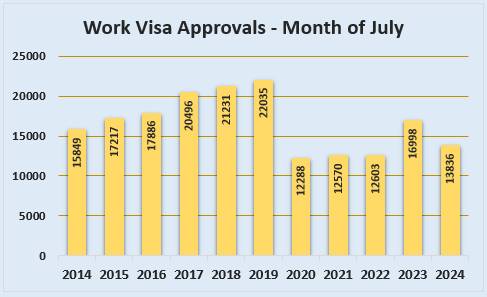
The latest figures from the Ministry of Business, Innovation and Employment show 13,836 work visas were approved in July this year, which apart from the three years of 2020-2022 which were affected by Covid-related travel restrictions and their aftermath, was the lowest number of work visa approvals in the month of July in the last 10 years. See the first graph below for the trend.
Work visa approvals are also lower on an annual basis, with 197,418 approved in the 12 months to July this year, down 33,048 (-14.3%) from 230,466 approved in the 12 months to July last year.
Work visa approvals peaked at 243,195 in the 12 months to July 2019, and were above 200,000 a year for 2016 to 2019 July years.
However while the number of work visas being approved appears to be in a modest decline, the number of overseas workers in the country is not.
According to MBIE there were 188,634 people in NZ on work visas at the end of July this year.
That's within a whisker of the 190,263 here pre-Covid in July 2019, and well ahead of the 168,105 in the country in July 2018.
However their impact on NZ's population is probably much greater than those numbers suggest.
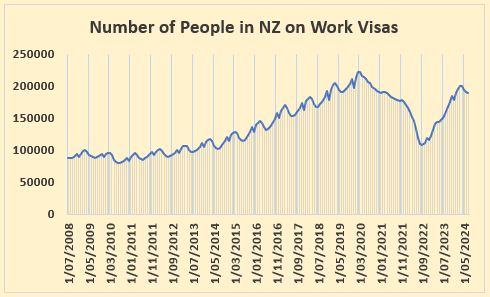
The second chart below shows the number of people in NZ on work visas at the end of each month going back to 2008.
This shows their numbers follow a very regular seasonal pattern and steadily increased from 2011 to early 2020.
Numbers then began dropping away sharply in April 2020, falling to a low point of 108,336 in September 2022, and started rising steadily again from October 2022.
Because that period coincided with Covid-related travel restrictions, it would be easy to think that was the main cause of the downturn in the number of work visa holders in the country.
But there was also another factor at play - the 2021 Residence Visa Approval Scheme.
This scheme provided a fast track approvals process for people who had been in NZ on work visas for several years and wanted to apply for residence visas.
Applications for residence visas under the scheme have now closed and it is essentially being wound up as Immigration NZ processes the last stragglers - just 15 residence visa applications under the scheme were approved in July this year.
However between December 2021 and July 2024, 211,335 residence visa applications were approved under the scheme.
This caused a massive decline in the number of work visa holders, as people transferred from a work visa to a residence visa, and a correspondingly massive increase in residence visa holders.
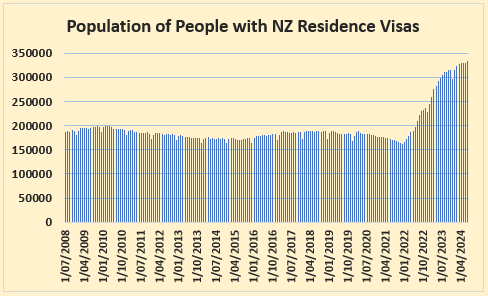
Between January 2021 and July 2024 the number of people in NZ on residence visas, as measured by MBIE's truncated data, more than doubled, from 161,183 to 333,198.
The effect of this is easily seen in the second and third graphs below, one showing a huge but temporary decline in the number of people in the country on work visas, and the other showing a correspondingly huge surge in the number with residence visas.
Given that so many migrants to NZ originally arrived on work visas and later obtained residence visas, and that trend is likely to continue in the future but probably at a slower rate than was evident during 2022/23, the impact overseas workers have on our population growth and therefore our economy, is almost certainly much greater than is suggested by the work visa data alone.
- The comment stream on this story is now closed.
•You can have articles like this delivered directly to your inbox via our free Property Newsletter. We send it out 3-5 times a week with all of our property-related news, including auction results, interest rate movements and market commentary and analysis. To start receiving them, register here (it's free) and when approved you can select any of our free email newsletters.
We welcome your comments below. If you are not already registered, please register to comment
Remember we welcome robust, respectful and insightful debate. We don't welcome abusive or defamatory comments and will de-register those repeatedly making such comments. Our current comment policy is here.