
New Zealand’s fiscal settings are not sustainable in the long-term and the spending cuts required to balance the budget this decade are “unprecedented” in recent history.
That’s the view of the Treasury’s chief economic advisor, Dominick Stephens, who gave a speech on debt, deficits and the ageing population in Queenstown on Thursday.
His speech reiterated the Government agency’s often repeated message that New Zealand’s fiscal settings will not be able to cope with the ageing population.
The Treasury had been “banging the drum” on the need for policy reform for many years but higher levels of government debt had now added to the fiscal challenge, he said.
It was in 2006 that analysts first advised net debt would rise exponentially as the population aged, unless significant policy changes were made to prevent that outcome.
At the time, net core Crown debt was forecast to be roughly 13% of gross domestic product in the year ended June 2020. In actuality, it ended up at 26% and has risen to 39.3%.
“Starting out with higher debt increases the sustainability challenge, because of the compounding nature of interest,” Stephens said.
At minimum, the Government’s annual operating costs need to be brought back into balance with its revenues just to halt the growth of debt. But Finance Minister Nicola Willis wants to go even further and reduce overall debt levels in the long term — this would be a challenge.
Treasury has estimated New Zealand would be in deficit even if the country was in normal economic times rather than recession, and the Coalition have compounded the problem with tax cuts.
Willis has opted for new spending allowances of just $2.4 billion each budget through to 2027 in order to return the Crown accounts to a surplus in the year ended June 2028. That allowance is $100 million less than the estimated costs of delivering existing services.
“This means that the Government will have to increase revenue or reduce the amount that it spends per person, in inflation adjusted terms, to meet this target,” Stephens said in his speech.
“The Treasury’s latest forecasts assume that most of the return to surplus will be driven by declines in per capita government consumption. The implied speed and size of this decline is generally unprecedented in recent history in New Zealand.”
Michael Reddell, an independent economic commentator, said on Twitter that this comment shouldn’t be overblown as spending levels were coming down from abnormally high levels.
“While the implied decline is sharp, so has been the decline in the last couple of years, and the increase since 2019 was also without precedent in recent times,” he wrote.
Reddell also pointed out this analysis assumed only spending cuts were used to achieve a surplus, and didn’t factor in planned revenue increases.
Simon Watts, the Minister for Revenue, said the Coalition was focused on the spending side of the equation. However, they were taking advice on collecting more from unpaid student loans overseas and possibly taxing charities which operate as commercial businesses.
Looking ahead
Despite the headline-grabbing comment, Stephen’s speech was about the fiscal challenge of an aging population over the next five decades. The cuts per capita planned over the next four years will only stop this from getting worse, it won’t do anything to solve it.
The problem is really the opposite of a problem: New Zealanders are living longer and better lives. While this is unquestionably good, it hasn’t been budgeted for in existing policies.
Stephens said there were seven working age people for every person aged over 65 back in the 1960s, but today there were only four and in 50 years’ time there may be just two.
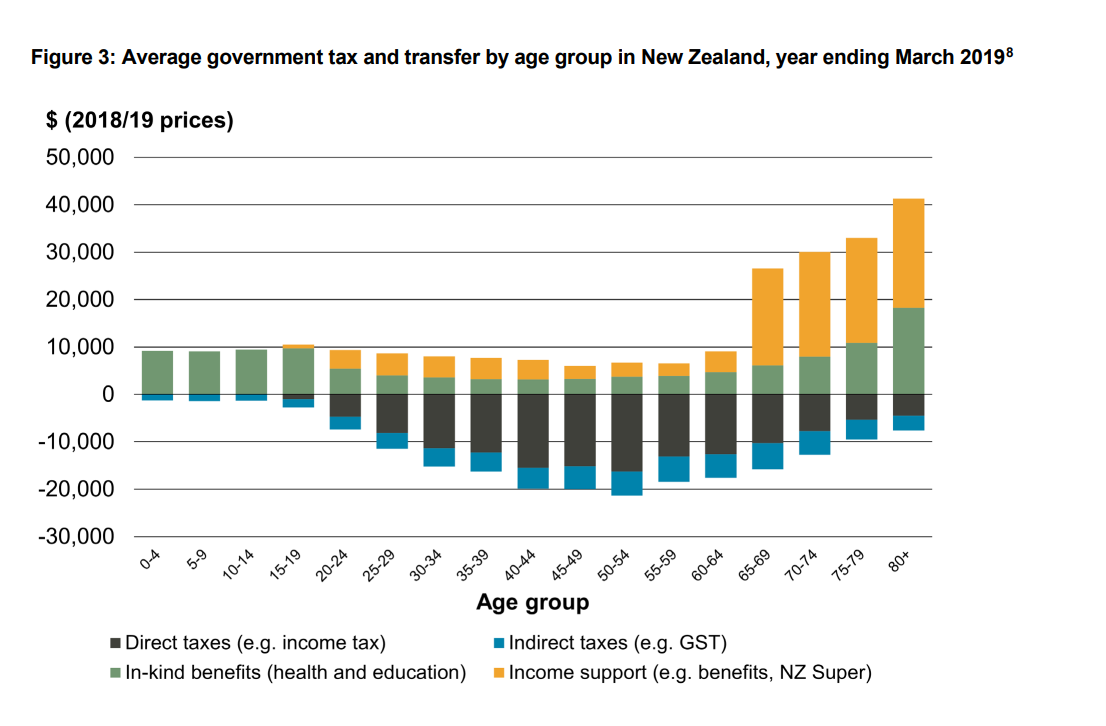
NZ spends considerably more on people over-65 than it gathers from them in taxes, and therefore will find the public purse “stretched further and further” as the population ages.
There have been three unexpected developments which are helping to offset the impact, even as higher-than-expected debt makes the challenge harder to meet.
Seniors are staying in work much longer, the population has grown faster, and long-term interest rates are lower than forecasters had predicted when first sounding the alarm.
Stephens said it was “hard to overstate how profound” the first change had been. NZ has gone from having one of the lowest rates of over-65s working in the OECD, to one of the highest.
Labour market participation of 65 to 69 year olds was first forecast to be around 38% in 2023 but it was actually 49%. Even 27% of those in their early 70s were still working that year.
This may be partly because earning extra income doesn’t reduce superannuation payments and therefore discourage people from staying in work.
“The downside of universality is that it makes National Superannuation expensive, as discussed earlier. This tension between affordability and work incentives will need to be balanced in future thinking about the design of retirement policies,” Stephens said.
Faster population growth has also helped reduce NZ’s average age and made universal healthcare and superannuation more affordable. The population is 10.5% larger today than it was forecast to be in 2006.
Act early
Regardless, these helpful developments are not enough to stop a rapid increase in debt over the next few decades. Governments will have to adjust their policy settings.
“There is no silver bullet: none of the policy options we modelled in 2021 was large enough to stabilise debt on its own. This means that governments will likely need to draw on multiple expenditure and revenue changes to close the fiscal gap,” Stephens said.
Managing the amount of money spent on healthcare would be critical, as it is a fast growing part of total spending and isn’t likely to get significantly cheaper in the future.
The Government could also choose to raise taxes, although this comes with economic costs and would require successive increases if the costs were not also reduced.
Stephens said boosting productivity would be vital for improving New Zealand’s general economic wellbeing but would have minimal impact on this particular problem.
“Higher productivity growth would boost wages, which flows through to higher wage-indexed superannuation payments and higher costs of providing labour-intensive public services.”
Finally, the Treasury has advised the Government to select some solutions soon, so that young New Zealanders can feel confident they will not be short-changed in the future.
There is already a growing wealth gap between younger and older New Zealanders, which could translate into a reluctance to support their retirements.
“Acting early to ensure fiscal sustainability will help sustain this trust and may bolster the willingness of future generations to continue participating in our pay-as-you-go pension provision system,” Stephens said.
We welcome your comments below. If you are not already registered, please register to comment
Remember we welcome robust, respectful and insightful debate. We don't welcome abusive or defamatory comments and will de-register those repeatedly making such comments. Our current comment policy is here.