
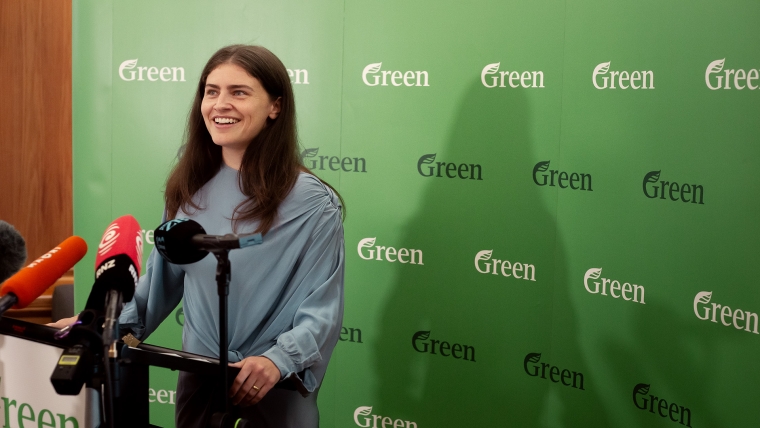
The Green Party has outlined a plan to reduce emissions more quickly and redistribute economic resources more evenly across society.
The full plan is estimated to cut net emissions 35% by 2030 and 47% by 2035, relative to 2020 levels. That would be almost four times as much as the Government's draft emissions reduction plan.
But He Ara Anamata, or the Alternative Emissions Reduction Plan, doesn’t just look for cleaner ways of working within the economic system. It suggests significantly reorganising it.
This would include more state-control of the economy, a much higher carbon tax, less farming and oil production, and a job creation programme similar to the 1930s and 1970s.
In a speech to launch the plan, Greens co-leader Chloe Swarbrick said the current economic system was radically reshaping the world’s ecosystem without the consent of the public.
“Who so thoroughly and successfully embedded the idea that we’ll just have climate change instead of changing the economy which produces it?” She asked.
The economy was working against human nature, to care for each other, and the ecosystem which sustains human life in the first place. It needed to be reorganized to not “exhaust and exploit” them both.
A 58 page report, released in Auckland on Sunday morning, outlined her party’s plan to achieve this without relying solely on market forces.
‘Think Green’
A Green Jobs Guarantee would echo job creation programmes from the 1930s and 1970s, where governments launched infrastructure projects to employ people who might otherwise be unemployed.
During the Great Depression, Labour's public works schemes upgraded the Milford Track, planted much of Wellington’s town belt, and built the Palmerston North to Gisborne rail line—parts of which recently were destroyed by Cyclone Gabrielle.
In the 1970s and 1980s, Robert Muldoon’s ‘Think Big’ initiative developed the Maui gas field and its associated infrastructure off the Taranaki coast, aiming to boost energy self-sufficiency and create jobs.
The Green Party’s version would attempt to create jobs for workers in climate-exposed industries, either restoring environments or building new infrastructure.
Rau Paenga would be scaled up into a “Ministry of Green Works” which would coordinate with a new Future Workforce Agency to plan projects and train a workforce to build them.
‘Super-charged ETS’
A hard cap would be imposed on the Emissions Trading Scheme (ETS) to drive gross emissions reductions, instead of mostly incentivising offsets. New forestry would not be allowed to register for the scheme beyond 2026.
Carbon credits or cash payments will be available to projects which sequester carbon or create biodiversity by planting native forests or restoring wetlands. Existing pine forests would have to transition to natives to be eligible; a difficult task.
The allocation of free units to trade-exposed industries would be replaced with an import tax on goods that do not face a carbon price in their home market. This is effectively a tariff which would protect domestic producers from unfair competition and prevent carbon leakage.
These two policy changes would increase the carbon price and could boost the revenue earned by the Government through auctions. Some of this extra money would be used to finance decarbonisation in the private sector, similar to Labour’s GIDI fund.
Re-nationalisation
However, these would not be structured as grants or loans but as equity investments. This would give the Crown an ownership stake in the companies equal to the cash injection.
The plan also proposes the Government could re-nationalise parts of the energy sector by constructing new assets and buying back those privatised under National governments.
Further direct involvement in the economy could involve investing in domestic production of wood pellets, to replace coal burning, even if it were not commercially profitable.
This revised Green economy would likely not involve as much agriculture production as the current one. Farmers would be added to the “super-charged ETS” and required to pay for emissions, like most other sectors.
And a sinking cap imposed on nitrogen fertilizer could also mean reduced output, although it can be offset by changes in farming practices and additional feedstock — likely at a higher cost.
Greenpeace welcomed these policy changes, saying there were “simply too many dairy cows in New Zealand” and it was only possible due to synthetic nitrogen fertiliser.
We welcome your comments below. If you are not already registered, please register to comment
Remember we welcome robust, respectful and insightful debate. We don't welcome abusive or defamatory comments and will de-register those repeatedly making such comments. Our current comment policy is here.