By Katharine Moody*

New Zealand was founded on a meritocracy? I’d love to see Winston Peters’ evidence associated with that claim, given Britain at the time was a monarchy – and still is.
But that debate is not the point of the article. This is an article in defence of DEI (diversity, equity and inclusion). Indeed, Winston is right that DEI is part of an ideology - one rooted in Western liberal representative democracy.
Democracy over time
For Winston’s benefit, I provide a visual resource I use for students of political philosophy. DEI is an ideology whose foundation comes from the Greek concept of demos (the common people) and kratein (to rule), giving “rule by the people”. However, democracy in ancient Greece was only open to adult, free male citizens (not permanent residents, women or slaves).
And with each iteration of democracy over the centuries, new features were added, eventually producing New Zealand’s current governing ideology: Western liberal representative democracy;
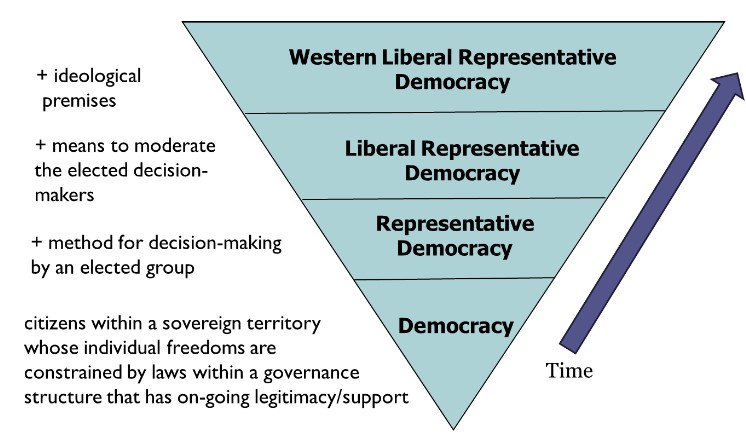
The distinguishing premises of the “Western” application of democracy being:
- Civil society - voluntary civic and social organisations form the basis of a functioning society.
- Market economy – goods/services are exchanged at a price determined when a buyer’s bid prices match a seller’s asking prices (largely referred to as a ‘free market’ economy).
- Pluralism – affirmation and acceptance of diversity.
- Political pluralism – multiple and distinct political parties.
- Universal suffrage – all adult citizens have the right to vote and to participate regardless of race, gender, belief or social status.
- Liberal freedoms – freedom of expression; freedom of the press; freedom of association; equality before the law and due process under the rule of law.
So, there we have it – pluralism (diversity); universal suffrage (equity) and freedom of association (inclusion) all fundamentally bundled into our existing New Zealand governance framework.
If Winston Peters finds this “mind-numbingly stupid”, I’d say he’s in the wrong country.
And if that is so, regarding Western liberal representative democracy, why did someone need to “re-coin” these ideological premises as DEI?
My answer would be because Western civilisation was not conceived, nor has it ever been, a meritocracy. Instead, New Zealand, like most Western nations is a patriarchy, albeit more recently with a stated ambition via legislation to work toward achieving meritocracy in governance. To my mind, meritocracy is a work-in-progress and DEI is not a weakness in Western civilisation.
The New Zealand First amendment bill looks to me to be in concert with the intent of Christian nationalism in the United States, whose leaders are currently re-making American political ideology in the execution of Project 2025. Page 4 of the Mandate for Leadership sets the tenor;
“The next conservative president must make the institutions of American civil society hard targets for woke culture warriors. This starts with deleting the terms sexual orientation and gender identity (‘SOGI’), diversity, equity, and inclusion (‘DEI’), gender, gender equality, gender equity, gender awareness, gender-sensitive, abortion, reproductive health, reproductive rights, and any other term used to deprive Americans of their First Amendment rights, out of every federal rule, agency regulation, contract, grant, regulation, and piece of legislation that exists.”
And, in addition to erasing the rights of women and minorities from legislation and practice, the Christian nationalist prescription:
- Expresses a special contempt for the LGBTQ+ community.
- Recognizes women primarily in their roles as wives or mothers.
- Recommends the elimination of the Head Start child care program despite the fact that for nearly six decades the program has helped low-income children and families with nutrition, education, and high-quality, affordable day care to prepare children for school and enable low-income parents to work.
- Recommends banning abortion, ensuring that only pro-life government policy prevails, and outlaws the mailing of abortion-inducing medication.
- Portrays single motherhood as destroying families.
- Identifies fatherlessness as the root of all evil, stating that fatherlessness is “one of the principal sources of American poverty, crime, mental illness, teen suicide, substance abuse, rejection of the church, and high school dropouts.”
Naturally, there will be those defending Winston’s stance – probably saying it is not his intention to go that far with his anti-woke, anti-DEI movement – but how does his proposed legislation prevent the sort of perverse outcomes of the “anti-woke” agenda as we are seeing in the US?
So, what’s in the NZF Member’s Bill?
According to their website, the Public Service (Repeal of Diversity and Inclusiveness Requirements) Amendment Bill seeks to “…ensure employment decisions in the public service are based on merit and not on forced woke ‘Diversity, Equity, and Inclusion’ targets”. Specifically;
- Clause 4: Amends section 44 to remove the Public Service Commissioner’s duty to develop a workforce that reflects societal diversity.
- Clause 5: Amends section 73 to eliminate requirements for chief executives and boards to promote diversity and inclusiveness as part of being a “good employer,” including specific references to Māori involvement.
- Clause 6: Repeals section 75 entirely, which mandates promoting diversity and inclusiveness in public service workplaces.
- Clause 7: Amends section 97 to exclude workforce diversity and inclusiveness from government workforce policy considerations.
- Clause 8: Removes the requirement in Schedule 3 for the Commissioner’s three-yearly briefings to assess workforce diversity and inclusiveness.
- Clause 9: Amends Schedule 7 to delete the obligation for panels appointing chief executives to consider diversity and inclusiveness.
Only there is nothing in those clauses that prioritises DEI over merit; instead, the Public Service Act 2020 refers to “suitably qualified” and “highly qualified” employees throughout.
Take, for example, Section 44 of the Act – the offensive clause which speaks of both diversity and equity, when amended under Peters’ bill would perhaps read (strikethrough text would be removed);
44 Commissioner’s general functions
(c) work with public service leaders to develop a highly capable workforce
that reflects the diversity of the society it serves andto ensure fair and equitable employment, including by promoting the good employer requirements in this Act; andWhereby the “good employer requirements” mentioned above, once neutralised of all DEI content, might read;
73 Chief executive of department and board of an interdepartmental venture to be good employer
(3) In this section, a good employer is an employer who operates an employment policy containing provisions generally accepted as necessary for the fair and proper treatment of employees in all aspects of their employment, including for—
(a) the impartial selection of suitably qualified people for appointment (except in the case of ministerial staff); and
(b) good and safe working conditions; and
(c) an equal employment opportunities programme; and
(d) recognition of—
(i) the aims and aspirations of Māori; and
ii) the employment requirements of Māori; and
(iii) the need for greater involvement of Māori in the public service; and(e) opportunities for the enhancement of the abilities of individual employees; and
(f) recognition of the aims and aspirations, employment requirements, and the cultural differences of ethnic and minority groups; and
(g) recognition of the employment requirements of women; and
(h) recognition of the employment requirements of people with disabilities; and(i) recognition of the importance of achieving pay equity between female and male employees; and
(j) recognition of the importance of decisions about remuneration being free from bias
including, but not limited to, gender bias.
Anti-diversity is anti-nature
As he is a politician, I would liken Peters’ anti-diversity political stance with respect to the public service, to a situation where an environmental management professional comes out against biodiversity, and in favour of monoculture.
And I would call that, “mind-numbingly stupid”.
Thankfully, a Biscuit Tin stands between Peters and the public service; and might save us all from the angst of having to go through yet another highly divisive piece of proposed legislation.
*Katharine Moody is a retired Massey University planning programme academic, having entered the teaching profession following her role as Radio Spectrum Manager under the Shipley and Clark governments. She was born and raised in the US and moved to New Zealand in 1978. She currently works as an advocacy planner on a pro-bono basis. She comments on interest.co.nz as "Kate".
We welcome your comments below. If you are not already registered, please register to comment
Remember we welcome robust, respectful and insightful debate. We don't welcome abusive or defamatory comments and will de-register those repeatedly making such comments. Our current comment policy is here.