
sign up log in
Want to go ad-free? Find out how, here.

Andrew King says scientists have scrapped the worst‑case climate scenario because action is making a difference

Public Policy / opinion
Andrew King says scientists have scrapped the worst‑case climate scenario because action is making a difference
sun
Ali Majdfar/Getty.

By Andrew King*

When major new climate change scenarios are released, there’s always strong interest. These scenarios lay out what our future climate will look like, depending on how fast we act to cut emissions.

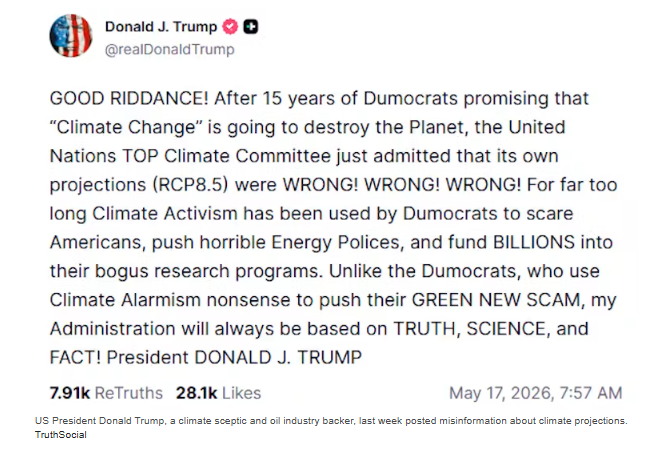
But what was surprising about the seven new scenarios announced last week was that United States President Donald Trump took an interest.

Why? Because a high-emissions scenario – known as RCP8.5 and its successor SSP5-8.5 – had been removed. Under these worst-case scenarios, nations would make no effort to cut emissions and expand fossil fuel use. By 2100, carbon dioxide levels would almost triple, to 1,135 parts per million and the world would be around 4.5°C hotter than the pre-industrial period.

The climate scientists responsible for laying out the range of possible futures removed the RCP8.5 scenarios for a very good reason. Although often slow and incomplete, our efforts to tackle climate change have made a tangible difference. We have averted the worst climate future once thought possible.

The job is far from done. Emissions are at record highs and global warming is speeding up.

But the removal of this high-emissions scenario isn’t, as Trump and other climate sceptics have claimed, a sign of failed modelling, or that climate change was a hoax. It’s a sign the expansion of solar, wind, electric vehicles and batteries have slowed emissions growth.

Global map of future climate under worst case emissions scenario. Deep red colour over land areas.

Under the previous worst-case climate scenario of SSP5-8.5, the world would have warmed about 4.5°C by 2100. IPCC, CC BY-NC-ND.

How are these scenarios made?

Many climate impacts are becoming evident after about 1.4°C of warming – the level we’re roughly at now.

Because this period of extremely rapid climate change is due to human activities, it means we also have the opportunity to shape the future.

What will this look like? Will the world keep heating up, or will rapid action cut emissions and bring warming to a halt? The answer will make a big difference to the future humanity faces.

Predicting anything is difficult. But a group of scientists has created scenarios representing a range of possible climate futures.

Because the future is not set, scientists lay out a range of possible pathways for our future greenhouse gas emissions. They base them on what’s happened so far and what might happen in politics and technology over coming decades.

Then they select the emissions pathways deemed most plausible and then sample a range of different futures which are more or less optimistic about our fossil fuel use.

Scientific groups around the world then model these scenarios in depth using different climate models to ensure there’s a large amount of data available at global, regional and local levels.

These scenarios aren’t ranked by how likely they are. All are considered to be plausible futures. The huge range of temperature outcomes – approaching 2°C between the most and least optimistic scenarios by 2100 – points to how much of the future is in our hands.

Why the fuss about RCP8.5?

The two previous releases included two closely related scenarios – RCP8.5 and SSP5-8.5 respectively.

Here, “8.5” refers to radiative forcing – the level of extra heat (in watts) trapped per square metre by 2100.

In these worst-case scenarios, the world sharply boosts fossil fuel use. Unsurprisingly, this leads to very high amounts of global warming. Scientists have long argued over whether this was plausible in the first place.

None of the new scenarios are as pessimistic as RCP8.5/SSP5-8.5. The worst possible scenario now envisions high emissions leading to warming of around 3.5°C by 2100. That would still be very, very bad.

Sceptics acting in bad faith

Climate sceptics leapt on the removal of RCP8.5 as a sign the projections were wrong. These attacks were not made in good faith, but to cast doubt on climate science.
A clear eyed assessment is that RCP8.5 was removed because climate action is starting to work.

But while the worst outcome has been averted, we have also missed the window for the best future climate.

The new scenarios have no pathway as optimistic as the lowest emissions scenario from the last round of major climate projections. That scenario – SSP1-1.9 – envisaged strong climate action and rapid cuts to emissions, leading to global warming peaking at around 1.5°C.

Because global emissions haven’t yet begun to fall, the most optimistic new pathway would lead to warming peaking at about 1.9°C.

While we will definitely now pass 1.5°C, the hope is to only temporarily overshoot that level of warming while working to draw carbon dioxide back out of the atmosphere to get back to 1.5°C.

Our current emissions trajectory is somewhere in the middle – below the high emissions path but well above the most optimistic scenario. Based on current policies and countries’ actions, we’re looking at around 2.6°C warming by 2100.

You might wonder why we need to keep redoing these climate scenarios.

One reason: facts change on the ground. Solar keeps rolling out far faster than expected, but fracking has opened up large new fossil fuel deposits. Political shifts make climate action more or less likely.

Another is because our climate models are continually improving. The better the models get, the more accurate and detailed our projections of sea level rise and other climate impacts can be.

Smokestacks from a coal plant against hazy sky.

What our future climate looks like depends on how fast we act to cut emissions. Dmitrii Marchenko/Getty.

Yes, this is progress

Taking RCP8.5 off the table is a sign of progress – we’ve avoided the worst-case scenario. But we have also missed the best case future.

The next five years could play out in many different ways, leading to better or worse future climates. We must understand and prepare for what we’re facing – and double down on our efforts to create the best future possible.The Conversation


*Andrew King, ARC Future Fellow and Associate Professor in Climate Science, ARC Centre of Excellence for 21st Century Weather, The University of MelbourneThis article is republished from The Conversation under a Creative Commons license. Read the original article.
We welcome your comments below. If you are not already registered, please register to comment

Remember we welcome robust, respectful and insightful debate. We don't welcome abusive or defamatory comments and will de-register those repeatedly making such comments. Our current comment policy is here.

20 Comments

I fear we have a very bad, very dry summer coming...

Up
1

Auckland Council to engage, outside hose use policing, come summer ?

Been extraordinally dry May! 
- Rain on first winters day though?

Up
1

"The drought has been pinpointed by the Treasury as one of the reasons New Zealand went into recession earlier than some other countries."

https://www.rnz.co.nz/news/national/1549/drought-cost-nz-economy-billio…

...on top of an energy shock?

Up
1

Definitely a drying trend here in South Canterbury. Soil moisture still ok because of the wet cold summer sinking deep into the profile. Nothing from the sky for a few weeks now. 

Up
1

Depends if the super el nino eventuates. Signs currently are that it will, but it can alter and technically always is

Up
0

Always is what...altering? It is a relatively well understood cycle...not exact but the indicators are increasingly better understood.

Up
0

Well no, 8.5 was taken off the table because the "new" scenarios include a sh!t load of CO2 capture and storage. Something being kept very quiet, unless you dig!

Interview with Detlef van Vuuren, chief author of a paper written by a group of scientists tasked with "overhauling" the climate case scenarios to be adopted in the next IPCC report. 

https://www.youtube.com/watch?v=L8EuYhK-ilU&t=58s

54.00... the new models assume energy efficiency will result in lower CO2 emissions with the aid of Carbon taxes.This point shows how BAU economics has polluted discourse in climate physics. Efficiency over time has clearly shown the result is MORE energy use.

The point that a Carbon tax will skew that energy use away from carbon, assumes that renewables can fill the gapping hole in societal energy use. It's low EROI, it's intermittent and it supplies electrictity, not liquid fuels. You could add to the mix, massive build out of dirty Nuclear, or massively expensive fusion hopium, but the models totally ignore populist fascist leaders like Trump and Putin, potential ones like Farage along with the rise of far right politics everywhere, all determined to burn all carbon on the planet.

1:05:30 Then we get to Carbon capture and storage. Without CCS 1.5-2degC is no longer possible according to the author. Because of this, they take it for granted CCS WILL be used and don't see any reason to publicise this fact in the new scenarios. CCS that is barely proof of concept today and would need enormous investment in energy, finance and materials to accomplish. In my opinion this is high risk modelling. 

29:30 So what these new scenarios have done by "dumping" 8.5 is ignoring the physics based uncertainties, feedbacks, sensitivity, in favour of the social model inputs, population, coal use trajectories. The author says 8.5 is still possible, but for the "wrong reasons" apparently, or "bad luck". My take is 8.5 is 8.5 regardless! 


Up
4

You forgot the bit where he said it implausible due to the simple reason - lack of population and coal nowhere near meeting six-fold increase in per capita use.

"And um and if you see the the emissions up to 2011 when you published your scenario,

coal was going up up up and it was really increasing a lot and then after

2011 2012 you see it flattening. Yes. So from that perspective, at the

time you published it, um you and your colleagues published the the previous scenarios, it was much less unlikely

than it is today. um because and that's indeed because of the renewables got

much cheaper and also of course a big uh increase in in in gas natural gas

production from fracking in the in the US and and also increase in other

countries and a slowdown in economic growth in China as well of course. Yeah. Economic crisis.

Yeah. Yeah. So and and population growth.

27:08

And that scenario went to 12 billion people. Um, by now we can still end up

at 12 billion people, but it's still like it was at that time and still is

not the most likely pathway. the most likely pathway is much closer to

somewhere between 9 and 10 billion. "

Up
0

Yeah and feedback and sensitivity uncertainty have been left out, while mitigating factors that don't exist have been added. sooo........

Obviously you didn't bother to read my comment in your denialist zeal.

"Equilibrium global warming for today’s GHG amount is 10°C, which is reduced to 8°C by today’s human-made aerosols. Equilibrium warming is not ‘committed’ warming; rapid phaseout of GHG emissions would prevent most equilibrium warming from occurring."

https://academic.oup.com/oocc/article/3/1/kgad008/7335889

Not "commited" warming mind, but there are a holes out there working tirelessly to commit while lining their pockets. :-)

Up
1

Aerosols

Up
0

Trump just wants to enable the build out hyperscale data centers.

Kevin O’Leary’s Stratos AI data center project in Utah is estimated to have the thermal output equal to 23 Hiroshima sized atomic bombs per day.

This is based on a power consumption of 9 GW.  Utah’s current statewide electricity consumption is only 4 GW on average currently.

The Stratos project alone could increase Utah’s carbon emissions by 55-65%.  The project’s emissions would exceed Utah’s entire transportation sector.

Up
6

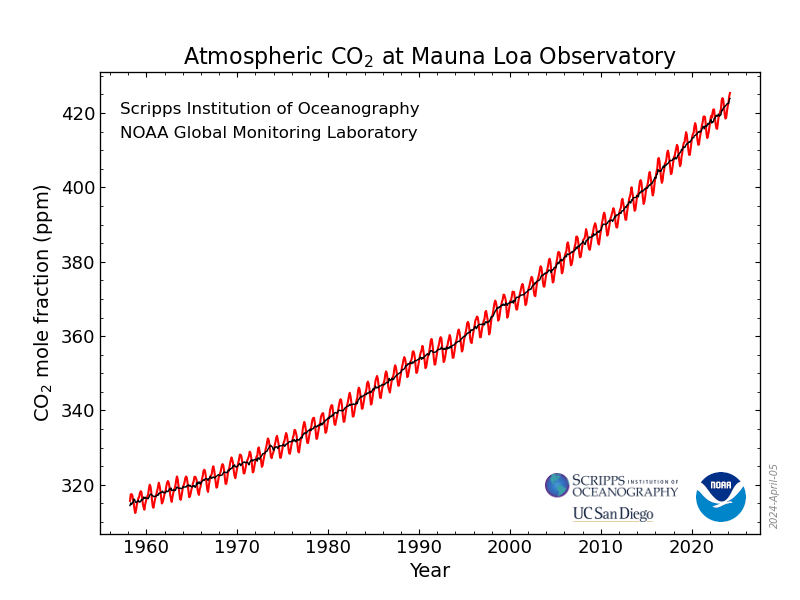
Andrew King, whose mortgage relies on the climate scare, is ignoring peer review from a decade ago showing how the scenario was implausible. RCP8.5 relies on a population of 12 billion, not happening, greater coal use than known reserves, and no technological advancement to 2100. The climate industry clung to this scenario to prop up false scare stories to generate funding for their lifestyle that they had become accustomed. They aren't going to give up a $2 trillion trough just because peer review says so, and had willing takers like interest.co.nz to publish the clickbait headlines.  To now say policy is working is laughable - show us on the  Mauna Loa CO2 chart where the policy started "working"!

"Accounting for this bias indicates RCP8.5 and other ‘business-as-usual scenarios’ consistent with high CO2 forcing from vast future coal combustion are exceptionally unlikely. Therefore, SSP5-RCP8.5 should not be a priority for future scientific research or a benchmark for policy studies."

https://www.sciencedirect.com/science/article/abs/pii/S0360544217314597 (2017)

"The scenario’s storyline describes a heterogeneous world with continuously increasing global population, resulting in a global population of 12 billion by 2100.

...Coal use in particular increases almost 10 fold by 2100 and there is a continued reliance on oil in the transportation sector."

RCP 8.5—A scenario of comparatively high greenhouse gas emissions (2011)

https://link.springer.com/article/10.1007/s10584-011-0149-y

https://gml.noaa.gov/webdata/ccgg/trends/co2_data_mlo.png

Up
5

Be honest profile, if the coal was there, you'd burn it. Because the capitalist exponential growth cult love their wallets just too much.

Up
3

Stop being silly.

Up
2

This is a shame that highly regarded and well qualified academics are making puffery-type excuses as per the above.  The high emission scenario was always an (intentionally?) alarmist scenario, bordering on "junk science".  It was initially devised as a worse case scenario, physically near unattainable in certain forcing inputs.  And even more unfortunately for the world, it generally became referred to by the climate change community as the 'Business as Usual" scenario - and the money for research started flowing in - and the consultancy sector had a ball as local government/government contracts went into overdrive in comparison to (and to the detriment of) other environmental issues deserving of increased R&D funding.

I've always thought the world will run out of freshwater in many, many places - well before any doomsday arising from global warming eventuates.  And, no doubt when the rivers and aquifers run dry, they'll still be blaming AGW, as opposed to rampant, unchecked, unregulated capitalism. 

Up
3

Global heating does cause changes to the hydrological cycle.

Certain members of the uber capitalist cult do understand action on climate limits the cash flowing to their wallets, hence our current state of affairs where 1.5-2degC are off the table without CCS.

Action on climate would have been action on rampant unchecked capitalism, which is why the massive astroturfing campaign for decades. "Would have been", because some in the uber capitalist cult are now seeing a dollar in solar radiation management, while they continue to pollute of course.

Up
0

A clear eyed assessment is that RCP8.5 was removed because climate action is starting to work.

No, it was NEVER a plausible scenario and all the many papers written on the basis of it being so, should now be torn up.  It assumed a totally unrealistic use of coal. This was shown very clearly in a 2017 study published in Research Economics "The 1000 GtC coal question: Are cases of vastly expanded future coal, combustion still plausible?  Hint; the answer is no. I will quote briefly from the Abstract. "In this paper, we explain why vast expansion in 21st century coal consumption should not be used to describe any plausible reference case of the global energy future".

In my view, those who now claim that this, I repeat, always unrealistic scenario, can be discarded thanks to climate action are, to be blunt, lying to cover their embarrassment. Examples like this do the cause of climate science no favours and serves only to diminish the believability of all climate scientists. That is unfortunate as human related climate change is a very real problem, though still only one of many facing us.

Up
2

8.5 was always a top end estimate of the potential extra forcing caused by human pollution. It's plausibility seems to rely on bad luck not being part of the mix. Solid! We are on track for 8.5, just not by the arbitrary 2100!

"Equilibrium global warming for today’s GHG amount is 10°C, which is reduced to 8°C by today’s human-made aerosols. Equilibrium warming is not ‘committed’ warming; rapid phaseout of GHG emissions would prevent most equilibrium warming from occurring."

https://academic.oup.com/oocc/article/3/1/kgad008/7335889?login=false

The head (Detlef van Vuuren) ,author of the new technoeconomics friendly scenarios says 8.5 is still possible, but for the "wrong reasons". That is, a miscalulation of feedbacks and sensitivity.

29:30 https://www.youtube.com/watch?v=L8EuYhK-ilU&t=58s

The lower forcing pathways(1.9 and 2.6) are now unobtainable without CCS. So you can say they were never plausible in hindsight either. Unless you believe in techno utopian fairyland!

1:05:30 

OTOH they've peered into their crystal ball and decided attempts by growthist politicians and oligarchs to increase birth rates won't work and neither will right wing politicians attempts to return to burning all the carbon molecules they can find.  


Up
1

equilibrium climate sensitivity 1.2 ± 0.3°C (2σ) per W/m2, which is 4.8°C ± 1.2°C for doubled CO2.

Learning nothing from the RCP8.5 scam Palmtree latches on to another implausible ECS model that relies on theoretical feedbacks in world where Hansen admits even basics like clouds can't be modelled. "...The Charney report [4] recognized that clouds were a main cause of a wide range in ECS estimates. Today, clouds still cast uncertainty on climate predictions."

Hansen's ECS of 4.8°C is an outlier in published research. Hansen is the crackpot who predicted NY highways would be under water by now and compared coal trains to The Holocaust. Now, despite being unable to model clouds,  he is proposing "solar radiation management"!

160 Papers with low climate sensitivity:

https://notrickszone.com/50-papers-low-sensitivity/

https://landshape.files.wordpress.com/2015/06/climate_sensitivity.pdf

Up
0

Reverting to type huh profile. The only scam around here is the denialist astroturfing campaign you champion!

If the first "Scientific paper" is an example of the quality of your reference resource it should be an embarrassment to anyone quoting it! 

"The line-by-line method gives the change of the global temperature  K as a result of doubling the carbon dioxide concentration. The contribution to the global temperature change due to anthropogenic injection of carbon dioxide in the atmosphere, i.e. resulted from combustion of fossil fuels, is approximately 0.02 K now."

What a pile of steaming bollocks! Only an astroturfer or a clown would take this nonsense seriously! We have already seen a 1.5degC increase in global temperature post industrial revolution, mainly attributable to CO2 released by burning geologicaly stored carbon!

"clouds were a main cause of a wide range in ECS estimates. Today, clouds still cast uncertainty on climate predictions."

Yep, but the "new" scenarios ditch this uncertainty in favour of CCS, and not believing the plethora of right wing science deniers rising to power will choose burning over living!


Up
0

Donald Trump has single handedly done more for EV, home battery system, and solar sales globally than years of warnings and incentives could have. 

Nobody thinks this is going to be the last oil shock, nor the worst. 

Up
0

Very true, yet we have some folks in Wellington who are not paying attention, determined to create a costly gas import terminal.  Is there a word to describe that stupidity?  

Up
0