
By Chris Trotter*
Then out spake brave Horatius,
The Captain of the Gate:
“To every man upon this earth
Death cometh soon or late.
And how can man die better
Than facing fearful odds,
For the ashes of his fathers,
And the temples of his Gods,”
From Horatius by Thomas Babington Macaulay, 1842.
There was a time when schoolboys across the English-speaking world were regaled with Horatius’s heroic pledge to patria – the fatherland. Not recently, of course. Macaulay’s stirring evocation of Roman virtues (standing-in for the virtues of the then rapidly expanding British Empire) would today be dismissed as a hymn to patriarchy, hierarchy, imperialism, suicidal ideation, and war. Certainly not ideas to be promoted before a classroom of sensitive twenty-first century students.
Therein lies the fundamental problem confronting every western government anxious (and under fierce American pressure) to boost their defences. New Zealand’s own Defence Minister, Chris Penk, has just returned from the latest Nato summit, bringing with him the many warnings and frustrations of his northern counterparts.
Voting more money to one’s country’s defence forces may be a good start, but it is not enough. All the weapons in the world are useless if there is no one to wield them. Where is the West going to find the young men and women needed to defend it?
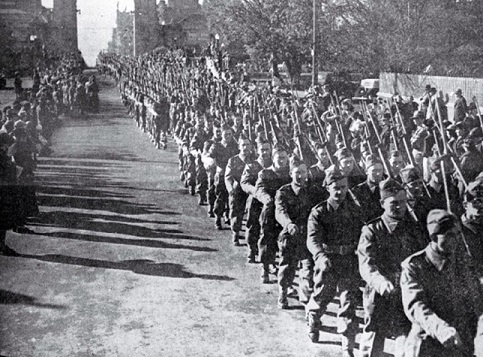
It was much easier in the past when, if your country called, you answered. Even when the call to arms came in the form of a conscription notice the level of compliance was, by today’s standards, astonishingly high.
In the early years of the twentieth century Germany fielded Europe’s most effective army by far. It was led by the aristocratic officers of Prussia, but it was bulked-up by millions of young middle- and working-class conscripts. Compulsory military training had become a rite of passage for all young German men: a patriotic duty that most of them accepted without protest.
One can only imagine how Germany’s present Chancellor, Friedrich Merz, envies his Imperial German predecessors. Determined to put Germany at the head of a credible military combination of Nato allies – sans the USA – he has been confronted with the dispiriting advice that, the nation’s impressive martial history notwithstanding, the level of resistance likely to greet any attempt to resurrect conscription makes the whole idea a non-starter. Young Germans, raised to view their country’s past as a terrible warning against militarism and war have become pacifists – almost by default.
And New Zealand’s young people? Would they, too, default to pacifism? If Chris Penk, or a future Defence Minister, responding to a rapidly deteriorating geopolitical environment, decided to reintroduce compulsory military training (as Labour Prime Minister Peter Fraser did at the onset of the Cold War in the late-1940s) how many young Kiwi men and women would happily submit themselves to two years in uniform? Two years of being yelled at while learning to kill their fellow human-beings?
Penk and his party would doubtless reject outright the very thought of reintroducing conscription – pointing instead to their commitment to rebuilding New Zealand’s volunteer defence force after years of declining capacity and shrinking budgets.
“Not before time!”, would be the response of those who take an interest in matters military.
Today’s NZ Defence Force is but a shadow of its former highly-effective and highly-respected self. Its loss of effectiveness was illustrated for all the world to see by the foundering of the HMNZS Manawanui – probably the most embarrassing display of naval incompetence in New Zealand history.
And it’s not just the Navy that has problems. Our ground forces are currently at less than half their recommended strength. Even the point of the NZDF spear, New Zealand’s internationally renowned Special Air Service Regiment, has been plagued with recruitment and retention difficulties, degrading its efficiency.
Only the Royal New Zealand Air Force has reason to feel confident with its kit – even if it was forced to wait for decades to get it. Like all the other service arms, the RNZAF struggles to recruit, train, and retain the highly skilled personnel needed to maintain and use it.
The Coalition Government is hoping that monies already appropriated for improving the wages and conditions of NZDF personnel – serving and civilian – will take the sting out of the military’s recruitment and retention problems. Chances are that it won’t.
There is growing concern within the NZDF that the country’s most senior military personnel, the men and women responsible for orchestrating New Zealand’s defence capabilities, have failed to understand what has happened to their own services, and what is happening across the wider world.
The failure of the top brass to impress upon the Ardern-led government the extreme risk of ordering soldiers to guard quarantine facilities, and then to fully appreciate the catastrophic loss of morale and commitment which that failure had caused, has convinced a strategically significant number of service personnel to abandon their careers for institutions overseen by more serious people.
If a small nation of just five million is to maintain an effective military then it must either declare itself wholly and unabashedly for its traditional friends and allies and adopt with equal enthusiasm their strategic and tactical military doctrines; or it must take its commitment to an “independent” foreign and defence policy framework seriously and initiate a radical reassessment and reorganisation of New Zealand’s diplomatic and military posture.
The option the present Coalition Government appears to have chosen mirrors that of just about all of the governments preceding it: to go all-in with our traditional friends and allies. What they have not chosen to do, however, is make it clear to the New Zealand public that this is the course they have decided to follow. Indeed, Prime Minister Luxon continues to insist that his own and his government’s commitment to “New Zealand’s independent foreign policy” remains undiminished.
There will be many who argue that going all-in with our friends and allies is the only viable option for New Zealand. Who else, apart from Australia and the United States, would New Zealanders be comfortable fighting alongside?
That remains a fair question, and until 2025 the answer was always obvious. With Donald Trump in the White House, however, and the moral trajectory of his lawless administration becoming ever more concerning, attaching New Zealand to the United States has ceased to be the straightforward strategic option of decades past.
WHY DO HUMAN-BEINGS FIGHT? They fight out of love, or from fear.
In the entrance-hall of the first institution erected to look after the New Zealand veterans of a foreign war – in this case the Anglo-Boer War of 1899-1902 – stands a carved wooden memorial to those who fell. Inscribed upon its base are the words: “They died for the Empire.”
The New Zealanders who fought in South Africa did not do so out of fear for the Boers, but for the love they bore their King-Emperor and the British Empire over which he reigned.
In the wars that followed, more and more fear became mixed-in with the love.
Without that fear: without the hatred it aroused against Imperial Germany, the Nazis, Imperial Japan, the Soviet Union and “Godless Communism”; the vast mobilisation of people and resources required by New Zealand’s wars – hot and cold – could not have taken place.
How do you conscript your best and your brightest in the absence of fear and hate? How much love of country is required to rally the flower of a nation’s youth to their country’s flag?
The Ukrainians know the quantum required of both emotions to make a people stand and fight. Horatius, the Captain of the Gate to Rome, knew what he was prepared to sacrifice for “the ashes of his fathers, and the temples of his gods”. Māori New Zealanders also know.
But the rest of us? Do we fear Xi’s China enough; do we love Trump’s America enough; to fight against the one and for the other?
Do enough of us still love New Zealand enough to fight and die for it?
*Chris Trotter has been writing and commenting professionally about New Zealand politics for more than 30 years. He writes a weekly column for interest.co.nz. His work may also be found at http://bowalleyroad.blogspot.com.
We welcome your comments below. If you are not already registered, please register to comment
Remember we welcome robust, respectful and insightful debate. We don't welcome abusive or defamatory comments and will de-register those repeatedly making such comments. Our current comment policy is here.