By Edward Miller*
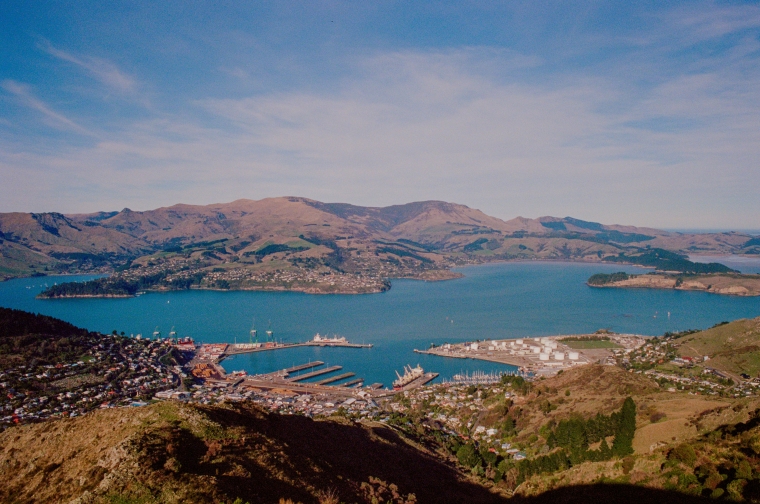
Christchurch City Holdings Limited is currently weighing an unsolicited bid from Tōnui, a consortium of global port giant DP World and three Ngāi Tahu Rūnanga, to operate and develop Lyttelton Port.
The rūnanga oppose further reclamation in Whakaraupō and their proposal may end up looking quite different to CCHL’s existing plans for a $800 million 380m deepwater port, but Tōnui spokesperson Liz Brown described the proposal as “a practical alternative to the challenge of funding the next phase of port investment entirely through CCHL, Lyttelton Port Company and, ultimately, ratepayers”.
Many will feel uncomfortable about the idea of surrendering operational control of a strategic asset like the South Island’s largest port to a foreign multinational (let alone one owned by another Government, Dubai's) but if the deal adds up it’s worth considering, right?
Elsewhere, Rāpaki Tangata Tiaka Chair Tutehounuku Korako has described the proposal as “due diligence”, which is a useful standard for consideration. Tōnui’s proposal may present good ideas that CCHL can adopt, but we still need to assess whether the financials stack up.
We can get an idea of this through a hypothetical like-for-like comparison, looking at finance costs and return on equity expectations of the respective projects.
Given CCHL was already contemplating an $800 million investment plan, let’s call it a billion over 30 years (five years to build and 25 to repay); what would it cost Canterbury if a private operator like DP World ran the port and delivered this expansion instead of CCHL?
On those assumptions, a DP World-backed proposal appears to impose more than $1 billion of additional cost over 30 years, an extra $37 million a year.
Undertaking the same comparison with a smaller price tag actually increases the extraction premium between the projects, with $500 million investment programme costing another $903 million to deliver with a private investor like DP World.
Other benefits may offset these costs, but this analysis suggests that they would have to be significant to make a DP World-backed bid more attractive.
Finance costs
CCHL’s long-term issuer credit rating was recently reaffirmed at AA- with a stable outlook. This is three notches above DP World’s BBB+ rating, and on a billion-dollar project those notches add up.
Let’s assume it takes a clean five years to build followed by a 25-year loan at 10% equity.
On a typical mortgage-like “amortising” loan, in which regular repayments that retire the debt over the loan term, CCHL’s AA- rate of 5.25% would incur finance costs of $737 million, while DP World’s BBB+ rate of 6.25% would push that to $852 million, another $115 million.
But DP World’s doesn’t use amortising loans. The latest Fitch ratings commentary flagged DP World’s use of “bullet” bonds, interest-only bonds where the full principal is repaid or refinanced at maturity rather than progressively retired.
DP World’s stratospheric revenue growth – from less than US$5 billion in 2018 to US$24 billion in 2025 – has been backed by huge borrowing, with total debt hitting US$29.5 billion that year. In 2022 and 2023 they paid $US8.8 billion to shareholders in dividends.
Applying DP World’s BBB+ rate to a $900 million debt tranche on a bullet structure incurs total interest cost of $1.406 billion, $667 million than under a CCHL amortising loan.
That financing gap may be wider still, since CCHL may be able to access concessional green and social loan rates through the Local Government Funding Agency.
Return on equity
Return on equity (ROE) measures profit generated per dollar of shareholder equity.
From 2019 to 2025 LPC’s ROE averaged 4%. Over the same period DP World averaged 9.4%, reaching up to 14.2% in 2025. Delivering a (slightly more conservative) 9% return on LPC’s 2025 equity base of $456 million would have required an additional $23 million annually.
Over the 30 years under CCHL’s amortising structure, every loan payment retires a slice of the $900 million construction debt, with that share of the asset becoming public equity. By year 30 CCHL owns the port debt-free, and its equity has grown to $1.456 billion.
With bullet bonds, the $900 million debt stays on the balance sheet throughout. Assets match liabilities, and the net equity remains constant. At the end of the period the bond matures and is either repaid or refinanced.
Over the 30-year concession the cumulative extraction premium between a 4% ROE on an amortising loan and a 9% ROE on a bullet structure amounts to approximately $453 million. The difference is greater at the beginning of the period, since a 4% return on a rising equity base grows over time, while a 9% return on a flat equity stays constant.
Combined with the $669 million financing premium, the total additional cost of private ownership on this hypothetical comparison exceeds $1 billion over 30 years, cost which would ultimately be borne by the community while benefits flow offshore.
There may be other offsetting benefits like operational efficiencies and productivity gains, but on this comparison they would need to be substantial to justify a billion-dollar premium on a billion-dollar project.
On an otherwise identical $500 million comparison, finance costs are lower but the ROE premium actually ends up being larger over 30 years, because amortising loans build up equity so much faster than bullet bonds. The combined premium is $903 million.
The benefits of a stronger iwi partnership could also be substantial and deserve to be explored in a more comprehensive manner, something that’s well beyond the scope of this analysis.
The due-diligence question here is not whether Tōnui has raised important issues worthy of consideration, that is clear.
The question is whether those issues require a higher cost private concession model, or whether an improved relationship between the Ngāi Tahu rūnanga, CCHL and the port company could deliver the best of both worlds: lower cost investment, continued public ownership and a stronger role for mana whenua in safeguarding the interests of Whakaraupō.
*Edward Miller is researcher at the Centre for International Corporate Tax Accountability and Research.
We welcome your comments below. If you are not already registered, please register to comment
Remember we welcome robust, respectful and insightful debate. We don't welcome abusive or defamatory comments and will de-register those repeatedly making such comments. Our current comment policy is here.