
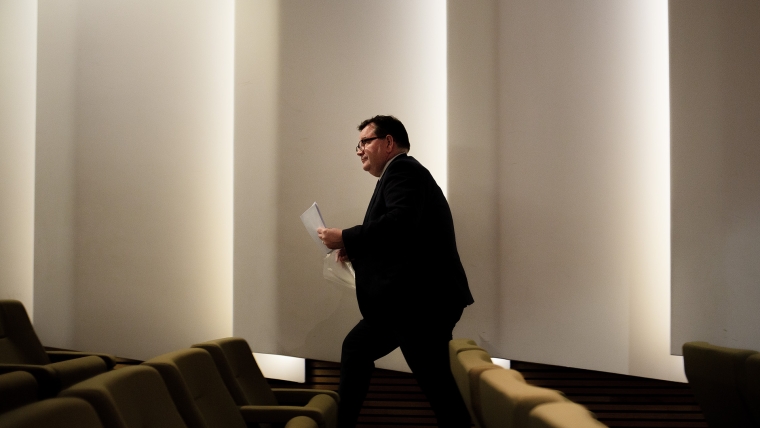
The world feels more urgent, more busy and more short term, former Deputy Prime Minister Grant Robertson says, and that’s filtered through to policy making in New Zealand as well.
“I think we are in a more partisan era,” Robertson said on Tuesday. “We are in an era where the half-life of politicians and policies seems to have got shorter.”
"We all know how our world feels more urgent and more busy and and more short term, and I think that has filtered through to policy making in New Zealand as well."
However, he didn’t think a turnaround was impossible, “but it’s definitely a challenge for any politician at the moment”.
Robertson was part of a webinar series organised by the Helen Clark Foundation where he talked about politics, building policy, artificial intelligence (AI) and universities, and the country’s ageing population.
Speaking to the audience online, Robertson said: “The three-year electoral term is a massive barrier to us being able to do that [policy making], and even one more year, being a four-year term would make a difference to … the ability to bed in policy and get some longevity.”
“It's only a part of the answer. It's by no means all of it but that three-year cycle combined with just the way the world works today, I think, makes it very challenging,” he said.
Asked more about the electoral system and long-term policy settings, Robertson said: “I think the electoral cycle is a problem. I don’t personally believe that MMP is the issue here.”
Ageing population
Asked about the country’s ageing population, Robertson said the debate about the ageing population needed to be one that’s not just set in a superannuation context.
“But much more in how we think about society, how we think about the health system, but also trying to be a bit more positive rather than just have a deficit mindset about all the costs of that.”
“Think about the fact that people are living longer, and what is it that we can all benefit from in terms of having an older, wise population that we can draw on. What sort of different ways of working? What sort of connections within communities we have?”
AI and universities
Previously the deputy prime minister and finance minister, Robertson is currently the vice-chancellor of the University of Otago.
With his University of Otago vice-chancellor hat on, Robertson said all universities around the world are grappling with what AI means for what they teach, how they research and what experiences are provided to students.
“Last year, I had the privilege of visiting a few universities around the world to look at what they were doing with AI. The very short answer is, it's so fast moving that everybody is facing a very big challenge here.”
From his view, it was their job to continue to be the “critic and conscience of society” and to provide students with the opportunity to be critical users of all technology and critical developers of all technology.
“We need people to be able to understand the impact of AI, the ethics of AI, the bias of AI, the environmental impacts of it, as well as being users of it ... I think I'd be failing the students who come to the University of Otago if we weren't making sure they understood and knew how to use AI.”
Robertson said AI had led to massive questions around what it meant for assessment and what it meant for how teaching happens.
The University of Otago had committees working on this and they were piloting various projects, he said.
“We're trying to support students with getting more consistent information about what they can and can't use AI for. But it's a real work in progress. But obviously, it represents one of the big challenges.”
We welcome your comments below. If you are not already registered, please register to comment
Remember we welcome robust, respectful and insightful debate. We don't welcome abusive or defamatory comments and will de-register those repeatedly making such comments. Our current comment policy is here.