

The Green Party wants to establish a publicly owned supermarket chain called KiwiMart, with a mandate to prioritise affordability for consumers.
The party's food and grocery policy, released on Sunday, also wants to break up the Foodstuffs and Woolworths supermarket duopoly and would require them to divest at least 120 stores and distribution centre capacity into public ownership to establish KiwiMart.
This proposal is part of the Green Party's affordable kai policy as they seek to give people “lower prices, more choice, and greater security.”
“Access to affordable, healthy kai cannot be left in the hands of profit-driven privately owned corporations.”
The Greens want KiwiMart to operate as a “self-sustaining and commercially viable competitor in the grocery market” comparing it to Kiwibank’s role in the banking sector “but at a competitive scale."
“We’ll task the Commerce Commission to work with the duopoly to identify which stores should be divested to KiwiMart based on local market share, and to determine fair compensation without merely rewarding them for their dominant market position.”
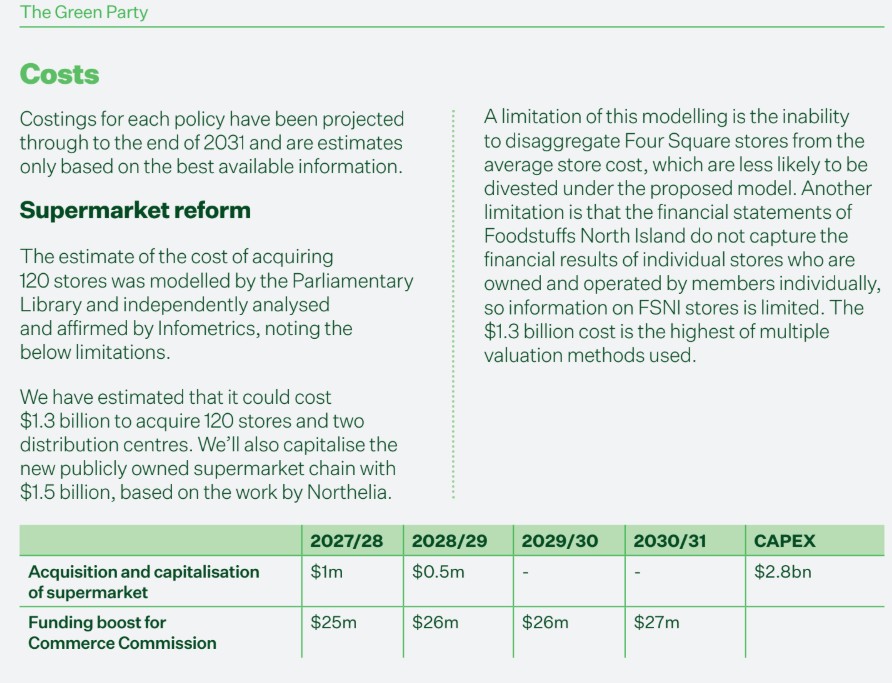
The party estimates that the acquisition and capitalisation of supermarkets would cost around $2.8 billion.
Broken down, it could cost $1.3 billion to acquire 120 stores and two distribution centres based, according to modelling by the Parliamentary Library and independent analysis and affirmation from Infometrics. The Greens would capitalise KiwiMart with $1.5 billion based on work by a group of entrepreneurs who wanted to set up a third supermarket chain, Northelia.
"Two companies control what almost everyone in this country eats, and they take about a million dollars a day in excess profit out of our shopping baskets. That is money that should be in people's pockets," Green Party co-leader Chlöe Swarbrick says.
Swarbrick says everyone agreed that competition was needed in the grocery sector to drive down prices but successive Government have “failed to lure one.”
“That's why today we are announcing the real solution: a supermarket owned by all New Zealanders, for all New Zealanders."
"There are only so many places in a town where a supermarket can go, and Woolworths and Foodstuffs have seen to it that these sites are locked up," she says.
"We're not short of supermarkets, we're short of competition. As experts have noted, divestment - that is, buying already existing stores - is key to breaking up the duopoly."
Consumer data and giving more powers to the Commerce Commission
The Greens also want to explore extending the Consumer Data Right framework to the supermarket sector.
The party says it would allow “consumers to share their loyalty data with other supermarkets and trusted price comparison tools and use their own purchase history to get better offers and compare baskets”.
“This would give consumers control over their information and help level the playing field for new competitors who lack the duopoly’s decades of information.
“To limit the shopping data collected and to prevent against ‘surveillance shopping’, we’ll give consumers greater rights to choose what data supermarkets can collect about their shopping habits, how long they can keep it, and what supermarkets can do with it.”
The Green Party says its reforms will put the Commerce Commission in a stronger position to enforce competition not just in the grocery sector but across the whole economy.
“We’ll deliver these priority interventions to address supermarket competition as part of a wider overhaul to ensure the Commerce Act is fit for purpose and stops giving big companies a free pass.”
The party wanted to ensure the Commerce Commission was resourced “and empowered to hold the supermarkets and other big corporates to account.”
“In contrast, over the last three years, the Luxon Government has reduced funding for the Commerce Commission by millions of dollars.”
Alongside this, the Greens are also proposing:
- Banning price gouging at supermarkets through a Bill to ban excessive pricing. This ban would also be extended to other sectors such as energy and fuel
- Increasing funding for the Commerce Commission to put them in a stronger position to enforce competition laws
- Raise the maximum penalties available under the Commerce Act
- Increase the Commerce Commission’s powers by giving the organisation the ability to issue binding directions in response to market study investigation like in the UK and Canada - not just recommendations
- Allow the Commerce Commission to directly regulate the use of loyalty cards, store brands and “other anti-consumer practices to protect competition and transparency
- Establishing a mandatory supermarket pricing accuracy code which includes compensation requirements for shoppers if they are overcharged - Creating a National Food Strategy, including a legislative right to “adequate and nutritious food”
- Establishing $150 million a year Fair Food Fund for community-led food security
- Increase funding for food banks and doubling the cap on food grants from Work and Income
- Restoring and permanently funding Ka Ora, Ka Ako, and expanding the school lunches programme to 400 more schools
Other costs
The Greens have not made clear in its policy document how it will pay for its proposals but has provided estimated costs.
When it comes to boosting the funding of the Commerce Commission, the Green Party estimates an allocation of $25 million in 2027/2028, $26 million in 2028/2029 and 2029/2030, and $27 million for 2030/2031.
The Fair Food Fund would cost $150 million yearly through to the end of 2031. Funding to increase the food secure network would be $17 million in 2027/2028, $18 million in 2028/2029 and 2029/2030, and $19 million for 2030/2031.
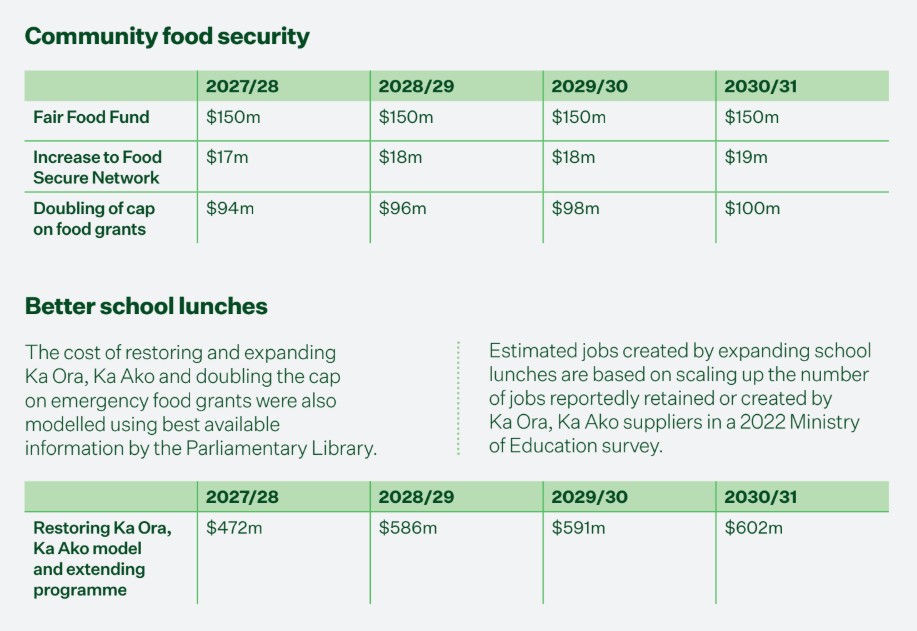
When it came to doubling the cap on food grants from Work and Income, the party estimated the costs to be $94 million in 2027/2028, $96 million in 2028/2029, $98 million 2029/2030, and $100 million for 2030/2031.
For Ka Ora, Ka Ako - the Healthy School Lunches programme - the party estimated the costs to be $472 million in 2027/2028, $586 million in 2028/2029, $591 million 2029/2030, and $602 million for 2030/2031.
We welcome your comments below. If you are not already registered, please register to comment
Remember we welcome robust, respectful and insightful debate. We don't welcome abusive or defamatory comments and will de-register those repeatedly making such comments. Our current comment policy is here.