
sign up log in
Want to go ad-free? Find out how, here.

Unemployment pushes into top four issues facing New Zealanders and 64% support wealth tax in latest Ipsos poll

Public Policy / news
Unemployment pushes into top four issues facing New Zealanders and 64% support wealth tax in latest Ipsos poll
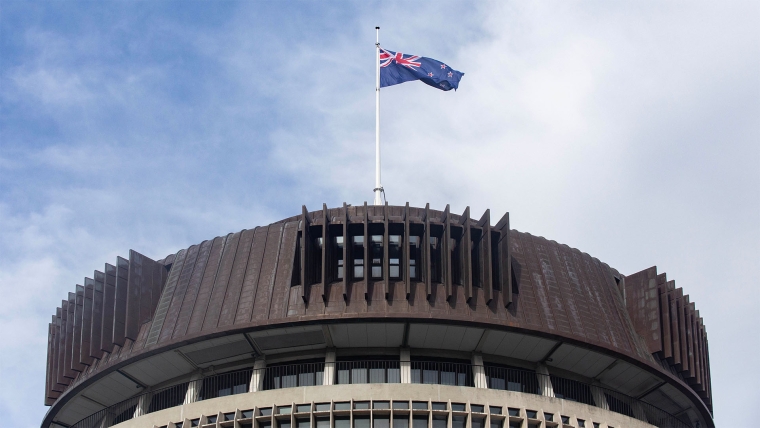
Beehive
Image source: Dan Brunskill

Concern around unemployment is at its highest level since November 2020, the latest Ipsos NZ Issues Monitor survey has found, pushing up into the top four most important issues. 

The survey also looked at the support around different taxes, with a wealth tax bringing in 64% suggested support. 

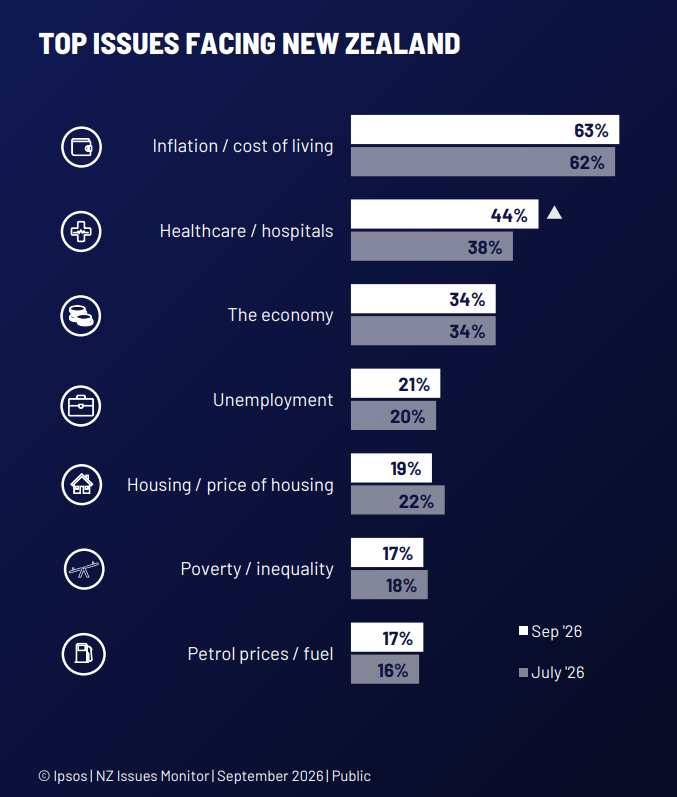
Inflation/cost of living remained the most important issue (63%), at its highest level since May 2023, followed by healthcare/hospitals (44% - rising from 38% in July), the economy at 34%, and unemployment at 21%. 
Ipsos | NZ Issues Monitor | September 2026


Concern around unemployment rose to levels last seen in November 2020. 

Those surveyed rated the Government's performance 4.1/10, which was stable since the last survey. Labour was the party seen as the most capable of managing the top five issues.

Tax 

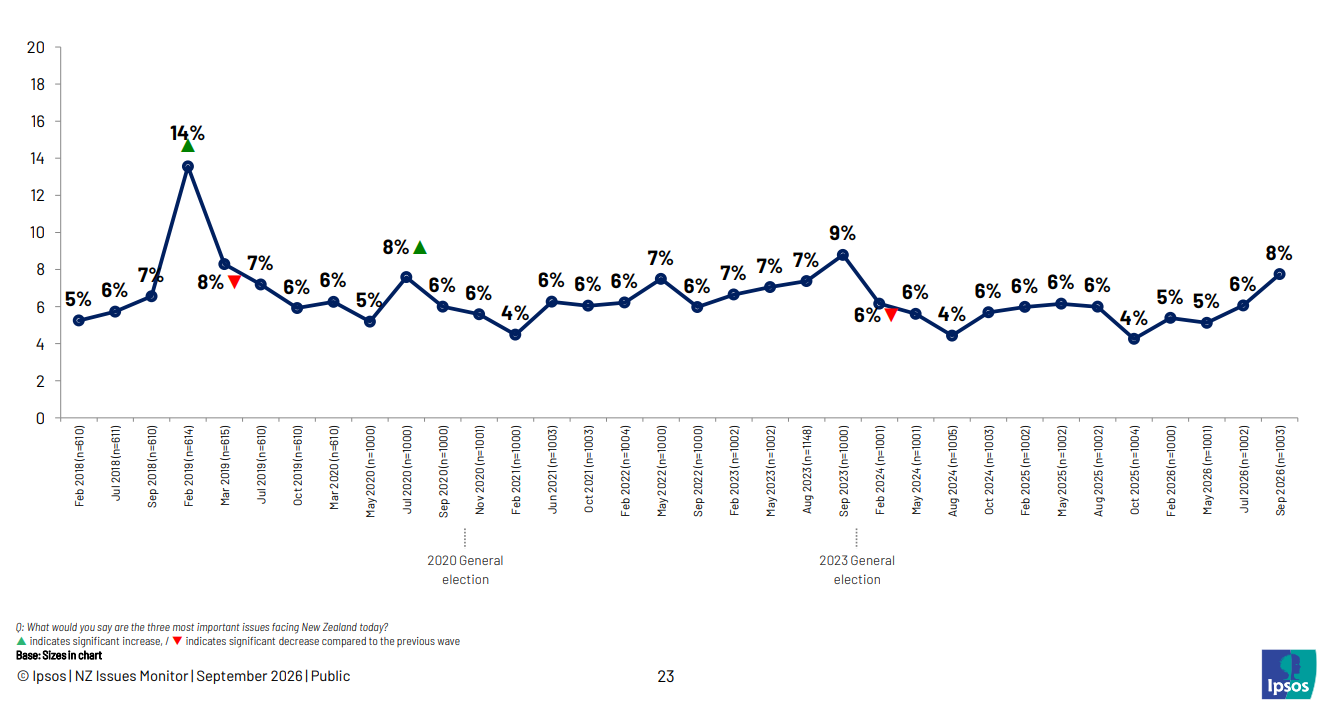
While tax was only at the 10th equal rated issue with immigration, concern around tax has been increasing since October last year, rising up to 8%. 
Ipsos | NZ Issues Monitor | September 2026 - tax


Those surveyed were asked about the level of tax they paid. Forty-four per cent felt they should pay less tax, 45% said they paid the right amount of tax, 4% said they should pay more and 7% did not know. 

They were also asked about different types of taxes. 

Asked about a wealth tax, at 2.5% on an individual’s net assets above $10 million with an exemption for family homes, 64% were in support, 26% were against and 10% did not know. 

Forty-five per cent supported a capital gains tax, at 28% percent tax on any profit made on property (excluding the family home) sold after July 1, 2027, 40% were against and 16% did not know. 

Less than a quarter (24%) supported a land value tax, a yearly tax unimproved value of all urban land set at 1.75% and on rural land set at 0.5%, 50% did not support the tax, and 26% did not know. 

Amanda Dudding, Ipsos NZ's Executive Director of Public Affairs, said responses to the questions on tax reveal an interesting contrast in public opinion. 

"While New Zealanders are divided on whether they personally pay too much tax, there is relatively strong support for taxes focused on wealth and capital gains. These findings suggest New Zealanders continue to distinguish between personal tax burdens and how they believe the overall tax system should operate," Dudding said.

The survey took place via online panels between September 3-11 with 1003 New Zealanders surveyed, and a credibility interval of  +/- 3.5 percentage points.

We welcome your comments below. If you are not already registered, please register to comment

Remember we welcome robust, respectful and insightful debate. We don't welcome abusive or defamatory comments and will de-register those repeatedly making such comments. Our current comment policy is here.

15 Comments

Ipsos online-only survey methodology using representatives from their self applying internal panel group is apparently not a random sample representation drawn from the wider NZ population.

Up
6

Ipsos online-only survey methodology using representatives from their self applying internal panel group is apparently not a random sample representation drawn from the wider NZ population.

Of course. It's a non-probability sample. As are all online panels. Ipsos may weight the data accordingly to make it more representative of a universe. 

Market research and companies companies like Ipsos, Kantar, Dynata, etc are in a real dilemma these days.

Market research data that is scraped from the internet should be far more expensive these days for quite a number of reasons - you can't feed AI models garbage if you want meaningful data; people won't engage with you if it's not worth their time; AI should be able to manage and handle the work of data synthesis, reporting, and analysis.   

Up
0

Would suggest that of the 64% favouring a wealth tax likely 100% of them would have no idea of the intricacies, distortions and bureaucratic cost  of application involved. For a start a figure of $10 mill is arbitrary and obviously must rely on valuations which are an industry within themselves, fluctuating, contestable and often ending up in litigation. A quick scan through the high court records of the Canterbury EQ claims will nicely identify that feature.Believe  not long ago Jack Tame asked an interviewee what nations impose a wealth tax that is actually meaningful and received no answer.

Up
5

A wealth tax is better thought of as a mechanism to restore a little balance in the trend of wealth concentration among fewer and fewer people. 

Up
2

Wealth taxes are simply Marxist envy.

"From each according to his ability, to each according to his needs." K Marx 1875

Up
5

That is what unthinking dolts like to gaslight the proletariat with, but ultimately turning human civilisation over to control by the greediest, and the US and worse is what you get. There's a middle ground there somewhere and 10 million is probably a good starting place for the amount of wealth anyone needs to live a more than comfortable life. 

Up
3

The idea of a WT i understand in terms of wealth inequality, which is good as an idea, and indicates that more of the public acknowledge there is growing wealth inequality. Good news for all....in some ways. But as said above, in practice the administration, monitoring and enforcement of it would be a nightmare. This would require everyone's assets to be listed and labelled, what then for trusts, companies, trustees, beneficiaries of trusts and all other loopholes people currently use to minimise personal liability, tax and asset ownership? Also any exclusions form the WT in terms of assets would add even further costs, inefficiencies and opportunities to find loopholes to circumvent the intended WT.

LVT is much more simple and effective as land is finite, ownership can be tracked much easier and enforcement more simple to carry out.

Up
1

Did a quick AI - Norway, Switzerland, Spain Columbia & have different forms of a wealth tax and highly indifferent outcomes for the effort. The same source identifies that the tax thus collected is about 1% of the total take and the cost of administration completely smothers that. As well there are persistent disputes on the values being nominated and a consistent departure of those being targeted to countries free of such a tax. To sum up the concept is self defeating.

Up
5

Foxglove,

I can tell you that in the early 90s, 12 European countries had a wealth tax and today, only 3 do. Germany was the first to dump it and for the reasons you give. It would be my least favourite capital tax.

Up
1

Incredible that 64% answered Yes to a new tax. What kind of survey question gets that kind of response.?

Up
2

"Do you believe other people should pay more tax?"

Up
5

People who understand economics need to get their backsides in gear and start loudly advocating for land tax. Our income tax is already too high  and we are sliding inevitably towards asset taxation as the only way to sustain our ageing society without making all the young people leave. Either we get the good asset tax, or else we will get one of the bad ones. 

Up
2

Agreed, and the youth need to get out and actually vote to make this happen.

Up
1

With say 2 people in a household that’s $20 mill. Then have few structures for the kids or dog, goldfish etc.

If your older just give some to the kids or just spend it and forget trying to grow it.

Get a career as a valuer - be in clover all your life.

Endless opportunities.


Up
5

People shouldn't be so naive. A wealth tax for assets over 10m is never going to raise much revenue because only a small minority have assets greater than 10m. To raise serious revenue, a tax has to hit the middle class, so voting for a 10m+ threshold simply opens the floodgates and once given an inch  future govts will take a mile (as Labour will do if it gets its CGT on 2nd+ residence over the line. Next step will be farms, businesses, classic cars, stamps, shares and everything else under the sun).

Up
1