
By Chris Trotter*
Influence, it’s a problem. At least that’s what we are constantly being told. The past week has been dominated by the claims of political writer Nicky Hager that the influence New Zealanders have most reason to fear is the influence of the “Far Right”, whose avatar Hager’s book “Dirty Work” identifies as the Taxpayers’ Union.
From an historical perspective Hager’s argument is unusual. For most of the eight decades since the Second World War, the movement generally identified as the prime generator of unwanted political influence has been the “Far Left”.
There was a very good reason for the nations of the capitalist West being fearful of the Far Left. It went by the name of the Union of Soviet Socialist Republics. The Soviet Union lay at the heart of a vast socialist empire. To Moscow’s west lay the socialist republics of eastern and central Europe. To its south stretched the People’s Republic of China which, up until the early-1960s, looked to the Soviet Union for aid and geopolitical guidance. Also appended were the Democratic People’s Republic of Korea and the Republic of Cuba.
Since the early-1920s the Soviet Union had consciously seeded ideologically aligned political movements within the borders of its capitalist antagonists. The express purpose of this “Communist International (Comintern) was to spark a global revolution that would overturn capitalism and usher-in world-wide communism.
Disbanded for the duration of the global struggle against fascism, the Comintern returned in 1947 as the Communist Information Bureau (Cominform). Right up until the mid-1980s when Mikhail Gorbachev became the General Secretary of the Communist Party of the Soviet Union, the Moscow-aligned “Far Left” constituted an at times imminent and always potential threat to the world’s capitalists.
A long time ago it is true, and for those born since the Soviet Union blipped off history’s screen in 1991 – which is everyone under 35 years-of-age – the Cold War (1948-1991) must seem of no more significance than the Peloponnesian War (431-404 BCE). For the Baby Boom generation, however, the Capitalism vs Communism contest was a fact of roughly half their adult lives.
Sometimes it arrived in the mail.
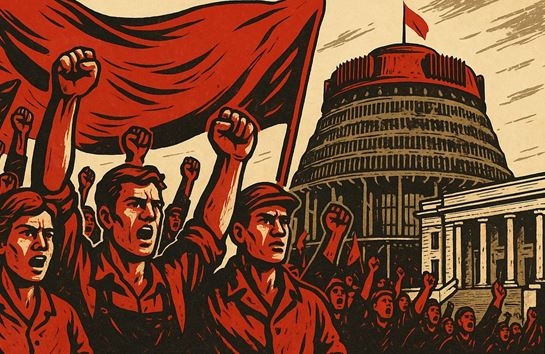
For many years the Otago University Students Association received large cardboard tubes addressed to the “Progressive Left”. Since no such group existed on campus these tubes generally ended up in the office of the student newspaper, “Critic”. Inside were the best posters the Cominform could commission – genuine works of graphic art – which were soon gracing the walls of student flats across Dunedin. Some denounced apartheid. Some promoted national liberation movements. Others proclaimed the inevitable victory of “Peace. Progress. Socialism.”
Small beer you might think in the age of TikTok and Instagram, but the impact of those posters arriving year after year for more than 20 years was appreciably greater than zero. What’s more, the messages they carried, like the Kalashnikov, went everywhere. After December 1991, however, no more carboard tubes addressed to the Progressive Left arrived in the offices of OUSA – or anywhere else. The financial and ideological backers of the Far Left had shut up shop.
What was the Far Left to do? With global capitalism’s great counterweight gone, the bosses’ gloves were off. With no one left to beat the capitalists for them the radical leftists’ options were few. If they couldn’t beat them, then maybe they should join them?
Twenty years earlier the German student radical Rudi Dutschke had shrewdly advised his comrades to begin “the long march through the institutions”. With the disappearance of the Soviet Union and the Chinese communists energetically embracing capitalism (albeit with “Chinese characteristics”) the comrades were left with few viable alternatives. The Labour and social-democratic parties had turned their coats. The unions had been destroyed as independent economic and social partners. What else were the conscientized members of the Professional-Managerial Class supposed to do?
In simple terms, the Left decided there were more ways to skin the capitalist cat than with a sharpened bayonet. Rather than seize the material means of production on behalf of the workers, a goal the capitalists were now uniquely well-positioned to resist, the radicals of the Left decided to swap Lenin for Antonio Gramsci. The strategy, now, was to seize control of the means of cultural production on behalf of everyone. From within the Professional-Managerial Class, these “new” leftists would make themselves the arbiters of an equally novel iteration of “common sense”.
According to Google’s AI assistant, Dutschke’s “long march” (a reference to Mao Zedong’s heroic Long March of 1934-35) described “a strategy for creating radical systemic change from within. Instead of attempting to overthrow the government by force, he argued that activists should enter established social institutions—such as universities, schools, the legal profession, and the media—and subvert capitalism and bourgeois cultural dominance from the inside.”
Many observers of New Zealand politics in the 2020s would struggle to avoid the conclusion that the successors of the Far Left of the Soviet Era, the people derisively dismissed by the Right as the “Woke Left”, have marched their way into what Gramsci’s cultural take on Marxism calls a “hegemonic” position.
Indeed, the New Zealand Left has stolen a march of its own. In addition to the institutions identified for infiltration by Dutschke, the Kiwi comrades have also captured the public service, the state sector unions and, perhaps inspired by the 1930s alliance between Labour and the Ratana Movement, forged a strategic constitutional alliance with the tertiary-educated Māori elites pursuing tino rangatiratanga through the Waitangi Tribunal and the big iwi corporates.
Small wonder, then, that the New Zealand Right is marshalling its forces into a resistance movement powerful enough to check, if not halt, the advance of this new Far Left. Certainly it is in no way surprising that Nicky Hager has dedicated his latest book to undermining and discrediting the most successful of these resistance groups – the Taxpayers’ Union.
Equally unsurprising is that Hager and his followers remain completely blind to the fact that, 35 years after the collapse of the Soviet Union, it is now the hegemonic Left that is marshalling all its institutional resources to suppress what it perceives to be a dangerously subversive constellation of political causes.
They simply cannot see that in exactly the same way that Rob Muldoon deployed the intelligence services, the Police, the courts, and the news media to discredit the Moscow-aligned Socialist Unity Party in the 1970s and 80s, the Long Marchers are similarly mobilising their institutional power against the Taxpayers’ Union “from the inside”.
Those of us who must confess to being a little older than 35 will recall the concern of successive National Party governments that the SUP was regularly in receipt of “Moscow Gold”. The potential damage that such an inexhaustible source of funds could wreak upon New Zealand’s internal security kept the SIS up at night.
The same concern for national security is evident in Hager’s determination to expose who is, and is not, funding the Taxpayers’ Union. Again, he betrays not the slightest awareness of the financial and opinion-shaping resources represented by the institutions that have joined his crusade against the “Far Right”.
The Taxpayers’ Union boss, Jordan Williams, has to purchase his influence with the cold hard cash of his donors, Hager gets his backing from institutional actors intervening pro bono publico – for the public good.
Or so they say.
*Chris Trotter has been writing and commenting professionally about New Zealand politics for more than 30 years. He writes a weekly column for interest.co.nz. His work may also be found at http//:bowalleyroad.blogspot.com.
We welcome your comments below. If you are not already registered, please register to comment
Remember we welcome robust, respectful and insightful debate. We don't welcome abusive or defamatory comments and will de-register those repeatedly making such comments. Our current comment policy is here.