
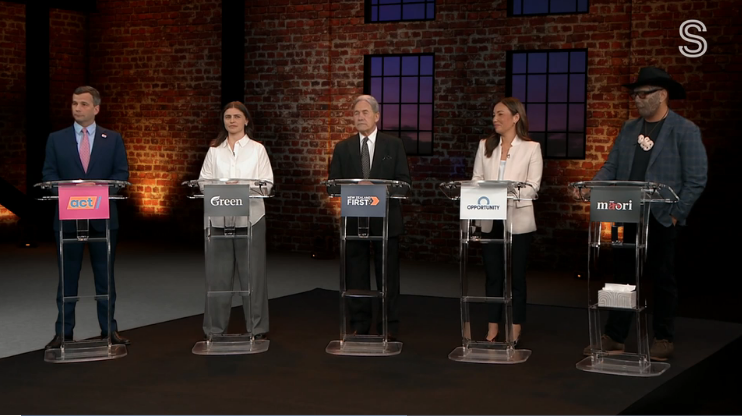
The anticipation for one of the first main political party debates was high and the combination of four of the top entertainers of Parliament- David Seymour, Chlöe Swarbrick, Winston Peters and Rawiri Waititi, plus Opportunity candidate Qiulae Wong, in Thursday night's The Press Kingmakers' Debate guaranteed it wouldn't be a boring watch.
With the major parties polling at equally low rates - both on 28% in the latest 1News Verian Poll - it raises the stakes for the influence the leaders in that room will hold in the next Government, whatever the make up.
No topic was untouched. Cost of living, power gentailers, supermarkets and superannuation were delved into. As were sunbeds, subsidised sunscreen and weightloss drugs, and which of the two Chris' (Luxon or Hipkins) were their favourites.
Politician pay was traversed in the cost of living section, the panel asked if they would freeze politician pay for 10 years in light of MPs' pay being far higher than the median salary. Swarbrick called "fixating" on politician pay a red herring, instead saying it should be turned to union bargaining power, while Wong referenced her party's policy to impose restrictions on MP accommodation allowances.
Seymour said during Covid he did introduce a bill in an attempt to drop MP pay by 20%, but "ultimately the real question is how is New Zealand going to get wealthier?"
Peters, asked if he would allow Seymour's proposal to freeze the minimum wage for three years to go ahead, said, "most definitely not."
He also said he intended to do "far better" this time around in negotiating to break up the power gentailers.
Asked about the power companies, Waititi said they want to make sure "Māori own the power and have the infrastructure to do it."
"What we want to do is break up the gentailers. We don’t want to create any public companies and things like that because what that does is then you start to create a cartel."
On the party's supermarket proposals: "These solutions are insane", Seymour said.
Peters said he would keep the $50 a week fuel subsidy if prices stayed above $3 - and would increase working for families, by possibly $120.
"We want to make sure everyone gets a fair go."
On how they would help small businesses, Seymour said they would finish reforming the RMA, Waititi said there needed to be more investment into small businesses and through their tax policy they would make savings in PAYE end, Swarbrick said they needed to "fix the tax system" through a wealth tax, Wong said they needed to lift terrible productivity, tackle competition, invest in renewable energy and invest in innovation, while Peters spoke of his policy to lower the company tax rate to 20% from 28% for SMEs.
On which 'Chris' they preferred, Wong said she was happy to work with both, while Peters said, they were "not in the same league as the best I’ve seen."
"Seen people who were good at their job, and some on training wheels, so to speak."
The debate had a non-scientific 'Read the Room' rating, where readers could vote during the debate on who they preferred. At the end of the debate, Wong was ahead on 35, Swarbrick on 29, Seymour 23, Peters 9 and Waititi at 4. (The rating stated there were technical issues during the show where some people could not vote).
We welcome your comments below. If you are not already registered, please register to comment
Remember we welcome robust, respectful and insightful debate. We don't welcome abusive or defamatory comments and will de-register those repeatedly making such comments. Our current comment policy is here.