
The Green Party is proposing a bus and train fare cap at $2 per journey for most adults as it launches its public transport policy, costed at more than $20 billion, ahead of November’s election.
Making the policy announcement on Sunday, Green Party co-leader Chlöe Swarbrick says congestion sucks - costing people time, money and productivity.
Alongside the bus and fare $2 cap, the party is also promising to make travel on buses and trains free for children, people under 25, students, apprentices, Community Service Card holders and Total Mobility Users. The party's policy document does not specify whether ferries would be included in the fare cap.
The Greens are also proposing to build bus rapid transit or light rail in Auckland, Wellington and Christchurch. The Greens say whether it’s bus rapid transit or light rail would be up to the Infrastructure Commission.
Mass rapid transport routes proposed in Auckland would have two phases. The first phase includes Waitematā to Parnell to Newton to Mt Roskill shops to Puketāpapa, and the second phase is Puketāpapa to Onehunga to Māngere Bridge to Māngere town centre, ending at the airport.
For Wellington, the Greens are proposing a route between Island Bay, Wellington Hospital, Taranaki St and Wellington Railway Station. The proposed route for Christchurch would go between Belfast, Northwood, Northcote, Papanui, Merivale, Christchurch CBD, Riccarton, Sockburn and Hornby.
The party would want to establish a national passenger transport agency called Aotearoa Passenger Transport “charged with planning and funding affordable intercity public transport, and work with councils to set up phased planning and a pipeline of investment to "create a better economy of scale to bring down costs and maximise the benefits of these projects.”
The party says it also wants to improve public transport in smaller cities and towns, as well as major metropolitan areas by funding the shortfall councils need to deliver services and “to give people options to escape the fuel crisis.”
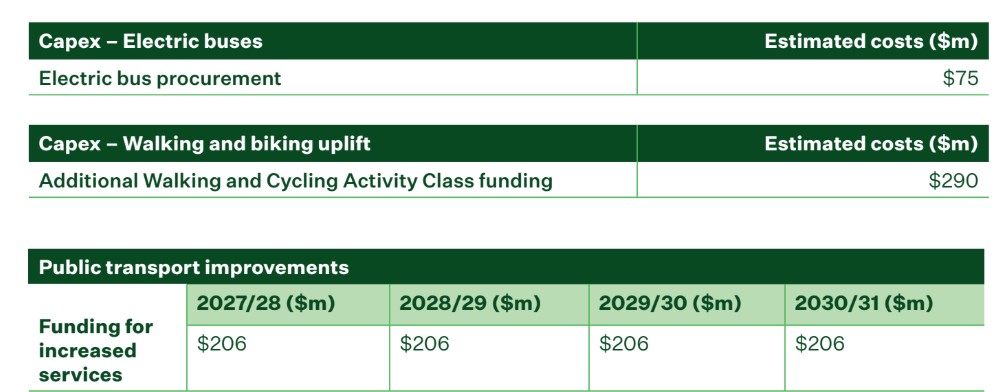
It’s also proposing to fund up to 150 new regional bus services to supplement existing services and wants to enable councils to pedestrianise more inner-city areas by increasing the funding for the Walking and Biking Activity Class by an extra $290 million.
An Activity Class is a category of transport funding set by the Government’s policy statement on land transport. This is administered through the NZ Transport Agency via the National Land Transport Programme. Other categories include local road and state highway operations, and public transport services and infrastructure.
Passenger rail plans
The Greens have also focused on passenger rail, proposing an Auckland to Wellington overnight service, bringing back the Southerner service between Christchurch and Dunedin, and improving, extending and electrifying Te Huia (a train service running between Hamilton, Huntly and Auckland).
Greens co-leader Marama Davidson says where public transport has been invested in, it’s well used - saving people time and money.
“But for a lot of New Zealand, public transport options remain expensive and infrequent, especially when travelling long distances.”
“We want to connect our cities and our country with alternative ways to travel that will save people money, connect our communities and give New Zealanders real transport choices,” Davidson says.
Green Party Transport spokesperson Julie Anne Genter says these tracks are already there so they should be used.
“Restoring commuter rail will give smaller regions and towns the benefits of more travellers stopping at their town stations, creating more economic opportunities and connecting them to main centres and other towns.”
“The train journey from Auckland to Wellington is long, which makes it perfect for an overnight service. All that is needed is new, comfortable sleeper trains and operating funding.”
The party wants to extend Te Huia to Tauranga and Genter says this would connect one of NZ's fastest growing regions.
“All it needs is some station, tunnel and track upgrades to give the region an affordable alternative to driving.”
“With KiwiRail already undertaking significant work on the Christchurch to Dunedin track, extending it to passenger rail would only take building stations and some upgrades, making better use of existing rail infrastructure,” Genter says.
The cost
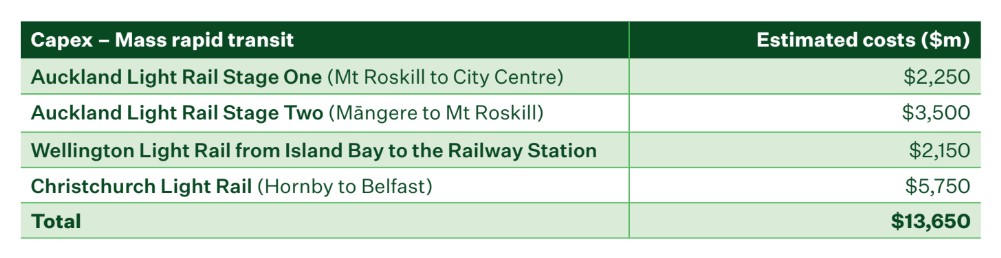
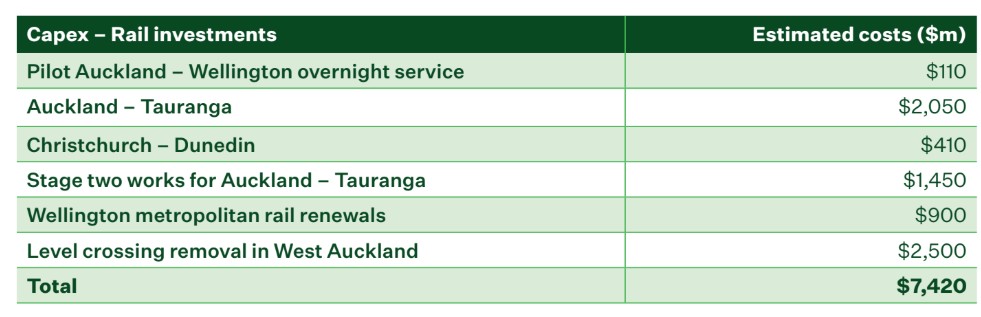
In its policy document, the party says the estimated costs of capital expenditure for its mass rapid transport proposal would total $13.65 billion while the capital expenditure for rail investments is estimated to cost $7.42 billion.
When it comes to electric buses, the party wants to restore $50 million in funding to support councils with the procurement of electric buses and increase it to $75 million.
Funding for increased services is estimated by the party to cost $206 million in 2027/2028, 2028/2029, 2029/2030 and 2030/2031.
Money around services and planning for inter-regional buses is estimated to cost $46.5 million in 2027/2028, $69.7 million 2028/2029, $116.2 million in 2029/2030 and $174.3 million for 2030/2031.
As for the fares, the costings are estimated to be $262 million in 2027/2028, $299 million in 2028/2029, $338 million in 2029/2030 and $381 million in 2030/2031.
On fares, the policy document says: “Costings have been provided by the Parliamentary Library, using the most recent available information from Waka Kotahi the NZ Transport Agency, using public transport boardings by region, mode and passenger type.”
Costs covering the $2 bus and train fare cap and free fares would be paid for by the Green Party’s tax policy.
Swarbrick says: “Visiting family members or friends across the country shouldn’t cost a small fortune or rely on an air carrier that’s been shutting down regional routes."
"Only a few generations ago, we invested in land transport to connect our cities and regions, and the Greens will do it again," she says.
“In the middle of a fossil fuel crisis, these common sense investments will save New Zealanders money, stress and time. It’ll cut emissions and improve quality of life. The Greens are ready to build a transport system that works for all of us."
Other transport announcements
Other political parties like Labour have pledged a $20 weekly public transport cost cap in Auckland, Wellington and Christchurch, and a $10 cap for the rest of New Zealand.
Meanwhile, on Sunday morning, National pledged to start construction on the first stage of Mill Rd in South Auckland.
Mill Rd is a Road of National Significance and National’s transport spokesperson Chris Bishop says: “Once complete, it will be a new four-lane, 21.5-kilometre corridor running alongside State Highway 1 from Manukau to Drury, crushing congestion, improving safety, and unlocking land for the homes and jobs the region needs.”
The party pledged to allocate $1.75 billion in Budget 2028 so construction could begin between Manukau and Alfriston and $100 million of Crown capital would be allocated to progress route protection on the second and third stage of Mill Rd.
We welcome your comments below. If you are not already registered, please register to comment
Remember we welcome robust, respectful and insightful debate. We don't welcome abusive or defamatory comments and will de-register those repeatedly making such comments. Our current comment policy is here.