

The Financial Markets Authority (FMA) says it has decided to publish how it identifies and manages potential conflicts of interest involving its board members.
The country’s investment watchdog made this announcement when it published its annual report for the year to 30 June 2026 on Wednesday.
The FMA said the new step to demonstrate increased transparency and support confidence in the regulator will see details of each board member’s relevant governance interests and their conflict management plans being published on the FMA website, alongside the FMA’s conflicts of interest policy.
Recently appointed FMA chairman James Miller said this change will enable the FMA Board to use “their diverse range of experience from across the financial sector” while ensuring potential conflicts of interest are managed appropriately.
“Our board members have a breadth of expertise in governance, capital markets, regulation, risk management, and financial services. This provides the Board with a deep understanding of how markets operate in practice, the challenges faced by market participants, and the risks that can affect investor confidence and market integrity,” he said.
“This also means that, at times, there may be Board members who have an actual, potential, or perceived conflict due to their association with an entity we regulate. We want to be open and transparent about how we manage those conflicts.”
Miller said the FMA has “strong conflicts of interest management policy and processes”, with FMA Board members having to disclose their financial and other interests and the Board then agreeing to conflict management plans for each member.
“These conflict management plans are clear that Board members do not participate in, or receive information about, matters where they may have a conflict of interest,” he said.
'It is important that the market knows what to expect from the FMA'
The FMA’s acting chief executive, Alastair Hercus, said the past twelve months were a year of “significant change and delivery” for the regulator.
“It was the first year we reported publicly against regulatory priorities set out in the Financial Conduct Report (FCR), and we delivered against almost all of them,” he said.
It's the FMA's second such report, which aims to be transparent about its regulatory priorities for the 12 months ahead, and report on the impact of FMA activity over the past 12 months.
The FMA said it will update its Statement of Intent (SOI) in 2027, the statutory document that outlines the FMA’s strategic intentions and impact it aims to make over the next four years.
Hercus and Miller said the SOI will sit alongside the FCR to provide “a longer-term context for the FMA's annual regulatory priorities.”
“It is important that the market knows what to expect from the FMA and experiences continuity in our regulatory approach,” they said.
Regulatory responsibility
The FMA said this was the year it took over regulatory responsibility for the Credit Contracts and Consumer Finance Act 2003 (CCCFA) from the Commerce Commission (ComCom) on July 1, becoming the single conduct regulator for financial markets in New Zealand.
The CCCFA is the primary consumer credit law in NZ and regulates mortgages, car loans, personal loans, credit cards and buy now, pay later (BNPL) schemes. The change in regulatory responsibility from ComCom to the FMA is aimed at bringing licensed consumer credit providers within a broader conduct framework.
At a conference in October, the FMA said post-transfer, the regulator was focusing on engagement with consumer credit lenders and outlining ongoing conduct expectations for the sector.
The FMA also finished transferring anti-money laundering and countering financing (AML/CFT) responsibilities to the Department of Internal Affairs (DIA) back in July. Previously, the DIA was one of three New Zealand AML/CFT Act supervisors alongside the Reserve Bank (RBNZ) and FMA, but is now the sole AML/CFT Act supervisor.
In the year ahead, Hercus and Miller said the FMA has begun preparations to support implementation of the Contracts of Insurance Act 2024 (CoIA), which comes into force in November 2027.
“Under this new legislation, the FMA will assume responsibility for regulating fairness of insurance contract terms and the conduct of insurers in their direct dealings with individual policyholders,” they said.
“To support these changes, we have engaged with insurance chief executives, outlining our expectations for how they should be preparing to operationalise the new requirements. Our engagement with the sector will increase as we get closer to CoIA coming into effect.”
'Significant organisational change'
In the report, Hercus and Miller said they wanted to thank ex-FMA chief executive Samantha Barrass – who abruptly exited the agency back in September after being on a period of leave since July – for her contributions during her four-and-a-half-year tenure as CEO of the FMA.
“This has included overseeing significant organisational change and changes in regulatory approach, as the FMA's remit expanded to include banking, insurance, transfer of consumer credit regulation to the FMA and climate reporting,” the pair said.
The FMA had confirmed back in May that Barrass would not seek re-appointment before her five-year term concluded in early 2027.
Barrass’s departure isn’t the only high-profile exit from the FMA this year. Craig Stobo resigned as FMA chairman in May after two years in the role, following an independent review into his conduct finding “just cause” for him to be removed from the FMA board, based on public comments he made falling “well below the expectations of a Crown entity board chair.”
Hercus and Miller also thanked Stobo for his contributions to the FMA in the annual report. They said his leadership saw the introduction of “focused operational and regulatory priorities” for the regulator.
Stobo was unveiled as an NZ First candidate in August. He is running for NZ First in Botany, a seat currently held by Prime Minister Christopher Luxon.
Survey 'highlights' areas FMA needs to improve in
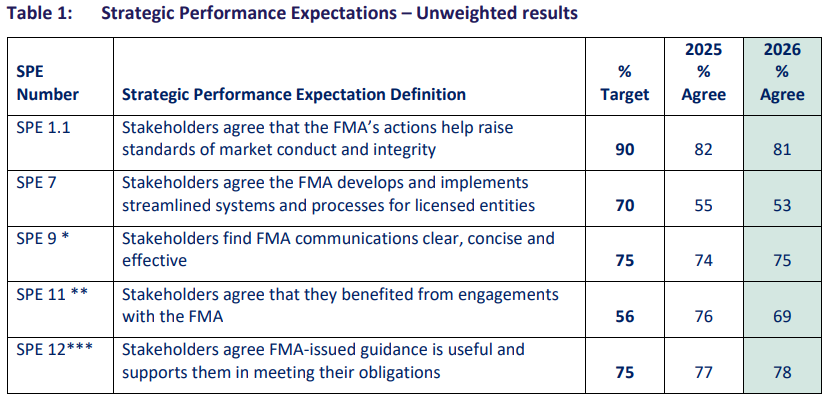
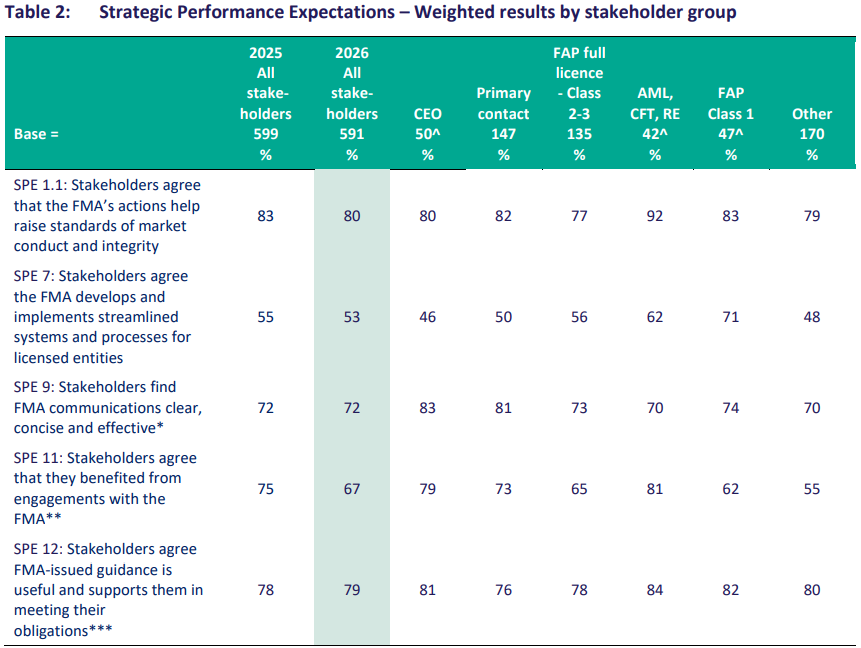
Alongside the publication of its annual report, the FMA also released its annual ‘Ease of Doing Business’ survey, which surveys key stakeholders to understand the effectiveness of their interactions with the FMA and the FMA’s overall effectiveness in delivering its mandate.
Hercus said the survey feedback “highlights” areas where the FMA needs to improve, as only 53% of stakeholders agreed that
the FMA develops and implements streamlined systems and processes for licensed entities.
“We want to make it easier for entities to engage with our systems and reduce administrative friction,” Hercus and Miller said in the FMA's annual report.
Key findings from the survey results include:
We welcome your comments below. If you are not already registered, please register to comment
Remember we welcome robust, respectful and insightful debate. We don't welcome abusive or defamatory comments and will de-register those repeatedly making such comments. Our current comment policy is here.