
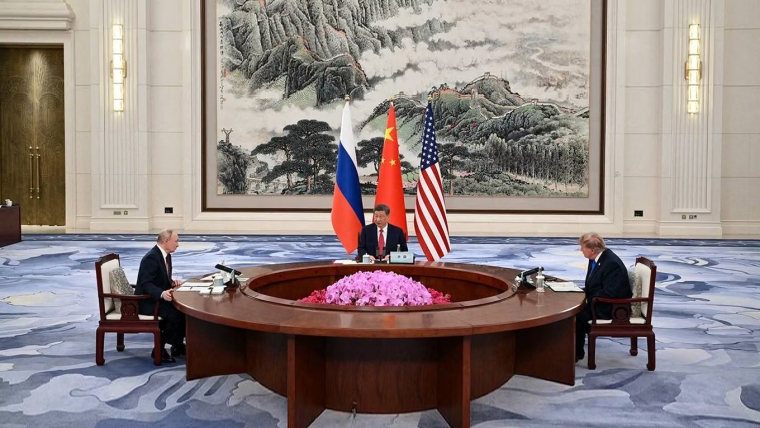
The trilateral meeting between Chinese President Xi Jinping, US President Donald Trump, and Russian President Vladimir Putin in Shenzhen on November 19 was no Yalta 2.0. It was about one thing above all: self-promotion. Forget about trying to solve the major interrelated problems confronting the three countries, let alone the world.
The summit sidestepped the wars ravaging Ukraine and the Middle East. There was no mention of mounting AI challenges as the technology revolution reaches a critical point. The leaders also overlooked the expiring trade truce between the United States and China and failed to make any progress on the new trade and investment boards recently established by the two superpowers. As a long-standing skeptic of pre-scripted summits, I already had a low bar for the Shenzhen gathering. But it did not even clear that.
Unsurprisingly, Xi, Trump, and Putin beg to differ. They claim that world history was made in Shenzhen with the US–Russia–China Heads of State Declaration toward Peace, which calls for reforming the United Nations, reducing the risks of nuclear weapons, and strengthening energy security, while condemning the International Criminal Court.
Don’t get me wrong: I am not making light of the first three goals as basic, albeit unspecified, building blocks of world peace. But the fourth point is patently transparent. The ICC issued an arrest warrant in early 2023 for Putin, charging him with war crimes for the unlawful abduction and transfer of Ukrainian children to Russia. The G3’s hypocritical indignation is appalling.
Optics are everything at summits. The official images from the meeting show Xi prominently situated as the central figure under Guan Shanyue’s majestic painting of the Great Wall at sunrise, flanked by Putin and Trump around a large, round table. This is in keeping with Xi’s recent ambitions to rewrite the world order with his Global Development Initiative, Global Security Initiative, Global Civilization Initiative, and Global Governance Initiative. Putin, grateful just to be at the table, was delighted to have his two friends discredit the ICC, while Trump, hunched in a subservient posture, could only claim to have inspired “plane envy” in the others.
The Shenzhen summit exemplifies everything that is wrong with these events. The three leaders face urgent issues, both individually and collectively, but failed to deliberate over them in any meaningful way. Putin’s illegal war in Ukraine continues to take a tragic civilian toll, while Trump has threated to extend his war of choice in Iran with new strikes. And Xi’s willingness to support Russia’s and Iran’s military machines through outsize oil purchases is acting at cross-purposes with world peace. Meanwhile, the recent volatility in financial markets underscores the need for US–China collaboration on AI governance, sooner rather than later.
Foreign summits are often a foil for domestic problems. China is a case in point. Xi’s success as an international impresario stands in stark contrast to his government’s feeble approach to domestic economic policy. The economic statistics for October were terrible, with broad-based shortfalls in retail sales and fixed asset investment (especially real estate and private-sector capital spending). Relative support for industrial production was diverted to foreign markets, with exports surging more than 30% in the year ending in October.
These trends are a visible manifestation of China’s strategic conundrum. Unable to hit its growth target by relying on domestic demand, China continues to turn to external demand, triggering a protectionist backlash from Europe and parts of the Global South. This has opened a debate over China’s inclination to export its overcapacity and the deflationary pressures of involution.
This reflects Xi’s bet on achieving the China Dream, or “the great renewal of the Chinese nation,” through an industrial strategy that emphasizes so-called new quality productive forces. Shenzhen exemplifies that bet, as home to some of China’s most dynamic companies, from Huawei (AI and telecoms) and BYD (electric vehicles) to DJI (drones) and BGI (genomics).
Returning to China for the second time in a month validated this view. Yet, I was alarmed to find that, when sharing my concerns about this economic strategy, most of the policymakers, regulators, businesspeople, and academics with whom I spoke simply nodded in agreement. There is a strong feeling that conditions in the Chinese economy are “good enough” for now. This has given rise to a worrisome sense of complacency, at odds with the era of reform and risk-taking that Deng Xiaoping ushered in nearly a half-century ago.
This underscores a sense of irony in selecting Shenzhen as the summit’s venue. Deng’s famous southern tour of 1992 played a key role in establishing Shenzhen as China’s first special economic zone. (For Xi, the Shenzhen story is also about family pride: his father, Xi Zhongxun, played a pivotal role in the city’s early development.) But Deng knew that Chinese modernization would have to be about far more than Shenzhen, advanced technologies, and export-led growth. Showcasing the “Shenzhen model” illustrates how the government’s growth strategy has fallen short of Deng’s more balanced approach.
According to official Chinese statistics, leading-edge “new economy” industries, including electric vehicles, lithium batteries, and solar panels, account for about 18% of Chinese GDP. That is not nearly large enough to offset the headwinds from the carnage in the property sector, a serious youth unemployment problem, and fear-driven saving that inhibits discretionary consumption.
The stagecraft of summitry, on full display in Shenzhen, was an exercise in obfuscation, without any meaningful exchange of views on tough issues. The 1945 Yalta conference between Franklin D. Roosevelt, Winston Churchill, and Joseph Stalin took place over eight days. By contrast, the conversation between Xi, Trump, and Putin reportedly lasted only about 90 minutes. Even that was a waste of time.
*Stephen S. Roach, a faculty member at Yale University and former chairman of Morgan Stanley Asia, is the author of Unbalanced: The Codependency of America and China (Yale University Press, 2014) and Accidental Conflict: America, China, and the Clash of False Narratives (Yale University Press, 2022). Copyright: Project Syndicate, 2026, published here with permission.
We welcome your comments below. If you are not already registered, please register to comment
Remember we welcome robust, respectful and insightful debate. We don't welcome abusive or defamatory comments and will de-register those repeatedly making such comments. Our current comment policy is here.