
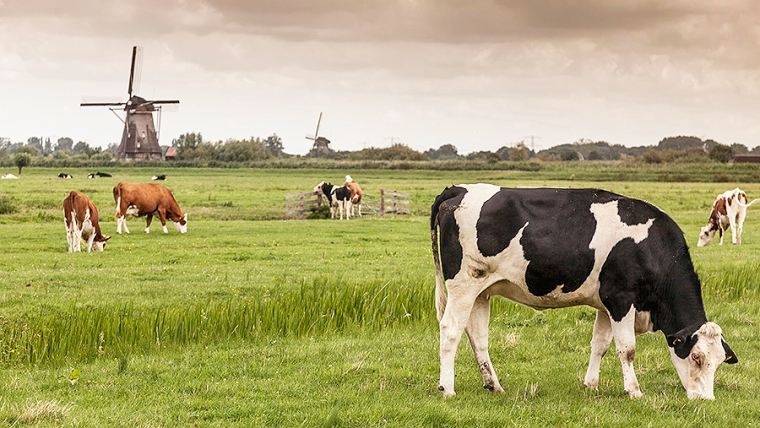
In a recent video (watchers need to scroll down article to get to the video) was an arguably persuasive coverage of the issues facing Canterbury dairy farming and returning to a clean water environment. One of those involved was a ECan councillor who is also a dairy farmer, and he raised the issue of what the government, or society, would do for farmers to basically help them to exit farming or at least greatly reduce cow numbers to create the change argued for to improve water quality.
To date very little has come out of central government to address this area. Europe has been also dealing with similar issues and with a bigger chequebook than the New Zealand government has, so it seemed worthwhile to examine what they are proposing and also what farmers reactions are.
Within the EU stocking rates are spread over a wide range from 0.4 livestock units (LSU) per hectare of grazing density (a LSU equals 1 dairy cow producing 3,000kgs of milk annually) in Latvia and up to 3.8 LSU in the Netherlands with an EU average of about 1 LSU. So, in New Zealand where we use ‘stock units’ and where a su (for simplicity sakes) is 1 ewe equivalent and with a stocking rate ranging from something like 8su’s to 33.6su’s we inhabit a similar range. A dairy cow would be somewhere around 8su equivalents so 8 to 33.6 would be 1 to 4.2 cows per ha by the EU measure. We can assume if the Netherlands has an average of 3.84 cows per ha there will be farms at a higher rate.
The Netherland’s with its high rate is worth looking at closer as it has made the news recently with farmers there pushing back in protest against proposed government moves to restrict their carrying capacity and also because its stocking rate can be compared to that of Canterbury’s which has been reported to be at 3.3 cows per hectare (2017). This is considerably higher than the national average of 2.84 and which without Canterbury included would be nearer 2.7 cows per hectare. Within the EU there has been considerable movement in numbers (note; these include all livestock not just dairy cows)
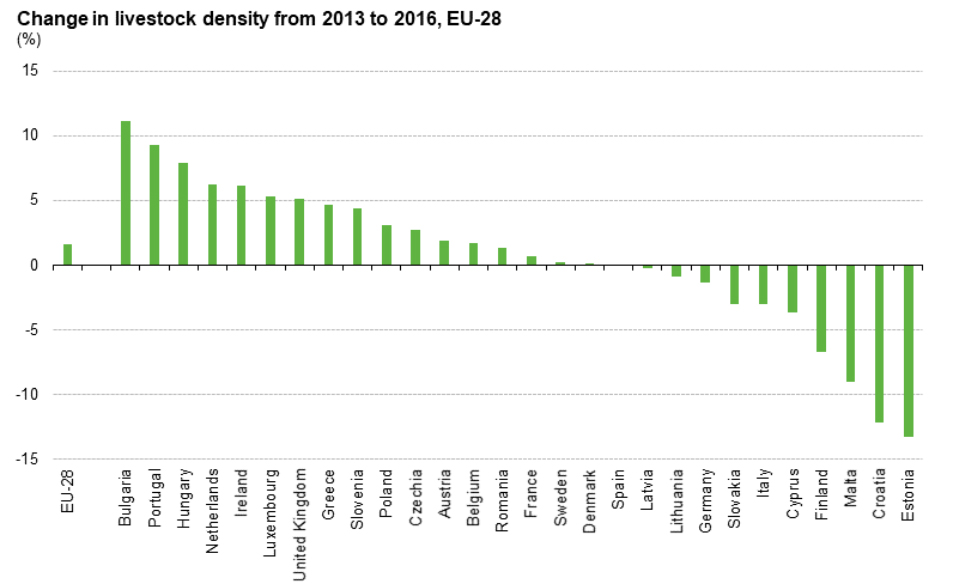
Source: Eurostat.

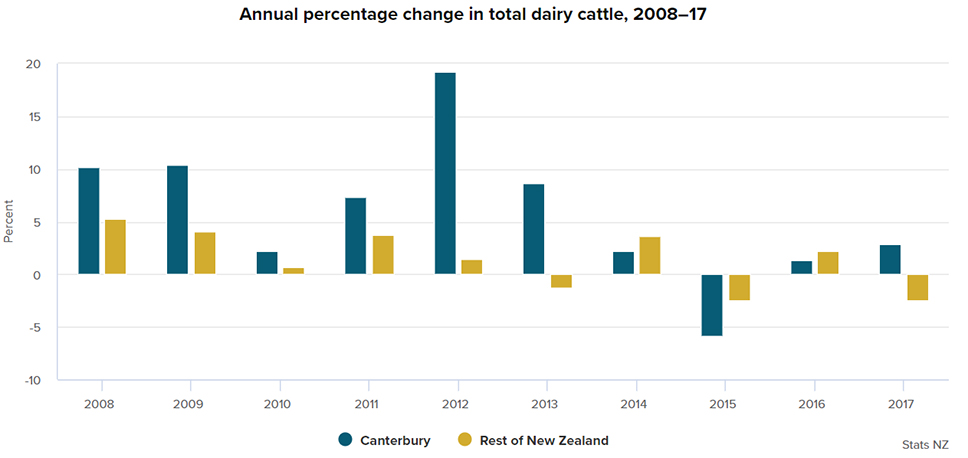
Within Canterbury over recent years despite pressure from local and national governments Canterbury overall stocking rates appear to have increased with overall cow numbers going up and per hectare rates also increasing (approximately 3.42 in 2021). The graph below shows that while all dairy regions are following a similar trend Canterbury is considerably ahead. It’s no wonder Dr Mike Joy and others get upset at the Canterbury situation, especially with its porous soils.
So back to Europe and the Netherlands in particular. In 2019 the highest Dutch administrative court found that their government was breaking EU law by not doing enough to reduce excess nitrogen in vulnerable natural areas. This led to the decision in late 2021 of the government to seek to reduce livestock numbers by 30%.
Two scenarios were proposed including forcing some farmers to sell emissions rights and even their land to the state. If the farmers lose their emission rights then they effectively cannot farm livestock.
The Netherlands government has announced that it has a ‘war chest’ of €25 bln (NZ$41 bln) to ‘enable’ farmers to meet their new requirements. Their plan is run over 13 years and proposes to help some farmers to exit while enabling others to move to more extensive (sustainable modes of farming).
While agriculture may not be so critical to the Netherlands economy as it is to New Zealand, it is still at around €100 bln makes up about 20% of their exports and is a considerable component of the Dutch export portfolio. New Zealand by comparison has a total “food and fibre” export value of NZ$49 bln (€30 bln equiv) and currently (with tourism well down) makes up about 77% of our total exports.
For New Zealand to try and adopt a similar policy we might have to adopt a similar payment system as the agricultural area in New Zealand has approximately 30% more land in agriculture and while overall may be at a lower stocking rate, areas like Canterbury may require greater reductions. A scary thought. Needless to add the Dutch farmers are not happy about the (what appears to be more than) proposal and has led to widespread protests.
Belgium, Demark, Germany and the UK are also looking at looming problems.
What politicians appear to have overlooked is that livestock farming for many is a lifestyle choice and replacing it with arable, trees or fallowing is not what they signed up for when they decided to go farming.
The buyout approach to solving the problem is not without precedent in New Zealand with the tax and ratepayers putting somewhere between NZ$80 and NZ$120 million to encourage farmers around the shores of Lake Taupo to reduce nitrogen emissions. Environment Waikato is also reported of taking a similar approach to pay farmers to reduce nitrogen flows into Lake Rotorua.
Regardless of where we are looking it certainly appears that big numbers are involved in going down the pay-out route are very expensive. This comes at a time where in New Zealand discussions have now begun about what costs are involved in mitigating the impacts of climate change. The public’s appetite for absorbing these costs which largely are created through someone making a choice, be it at some time in the past, is likely to be tested.
A buy out may get more approval from farmers but unlikely from non-farming public where-as a regulate out while likely favoured by non-farming public will certainly upset farmers more. The first test however will be are the politicians, be them local or national, up to making the hard decisions whichever way they go.
We welcome your comments below. If you are not already registered, please register to comment
Remember we welcome robust, respectful and insightful debate. We don't welcome abusive or defamatory comments and will de-register those repeatedly making such comments. Our current comment policy is here.