

After all the debating around the methane heating potential that has occurred over the last couple of years I for one would have thought the argument was settled.
The reality I believe is quite different and things are only just starting to really heat up (excuse the pun). The conventional wisdom supported by then science was that the Global Warming Potential (GWP) of methane (CH4) is around 28 times that of CO2 or up to 34 times if ongoing feedback loops are incorporated.
This is what was presented as a report to the Parliamentary Commissioner for the Environment in 2018. It was using, quite correctly, relevant science from 2013. It is now a decade old. While we should always adhere to good science, the trouble with science is that it does change as more is learnt on a topic. The no longer a flat earth a case point to remember.
Given the clearly laid out facts of the report it is completely understandable why the then government would have used the reports figures to help underpin its future policy making.
However, the understanding of the decay process of methane and the implications upon how it should be treated in future is another example of changing science.
As Peter Buckley and others have pointed out the IPCC knew this back in 2022 and included this comment in 2022 report “Since AR5 there have been developments in how to account for the different behaviours of short-lived and long-lived compounds”.
They then go on to say “By comparison expressing methane emissions as CO2 equivalent emissions using GWP-100 overstates the effect of constant methane emissions on global surface temperature by a factor of 3–4 (Lynch et al., 2020, their Figure 5), while understating the effect of any new methane emission source by a factor of 4–5 over the 20 years following the introduction of the new source (Lynch et al., 2020, their Figure 4”).
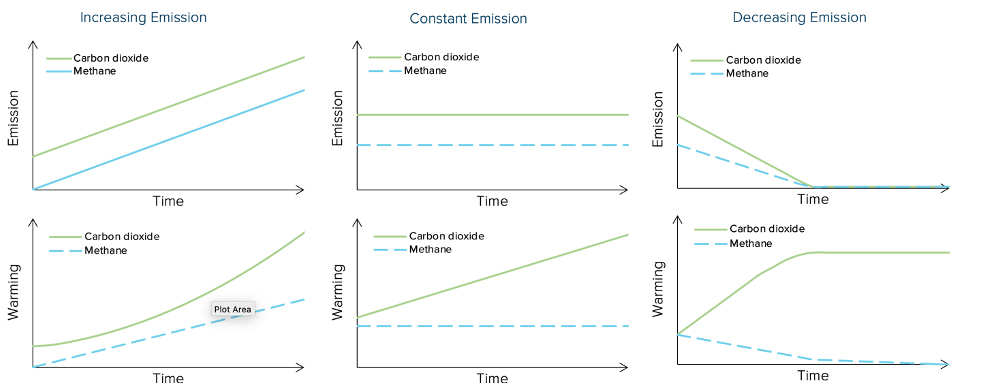
This decreasing methane scenario is much like filling a leaky bucket. If your flow in is less than the outflow (decay of methane) then your bucket will not fill and will eventually empty (depending upon where the hole is).
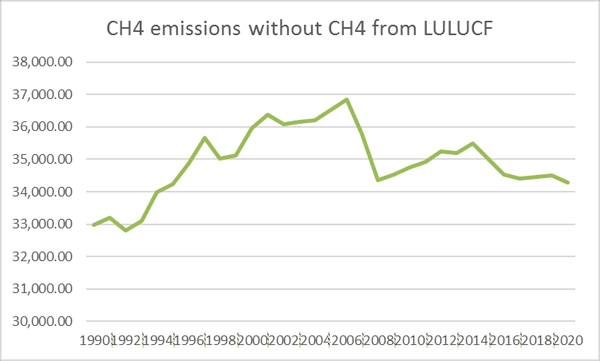
Back in 1991 New Zealand’s methane emissions were around 32.8 million tonnes by 2021 they had increased to 33.00 million tonnes. If this was the only story then it could be argued that settling upon x28 as the nominated GWP is a reasonable balance.
However, while the total is higher than 1990 the trend since 2014 has certainly be downward (see graph below). Note this is total CH4 emissions so a small proportion other than ag is included (but it is small and wouldn’t affect trend).
Source: Data sourced from Ministry for The Environment
We also know that livestock numbers since 2020 have continued to fall and over the later years a close guess would be around another -3% judging by Stats NZ numbers. There is a little ‘fly in the ointment in that recorded CH4 emissions as measured at Baring Heads have continued to rise.
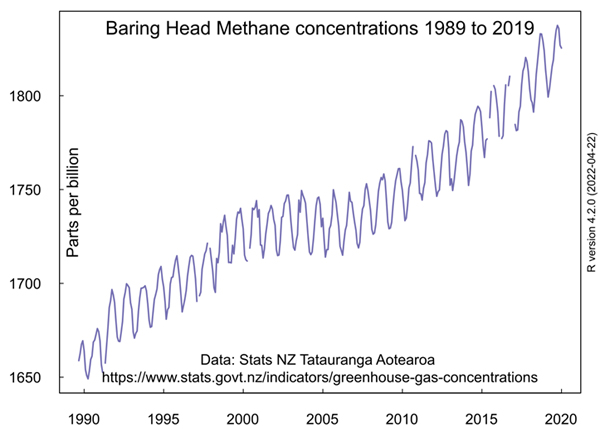
This is probably due to a lag effect although the graphs while matching each other in the earlier years appear to part company post around 2010. Perhaps given that Baring Heads could be argued to be down wind from Wellington, there are other sources of hot air at play.
Back to the livestock methane issue, it certainly appears that there is a reasonable argument that methane needs to be relooked at by the government boffins as the reducing emissions certainly fit the argument that the model is overstating GWP by a factor of 3-4.
The problem is amplified by the fact NZ (probably most countries) are tied to Global Warming Potential over 100 years (GWP100) rather than just GWP and treating gases on their merits.
The diagram below clearly shows how particularly in a reducing CH4 environment using the old metric grossly over states the GWP. New Zealand’s example is now looking more like the bottom right hand graph when it comes to CH4 emissions.
Source: Clarity and Leadership for Environmental Awareness and Research at UC Davis
The still current policy around methane is that ‘the government’ has committed to a -10% CH4 reduction by 2030 going up to -24% to -47% by 2050, based upon 2017 emissions. Currently (2023) if we work on drops of -1.5% annually which is what has been occurring in the previous 5 or so years it would put agriculture at -5% below 2017 levels with still 5 years to go and at this rate nearly 15% below 2017 level by 2030 (well ahead of government targets).
At the same rate by 2050 a -37% reduction on 2017 levels.
So even before we get to what multiplier rate should be used, agriculture is showing itself to be ahead of government aspirations.
Not that you would know that from publications which consistently go back to the 1990 levels, although it looks as though they will be lower even than them by 2025 based upon above assumptions.
Either argument reinforces why farmers could be feeling a little picked on by the government and bureaucrats alike. The authors of Lynch et 2020 made the following statement which is worth repeating.
“Using GWP100 to direct climate change mitigation strategy could be unfair, inefficient, and dangerous. Unfair, as it does not provide a clear link between emissions and climate change contribution, and could lead to an expectation that some actors (long-term methane emitters) have to undo their past warming, while others (CO2 emitters) merely have to limit further temperature increases. Inefficient, as it would overstate the level of action needed to offset long-term sustained methane emissions, while simultaneously undervaluing the potential short-term benefits of reducing these methane emissions. Dangerous, as it can greatly understate the impacts of increasing methane emissions, and obscure the fundamental need for net-zero CO2 emissions as soon as possible, regardless of what mitigations are made to shorter-lived climate pollutants.
There is an additional danger, which is to the perceived environmental integrity of climate policy. Basing climate policies and emission trading systems on a metric that demonstrably fails to reflect the impact of different emissions on global temperature, while at the same time claiming these are designed to deliver a long-term temperature goal, risks undermining confidence in the entire strategy. GWP* provides a straightforward means of dealing with these issues, calculating genuinely warming-equivalent emissions using information that is already being reported in the UNFCCC system”.
The lack of integrity is where we are now. None of this detracts from the principle that New Zealand needs to reduce emissions, but it should perhaps mean that more emphasis is put on other sectors, besides agriculture.
We welcome your comments below. If you are not already registered, please register to comment
Remember we welcome robust, respectful and insightful debate. We don't welcome abusive or defamatory comments and will de-register those repeatedly making such comments. Our current comment policy is here.