
The extremely strong dairy season is likely to drive on-farm profitability to a record high this year, analysts with financial services company Forsyth Barr believe.
In an extensive 'Milk Memo' looking at the current situation in dairy, Forsyth Barr senior analyst Matt Montgomerie and associate analyst Benjamin Crozier estimate a farmer breakeven milk price (BEMP) of about $8.30 per kilogram of milk solids for the 2024/25 season.
Fonterra is indicating a likely farmgate milk price of $10kgMs, while this week it updated its earnings guidance for the financial year to a range of 55c-75c per share. Fonterra's policy is to pay out 60% to 80% of profits as dividends.
The analysts therefore take this as an implied dividend of 45c-50c.
It would give a spread between milk price and dividend returns, and BEMP of over $2kgMS.
The analysts say the spread "will be the widest spread on record".
"Looking beyond 2024/25, we expect a slight reduction in BEMP. We estimate a NZ$9.50 milk price in 2025/26 would create a ~NZ$1.70kgMS positive spread to the BEMP (including Fonterra dividends)," they say.
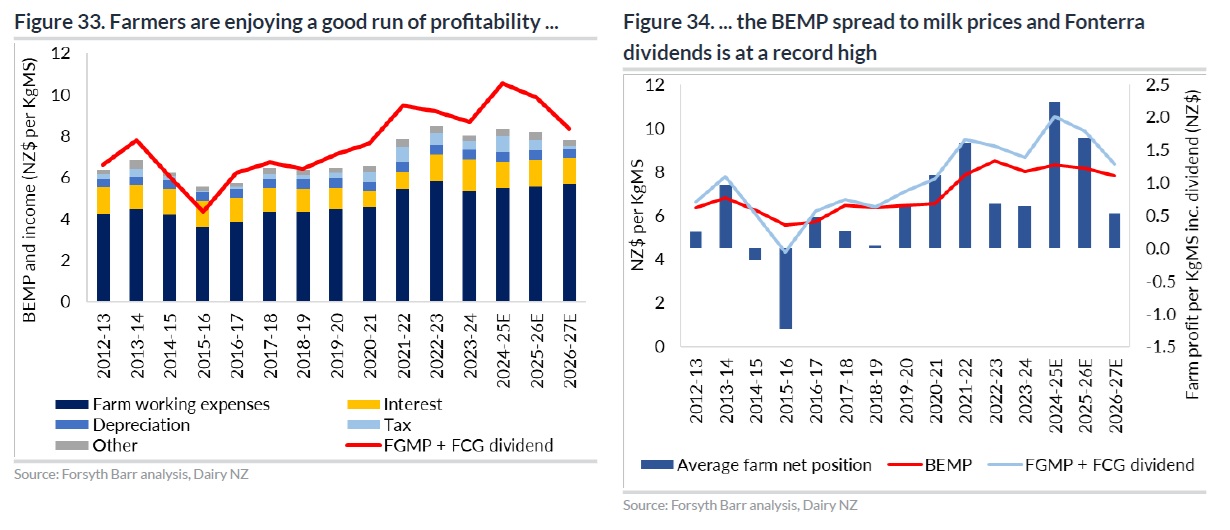
"This excludes the potential impact of Fonterra's possible special dividend (NZ$1.50–NZ$2.00), [from the proposed sale of its consumer brands businesses] which we would expect farmers to primarily use for debt repayment. We acknowledge that different production systems and ownership models make profitability comparisons across farms and regions challenging—there is no one-size-fits-all approach."
The analysts note that "life is good for NZ dairy farmers currently" and they also note that season-to-date production is also the highest since 2020, "pushing NZ dairy sector revenue to its highest ever".
"But it's not all positive—China, NZ's key export market, remains under pressure, with sluggish dairy imports. Weak local prices have slowed China’s production, offering some short-term relief, but NZ needs to remain open to diversifying its dairy exports."
Montgomerie and Crozer say dairy has historically directly contributed around 4% of NZ's GDP and accounts for 25%–30% of total exports, "making it the country’s largest export sector by some margin".
They say the implications of improving on-farm returns are significant for the broader NZ economy, particularly given ongoing economic weakness.
"A NZ$1 change in the FGMP [farmgate milk price] equates to a ~NZ$2bn production revenue impact (production multiplied by FGMP), so there is a clear, substantial multiplier effect.
"Further, the combination of dairy farming and dairy product manufacturing contributes >50,000 jobs across New Zealand (~2% of total employment). Historically, primary industries as a whole have contributed 10%–15% of NZ's GDP."
We welcome your comments below. If you are not already registered, please register to comment
Remember we welcome robust, respectful and insightful debate. We don't welcome abusive or defamatory comments and will de-register those repeatedly making such comments. Our current comment policy is here.