
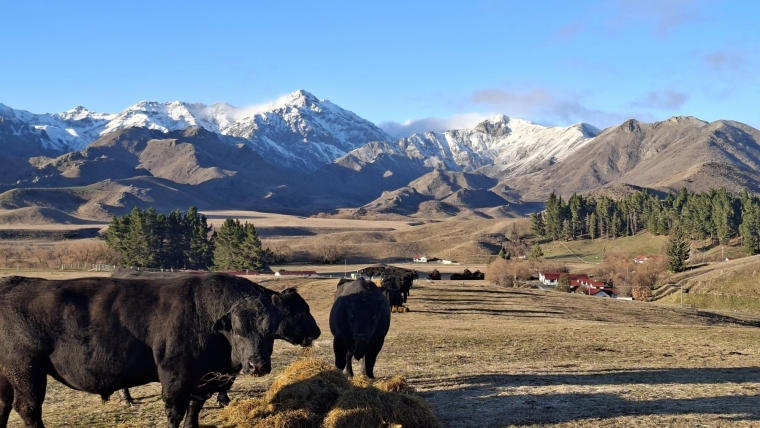
Every so often, someone declares that farming is no longer New Zealand's economic backbone.
It's an argument that usually begins with a simple observation. Our economy is more diversified than it once was. Technology companies have emerged, professional services have expanded, tourism has become a major employer and manufacturing continues to play an important role. Agriculture no longer dominates the economy in quite the same way it did 50 years ago.
On that point, there is little disagreement.
But the conclusion that follows, that farming is therefore no longer central to New Zealand's prosperity, misunderstands how modern economies actually work.
Perhaps "backbone" is no longer the best description.
Heartbeat might be more appropriate.
A heartbeat doesn't do every job within the body. It doesn't think, build, innovate or solve problems. What it does is provide the circulation that allows every other part of the body to function.
That is increasingly the role agriculture plays in New Zealand.
The mistake often made in these discussions is looking only at the number of people standing on farms. Agriculture has become more productive over time, meaning fewer people are able to produce significantly more food than previous generations. Judging the industry's importance purely by direct employment ignores the vast network of businesses that exist because someone first produces something from the land.
The Ministry for Primary Industries estimates New Zealand's food and fibre sector supports around 360,000 jobs, representing 12.4% of the national workforce. That includes not only farmers but rural contractors, transport operators, engineers, machinery dealers, veterinarians, food processors, scientists, software developers, exporters, port workers, accountants, financiers and countless small businesses that depend on the primary sector. The wider food and fibre system contributes around 15.3% of national GDP. Those are not the numbers of a declining industry. They are the numbers of an industry that continues to underpin a substantial part of the economy.
The same picture emerges when exports are considered.
New Zealand is a small country of around five million people. We do not become wealthier by selling products and services to ourselves. We create prosperity by producing goods and services that the rest of the world is prepared to pay for.
The food and fibre sector generated more than $60 billion in export earnings last year and is forecast to exceed $62 billion this year. More significantly, it accounts for almost 83% of New Zealand's merchandise exports.
Those export dollars do not stop at the farm gate.
They pay for imported medicines, fuel, vehicles, machinery, technology, manufacturing inputs and consumer goods. Every sector of the economy ultimately benefits from the foreign income generated by our exporters.
Agriculture is not separate from the wider economy.
It enables the wider economy.
Then there is something we rarely discuss because we simply expect it to happen.
Food.
Global events over the past few years have demonstrated that food security cannot be taken for granted. Conflict, pandemics, trade disruptions and extreme weather have all exposed vulnerabilities in international food systems.
New Zealand occupies an enviable position.
We produce significantly more food than we consume ourselves while maintaining some of the world's highest standards for food safety, animal welfare and environmental management. That should be regarded as a strategic strength rather than something requiring apology.
None of this means agriculture should be exempt from scrutiny.
The sector has responsibilities.
Water quality matters.
Biodiversity matters.
Climate change matters.
New Zealand farmers know this better than most because their businesses depend on healthy soils, reliable water and resilient landscapes. Across the country, farmers continue investing in improved genetics, precision agriculture, lower-emission production systems, riparian planting and environmental management. Progress is occurring, often faster than public debate acknowledges.
Constructive criticism is healthy.
Constructive improvement is essential.
What is less helpful is diminishing the value of an industry that continues to provide the economic foundation upon which much of the country relies.
That is why recent reports that Green Party co-leader Chlöe Swarbrick contacted European officials regarding New Zealand's climate and methane policies are concerning.
Democratic societies depend on vigorous debate. Opposition parties should challenge governments and argue for alternative policies. That is part of a healthy political system.
However, there is an important distinction between advocating for policy change within New Zealand and encouraging overseas institutions to place additional pressure on one of the country's most significant export sectors.
Political disagreements should be resolved through New Zealand's democratic institutions.
International confidence in New Zealand's exports is an asset that benefits the entire country, regardless of political persuasion.
Farmers, processors, exporters and the businesses that support them compete every day in global markets. Maintaining New Zealand's reputation as a reliable supplier of high-quality food is in the national interest.
The reality is that New Zealand's future prosperity will not be built by choosing between agriculture and technology, or between farming and professional services.
We need all of them.
A successful technology sector strengthens New Zealand.
A successful manufacturing sector strengthens New Zealand.
A successful tourism industry strengthens New Zealand.
And a successful primary sector strengthens every one of those industries by generating export income, supporting regional communities and providing food security.
Perhaps farming is no longer the backbone of New Zealand in the way it once was.
Economies evolve.
Industries change.
New opportunities emerge.
But if agriculture is no longer the backbone, it remains something just as important.
It is still the heartbeat.
And as long as New Zealand continues producing safe, sustainable food for millions of people around the world while feeding ourselves, that heartbeat will continue to sustain communities, businesses and livelihoods far beyond the farm gate.
Listen above to hear the full story.
Angus Kebbell is a producer at The Weekly Hotwire. You can contact him here.
We welcome your comments below. If you are not already registered, please register to comment
Remember we welcome robust, respectful and insightful debate. We don't welcome abusive or defamatory comments and will de-register those repeatedly making such comments. Our current comment policy is here.